A forest management plan is only useful if it tells you something specific. Here is exactly what goes into a professional plan — and why each piece matters.
I’ve looked at management plans prepared by other foresters. I’ve also seen what landowners sometimes bring me when they’ve inherited a property with an old plan already in the file. The quality varies. Some plans are thorough, specific, and genuinely useful. Others are thin documents that check a regulatory box without giving the landowner anything to work with.
A plan that doesn’t tell you exactly what’s on your property, exactly what it needs, and exactly what to do in what order is not a plan. It’s paperwork.
This article breaks down every component of a professionally prepared forest management plan — what each section contains, what it’s used for, and what a landowner should expect to see when the finished document comes back to them.
Property Description and Ownership Record
Every forest management plan starts with a factual record of the property itself. This isn’t a formality — it’s the foundation every other section builds on.
The property description covers the legal description and total acreage, the municipality and county, and a summary of land use history. That history matters. A woodlot that was farmed until 1960 and then left to grow back has a different stand character than one that’s been continuously forested for 150 years. The history shapes what’s there now.
This section also documents existing features that affect management — roads, streams, wetlands, property boundaries, any deed restrictions or conservation easements, and prior timber harvest activity. If someone cut your property 20 years ago and didn’t do it well, I need to know that before I recommend what to do next. Those old skid trails, that residual stand composition, the gap structure left by the last job — they all factor into current recommendations.
Stand Inventory and Maps
This is the core of the plan. Everything else depends on the accuracy of this section.
A stand is a distinct unit of forest with relatively uniform species composition, structure, and age. Most properties contain multiple stands — a mature oak-hickory stand on the south-facing slope, a younger mixed hardwood stand in the old field area, a wet area along the creek dominated by ash and red maple. Each one gets its own inventory entry and its own set of management recommendations.
For each stand I document:
- Dominant and co-dominant species — what’s actually growing there, in what proportion
- Average diameter and estimated age — where the stand is in its development cycle
- Basal area — a standard measure of stand density that determines whether the stand is overstocked, understocked, or in the right range for good growth
- Estimated timber volume — expressed in board feet or cords, depending on species and product type
- Stand structure — single-aged or multi-aged, canopy layers present, evidence of past disturbance
- Site quality — soil type, aspect, drainage, and productivity potential
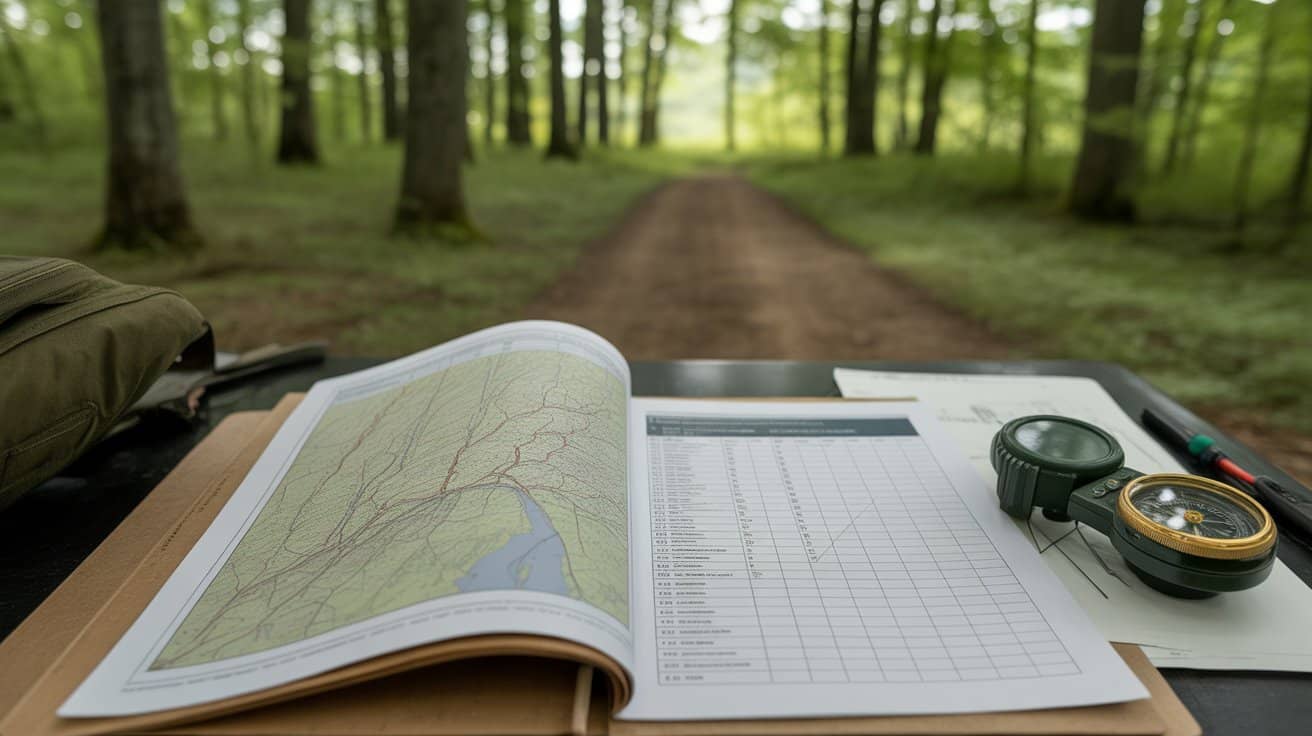
The stand maps show where each stand is located on the property, how stands relate to each other, and where key features — streams, wetlands, old roads, boundary lines — fall within the ownership. A plan without accurate maps is difficult to implement. The forester who prepared it knows where things are. The landowner needs to be able to find them too.
Goals and Objectives
This section is shorter than most, but it may be the most important one in the document.
A management plan without stated goals has no way to evaluate whether the recommendations are right for that landowner. Timber production and wildlife habitat both produce good forests — but they require different decisions at the stand level. A plan that doesn’t know which one you care about more cannot give you honest recommendations.
When I prepare a plan, I spend real time on this conversation before I write a word. I want to know what the landowner bought this land for. Whether they hunt it, lease it, or neither. Whether they’re thinking about their own income or their grandchildren’s inheritance. Or whether there’s a timber sale in the near-term picture or whether this land is never going to be cut. All of that shapes the recommendations that follow.
Goals I commonly document for landowners in Sullivan, Ulster, and Orange Counties: timber income on a sustainable rotation, enrollment in New York’s 480-a Forest Tax Law, wildlife habitat for hunting or wildlife watching, watershed and stream protection, invasive species control, and long-term land conservation. Most plans carry two or three goals at once. The plan has to hold them together without contradicting itself.
Stand-by-Stand Management Recommendations
This is where the plan does its actual work.
For each stand identified in the inventory, I write specific management recommendations — what to do, how to do it, and when. The recommendations are direct. “Conduct a commercial timber harvest using a selection method, targeting mature oaks and cherry above 16 inches DBH. Mark with a licensed forester prior to any cutting.” That’s a recommendation. “Consider possible future management activities when conditions allow” is not.
The types of management actions typically recommended in this section:
- Timber stand improvement (TSI) — non-commercial cutting to release crop trees, improve species composition, or open canopy gaps for regeneration
- Commercial timber harvest — sale of mature or low-quality timber, with method specified (selection, shelterwood, clearcut in appropriate situations)
- Invasive species control — species identified, treatment method specified, acreage estimated
- Regeneration work — establishing or protecting the next cohort of trees, including deer exclusion where browse pressure is limiting seedling survival
- Habitat improvements — snag retention, brush pile creation, mast tree release, early successional area development
- No action at this time — a legitimate recommendation when a stand is developing well and intervention would do more harm than good
Each recommendation carries a rationale — why this action, for this stand, at this time. A landowner reading the plan should understand not just what to do but why it makes sense for their property and their goals.
Schedule of Management Activities
The recommendations section tells you what to do. The schedule tells you when.
A standard forest management plan covers a 10-year activity schedule. The schedule sequences the recommended work into a logical order — what’s urgent versus what can wait, what needs to happen first to enable later work, how to spread the workload across the decade rather than front-loading everything into year one.
For a landowner enrolled in New York’s 480-a Forest Tax Law, the activity schedule is not optional reading. It’s the commitment. The scheduled activities are what the NYSDEC expects to be completed and documented over the enrollment period. Skipping scheduled work without a plan revision puts the enrollment at risk.
I structure schedules around practical realities — seasonal constraints on timber harvesting, the time needed between treatments for the forest to respond, market timing for timber sales, and the landowner’s own capacity to manage or supervise work. A schedule that ignores these things ends up ignored.
Forest Health, Wildlife Habitat, and Special Features
This section documents what’s on the property beyond the timber stand — the features that don’t show up in a board-foot tally but matter enormously to long-term forest health and ecological function.
What I inventory and document in this section:
- Pest and disease indicators — emerald ash borer sign on ash, beech bark disease on American beech, oak decline, hypoxylon canker, any active defoliation
- Invasive species — species present, estimated infestation extent by stand, and priority for treatment
- Regeneration condition — what’s coming up, whether it’s desirable species, and whether deer browse is limiting establishment
- Wildlife habitat features — snags, downed logs, vernal pools, wetland edges, mast-producing trees, forest interior acreage, early successional patches
- Water resources — streams, seeps, riparian buffers, wetland boundaries
- Special management areas — steep slopes, erodible soils, areas near property boundaries that require buffer management, any deed-restricted zones
For landowners whose primary goals are wildlife habitat or watershed protection, this section carries as much weight as the stand inventory. The management recommendations for these features are written into the stand-by-stand section — but the documentation lives here.
Monitoring Protocol and Compliance Record
A management plan isn’t a document you read once and file away. It’s a working record of what’s happening on your land over time.
The monitoring protocol describes how the plan will be reviewed — typically at the five-year mark for a standard 10-year plan — and what triggers a mid-plan revision. Significant storm damage, a new pest outbreak, a change in ownership, a major shift in timber markets, a change in the landowner’s goals — any of these can warrant revisiting the recommendations before the scheduled review.
For 480-a enrollments, the plan also includes a compliance record section where annual management activities are documented. This is the paper trail that demonstrates the landowner is following through on the commitment they made when they enrolled. I help the landowners I work with keep this documentation current. An enrollment that lapses due to missing paperwork is a frustrating and entirely avoidable outcome.
Frequently Asked Questions
How long is a typical forest management plan?
It depends on property size and complexity. For a small property with two or three distinct stands, a thorough plan runs 15 to 25 pages including maps. Larger properties with many stands, complex habitat features, or multiple management objectives run longer. Length isn’t the measure of quality — specificity is. A 10-page plan that gives clear, stand-specific recommendations is more useful than a 40-page document full of generic forestry language.
Can I use an old forest management plan for 480-a enrollment in New York?
Only if it’s current and was prepared by a licensed NYS forester. The NYSDEC requires an approved plan that reflects current stand conditions. A plan more than 10 years old, or one prepared by someone without a New York license, will not qualify. If you have an existing plan, I can review it and determine whether it needs a full revision or a targeted update to meet current enrollment requirements.
Do I need separate plans for different parcels I own?
Not necessarily. If adjacent parcels are under the same ownership and are managed as a unit, they can typically be covered under a single plan. For 480-a purposes, combining adjacent parcels is often the right approach — it can help properties that fall just below the 50-acre minimum reach the enrollment threshold. I work through the parcel configuration with every landowner at the start of the planning process.
What happens if I want to change my management goals after the plan is written?
Goals change. That’s normal. A management plan is a living document, not a contract you’re locked into. If your priorities shift — you decide to sell the property, a family member inherits it, or you become more interested in wildlife than timber income — the plan can be revised. For 480-a enrollments, significant goal changes that affect the activity schedule need to be reviewed with the NYSDEC before the enrollment is put at risk by non-compliance.
How Environmental Forest Products Can Help
Preparing a thorough, site-specific forest management plan is the work I’ve built my practice around for over 30 years. Every plan I write starts with a full property walk. Every recommendation is tied to what I actually found on that specific piece of ground. And every landowner gets a clear explanation of what the plan says and what it asks of them before I consider the job done.
I serve private landowners across Sullivan, Orange, and Ulster Counties in New York and into Pike and Wayne Counties in Pennsylvania and Sussex County in New Jersey. I am licensed to prepare 480-a management plans in New York and have been doing so through multiple enrollment periods.
If you want to understand what a plan for your property would look like — and what it would cost — the first step is simple. Request an estimate and tell me your acreage and county. I’ll give you a straight answer.
This article is part of the Forest Management Plans for Private Landowners series on the EFP blog.
(845) 754-8242
henry@eforestproducts.com
Westbrookville, NY 12785
Serving Sullivan, Orange, and Ulster Counties NY | Pike and Wayne Counties PA | Sussex County NJ
Henry Kowalec is a licensed consulting forester and member of the Society of American Foresters with over 30 years serving private landowners in the Hudson Valley and Catskills. Environmental Forest Products | Westbrookville, NY 12785 | Licensed in NY, PA, NJ.