The best wildlife habitat in the Hudson Valley and Catskills isn’t on state land. It’s on private land managed by people who know what they’re doing. Here is how to be one of them.
When I walk a property that’s been managed with wildlife in mind, I notice it immediately. There’s structural variety — tall timber, a shrub layer, patches of open ground, edge cover. There are snags still standing. Brush piles tucked along old skid trails. Mast trees with room to spread their crowns.
When I walk a property that hasn’t been managed, I notice that too. A closed canopy with nothing underneath. Invasive shrubs wall to wall. No food, no cover, no regeneration. The deer are there because deer are everywhere. But the grouse, the woodcock, the songbirds, the pollinators — they’ve moved on.
Improving wildlife habitat on private woodland is not complicated. It doesn’t require expensive equipment or a large acreage. It requires understanding what wildlife actually needs — and making a few deliberate decisions about how your land is managed.
What Wildlife Actually Needs: The Four Basics
Every wildlife species needs four things: food, water, cover, and space to move. A forest that provides all four in close proximity holds wildlife. One that’s missing any of them pushes wildlife out.
Food in a woodland context means mast — the nuts, berries, and seeds that fuel wildlife through fall and winter. In this region, oaks are the foundation. A single mature white oak can produce thousands of acorns in a good year. Beech, hickory, black cherry, and serviceberry fill in the rest of the calendar. When I’m managing a property for wildlife, protecting and releasing mast-producing trees is always near the top of the list.
Cover means places to hide, nest, roost, and escape predators. That includes dense shrub thickets, brush piles, downed logs, standing dead trees — what foresters call snags — and areas of young regeneration that provide low, thick structure.
Water is often overlooked on upland woodland properties. A small seasonal wetland, a seep, or even a maintained vernal pool can anchor wildlife use across an entire property. Protecting these features during any timber or land management work is non-negotiable.
Space means connected habitat — enough contiguous cover that wildlife can move, breed, and range without crossing open ground. On private land, this often means thinking beyond your boundary lines and understanding what’s adjacent to your property.
The Single Best Thing You Can Do for Woodland Wildlife
I get asked this question regularly. My answer is always the same: create structural diversity.
A forest with only one age class and one canopy layer holds very few species. A forest with young regeneration, a midstory, a closed canopy, and occasional gaps supports a completely different — and far richer — community of wildlife.
The practical way to create structural diversity on private woodland:
- Use timber stand improvement (TSI) to release the best crop trees and open canopy gaps where light hits the forest floor
- Retain snags and downed logs wherever it’s safe — cavity-nesting birds, bats, amphibians, and dozens of insect species depend on them
- Leave slash from any cutting work in loose brush piles along field edges and old roads — grouse, rabbits, and many songbirds use these heavily
- Allow small patches of early successional growth — young shrubby areas with dense regeneration — to develop alongside mature timber stands
None of these interventions are expensive. Most of them are free. What they require is intention — deciding ahead of time that wildlife habitat is a goal, and managing accordingly.
That kind of intention is exactly what a forest stewardship plan is built around. A stewardship plan maps your land’s existing habitat features, identifies what’s missing, and lays out specific actions to close the gap.
High-Priority Species and What They Need in This Region
I work with landowners across Sullivan, Ulster, and Orange Counties who have specific wildlife goals. These are the species I hear about most — and what their habitat actually requires.
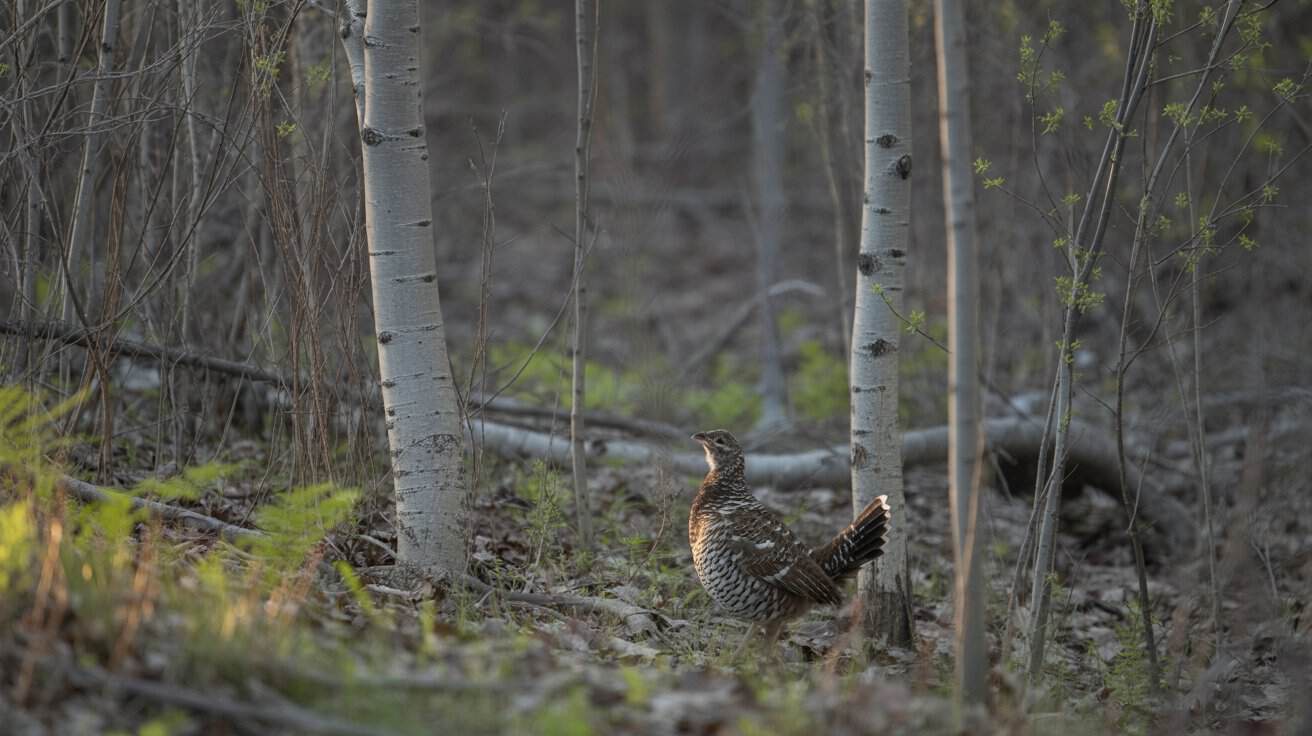
Ruffed grouse need young forest. Dense stands of aspen, alder, or birch regeneration — stems 1 to 3 inches in diameter — are their core habitat. Grouse populations across the Northeast have declined sharply as early successional habitat has matured out or been converted. A landowner with 20 acres of young forest managed on a rotation can hold a resident grouse population year-round.
American woodcock nest in young forest and feed in wet alder thickets and forest seeps. Their numbers are tied directly to the availability of young aspen and alder in this region. If you have a wet corner of your property that’s grown up in alder, you likely already have woodcock in season. Managing it carefully — and keeping some of it young — keeps them coming back.
White-tailed deer are present on nearly every property I visit. The question isn’t how to attract them — it’s how to manage their impact on the rest of the habitat. High deer density prevents forest regeneration, eliminates native ground cover, and ultimately degrades the habitat quality for every other species. Responsible deer management is part of habitat management on private land.
Neotropical songbirds — warblers, thrushes, vireos — need interior forest with little disturbance during nesting season. They also benefit from snag retention, diverse canopy structure, and native shrub and ground cover in the understory. Invasive shrub removal is one of the most direct things a landowner can do to improve conditions for these species.
What Hurts Wildlife Habitat Most on Private Land
In my experience walking properties across this region, the biggest threats to wildlife habitat on private woodland are not dramatic events. They’re gradual ones.
Invasive plants are the most widespread problem I see. Japanese barberry, multiflora rose, and Asiatic bittersweet replace the native shrub layer that wildlife depends on for food and cover. They do it slowly, over years, and by the time most landowners notice, the infestation is already deep-rooted and expensive to treat.
Unplanned timber harvests remove mast trees, damage residual trees, and open corridors for invasive spread. A harvest done without wildlife habitat goals written into the contract can undo decades of habitat value in a single cutting season.
Maturation without management — simply letting the forest age without intervention — produces a closed, even-aged canopy with little understory diversity. It looks like healthy woods to most people. To wildlife, it’s near-empty.
Frequently Asked Questions
Do I need a large property to improve wildlife habitat?
No. I’ve seen meaningful habitat improvements on properties as small as 15 acres. The key is concentrating your efforts — creating one or two high-quality habitat features rather than spreading thin across the whole property. A brush pile complex along a field edge, a managed alder thicket in a wet corner, or a set of released mast trees can all make a real difference on a small parcel.
Will improving wildlife habitat hurt my timber value?
Managed correctly, no. Retaining snags, maintaining some early successional areas, and managing for structural diversity are all compatible with long-term timber management. In fact, a well-structured stand with multiple age classes and species is more resilient and often more valuable than a single-age monoculture. The key is having a plan that addresses both goals — which is exactly what a forest management plan does.
Are there any programs that pay private landowners to improve wildlife habitat?
Yes. The USDA Natural Resources Conservation Service (NRCS) offers cost-share programs through EQIP — the Environmental Quality Incentives Program — that pay landowners for specific habitat practices including early successional habitat development, invasive species control, and riparian buffer establishment. Eligibility and payment rates vary. A consulting forester can help you identify which practices on your land qualify and prepare the documentation needed to enroll.
How does deer browse affect wildlife habitat on private land?
Heavy deer browse eliminates native tree seedlings, forbs, and shrubs from the forest understory over time. When the native plant layer disappears, so does the food and cover it provided to dozens of other wildlife species. On many properties I assess, unrestricted deer populations are preventing any meaningful habitat improvement — regardless of what else is done. Reducing deer pressure, either through hunting or temporary exclusion fencing, is often a prerequisite for successful habitat restoration.
How Environmental Forest Products Can Help
Wildlife habitat improvement and timber management are not separate disciplines. They’re the same work, done with the right goals in mind. I help private landowners across Sullivan, Orange, and Ulster Counties in New York — and into Pike and Wayne Counties in Pennsylvania and Sussex County in New Jersey — do both at once.
What I offer for wildlife habitat work:
- Habitat assessment — walk your property and identify existing features, gaps, and opportunities
- Forest management planning — written plan with habitat objectives built in alongside timber and tax goals
- TSI and crop tree release — create structural diversity and release mast-producing trees
- Invasive species evaluation — know what you’re dealing with and what it will take to address it
- NRCS / EQIP program guidance — identify cost-share opportunities for qualifying practices
If wildlife habitat is one of your goals for your land, the first step is a property walk. Learn more about my wildlife habitat services — or call me directly.
📞 (845) 754-8242
✉️ henry@eforestproducts.com
📍 Westbrookville, NY 12785
Serving Sullivan, Orange, and Ulster Counties NY | Pike and Wayne Counties PA | Sussex County NJ
Henry Kowalec is a licensed consulting forester and member of the Society of American Foresters with over 30 years serving private landowners in the Hudson Valley and Catskills. Environmental Forest Products | Westbrookville, NY 12785 | Licensed in NY, PA, NJ.