Most landowners have no idea what’s actually happening in their woods. A forest health assessment changes that — in a few hours, on foot, with no guesswork.
I’ve walked properties where the landowner thought the timber was ready to sell. It wasn’t. I’ve walked others where they assumed the woods were fine because they “looked healthy.” They weren’t. Crown dieback, invasive pressure, poor regeneration, pest damage — none of these announce themselves from the driveway.
A forest health assessment is a systematic, on-the-ground evaluation of what your woodland is doing and where it’s headed. It’s the professional answer to “what do I actually have out there?” And it’s almost always the first thing I do before any management work begins.
This article walks through exactly what I look at during a property assessment — and why each piece matters to you as a landowner.
What Is a Forest Health Assessment?
A forest health assessment is a structured field evaluation of a woodland’s current condition. It covers tree species composition, stand structure, timber quality, regeneration, invasive species, wildlife habitat features, and signs of pest, disease, or storm damage.
It is not a timber cruise — a cruise quantifies volume for a sale. An assessment answers a broader question: is this forest functioning well, and what does it need?
A full assessment results in a written report that documents findings and recommends specific management actions. That report becomes the foundation of a forest stewardship plan — the document that guides every decision you make on that land for the next decade or more.
For landowners pursuing New York’s 480-a Forest Tax Law, an assessment and a management plan are not optional — they’re required. But even landowners who aren’t interested in the tax program find that a written assessment changes how they see and think about their land.
Stand Composition and Structure: The First Things I Evaluate
The first question I’m answering when I walk into a woodlot is: what’s here, and how is it arranged?
Species composition tells me what kind of forest this is — oak-hickory, northern hardwood, mixed hardwood-softwood — and whether the species mix is shifting. In Sullivan and Ulster Counties, I watch closely for beech decline from beech bark disease, ash loss from emerald ash borer, and the slow replacement of native species by invasive shrubs in the understory.
Stand structure tells me how the forest is organized vertically and horizontally. Is there a diverse canopy with trees of different ages and sizes? Or is this a single-age stand with an even canopy and nothing underneath? Even-aged stands with no structural diversity are common on properties that were cleared and allowed to regrow all at once. They look solid. But they’re fragile — one bad storm, one pest outbreak, and there’s nothing in reserve.
What I want to see is multiple layers: a dominant canopy, a midstory, a shrub layer of native species, and a ground layer with active regeneration. That structure signals a forest that is replacing itself and resilient to disturbance.
Regeneration: The Most Overlooked Indicator of Forest Health
Regeneration — the seedlings and saplings coming up in the understory — is the next forest. If there’s no regeneration, there’s no future stand. It’s that simple.
I evaluate regeneration on every property I assess. I’m looking at three things:
- Presence: Are native tree seedlings actually coming up? Or is the understory dominated by invasive shrubs with no tree regeneration at all?
- Species composition: What’s regenerating? Desirable species like oak, cherry, and sugar maple — or shade-tolerant low-value species that dominate because the stand has never been opened up?
- Browse pressure: Are deer eliminating seedlings before they can establish? On many properties in this region, deer browse has suppressed regeneration for 10 to 15 consecutive years. The forest looks fine on the surface. There is simply nothing coming up behind it.
When I find a property with no regeneration and a closed canopy, that’s one of the clearest signals that management intervention is needed — before the current stand starts to fail.
Pest, Disease, and Storm Damage
Visible damage is the easiest thing to spot. It’s also the thing landowners most often misinterpret.
I document four categories of damage on every assessment:
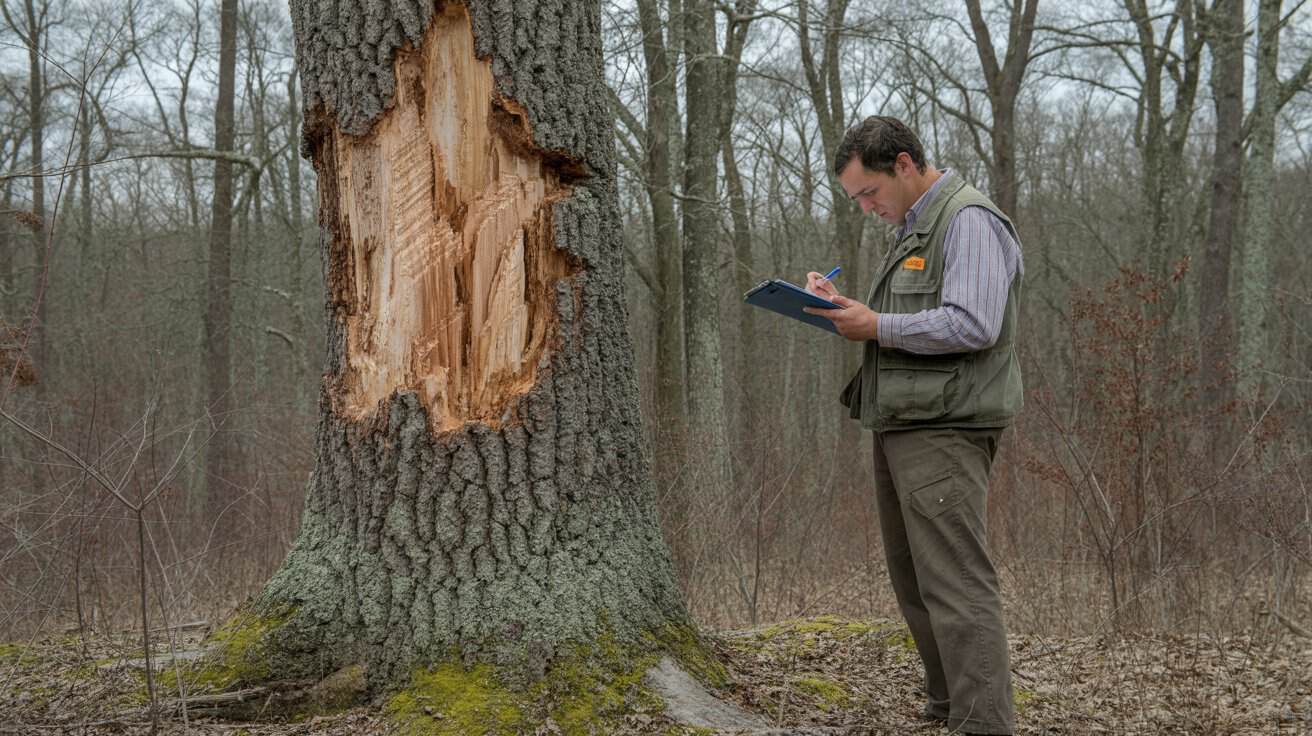
Crown dieback — dead branches or thinning foliage in the upper canopy — can indicate drought stress, root damage, soil compaction from old logging activity, or early-stage pest and disease problems. It’s not always fatal, but it’s never nothing.
Pest and disease signs — I look specifically for emerald ash borer galleries and exit holes on any remaining ash, beech bark disease cankers and beech scale insects, and signs of oak decline or hypoxylon canker on stressed oaks. In the Catskills and Hudson Valley, these are the active threats right now.
Storm damage — broken tops, uprooted root plates, leaning trees — creates both safety hazards and windows of opportunity. A well-placed gap from storm damage can be the starting point for a regeneration area. It can also be an entry point for invasive plants if it’s not managed deliberately.
Logging damage to residual trees — on properties that have been harvested before, I assess how well the operation was conducted. Scarred root flares, damaged cambium from skidder contact, and compacted skid trails all affect the long-term health and value of the remaining stand.
Invasive Species and Competing Vegetation
I cover invasives in detail in nearly every assessment I conduct. The reason is simple: invasive plants are the most widespread active threat to forest health on private land in this region, and most landowners underestimate the extent of the problem until someone maps it.
During an assessment, I identify invasive species present, estimate the extent of infestation by stand area, and note where it’s containable versus where it’s already entrenched. That distinction matters enormously for prioritizing treatment. A five-acre barberry infestation caught early is a manageable problem. Waiting three more years makes it a different conversation entirely.
I also note competing vegetation that isn’t invasive but is limiting stand development — dense fern mats that suppress regeneration, for example, or a heavy shrub layer of native species that needs thinning to allow crop trees to establish.
Timber Quality and Financial Condition
A forest health assessment isn’t a timber appraisal. But it does include an honest evaluation of timber quality — because the financial condition of the stand affects every management decision.
I assess form, defect, and maturity for the dominant species on site. I note trees that are approaching merchantable size, trees with significant defect that should be considered for removal, and overall stand value trajectory — is this forest building value, holding steady, or declining?
On many properties, I find that the best timber has already been removed in previous harvests and what remains is lower-quality material. That changes the management conversation significantly. On others, I find stands with real, unrealized value that the landowner had no idea was there.
Either way, the honest answer is better than the comfortable one. That’s what an assessment is for.
What Happens After a Forest Health Assessment
The assessment report gives you a clear, written picture of your woodland’s current condition. From there, the path forward depends on your goals.
For most landowners, the next step is a forest stewardship plan that turns the assessment findings into a specific, prioritized set of management actions. That plan covers a 10-year horizon and documents the work needed to qualify for New York’s 480-a forest tax program if the property is eligible.
For some landowners, the assessment itself is the goal — they want to understand what they have before deciding whether to do anything further. That’s a completely legitimate use of the service. Walking a property with a forester and hearing the findings in plain language is valuable even if no further action follows immediately.
Frequently Asked Questions
How long does a forest health assessment take?
For a typical private woodland property of 20 to 50 acres, a field assessment takes two to four hours on site. The written report follows afterward. Larger properties take proportionally longer. I walk the whole property — not a sample — because conditions vary significantly from stand to stand, and a partial walk misses the complete picture.
What is the difference between a forest health assessment and a timber cruise?
A timber cruise measures standing timber volume for a specific commercial purpose — usually a pending sale. A forest health assessment is broader. It evaluates overall stand condition, regeneration, invasive species, pest and disease indicators, wildlife habitat features, and management needs — regardless of whether a timber sale is planned. The two can overlap, but they answer different questions.
Do I need a forest health assessment before I can sell timber?
You don’t legally need one, but you should have one. Selling timber without a professional evaluation of what you have and what the stand needs is how landowners end up with high-graded, damaged woodlots they regret for decades. An assessment, combined with a timber appraisal, is how you protect both your land and your financial interest in any transaction.
Can a forest health assessment help me qualify for the 480-a tax program in New York?
Yes. New York’s 480-a Forest Tax Law requires an approved management plan prepared by a licensed forester. A forest health assessment is the first step in preparing that plan. If your property has 50 or more contiguous acres of qualifying forest land, an assessment and plan can put you on the path to an 80% reduction in your property’s assessed value. I’m licensed to prepare 480-a plans in New York and conduct the assessment as part of that process.
How Environmental Forest Products Can Help
I conduct forest health assessments on private woodland properties across Sullivan, Orange, and Ulster Counties in New York and into Pike and Wayne Counties in Pennsylvania and Sussex County in New Jersey. Every assessment is a full property walk — not a windshield survey, not a sample plot.
What the assessment covers:
- Stand composition and species inventory
- Structural diversity and regeneration evaluation
- Pest, disease, and storm damage documentation
- Invasive species mapping and extent estimate
- Timber quality and stand value trajectory
- Wildlife habitat feature inventory
- Written findings report with prioritized management recommendations
If you want to know what’s actually happening on your land, start here. Request an assessment estimate — or call me directly.
📞 (845) 754-8242
✉️ henry@eforestproducts.com
📍 Westbrookville, NY 12785
Serving Sullivan, Orange, and Ulster Counties NY | Pike and Wayne Counties PA | Sussex County NJ
Henry Kowalec is a licensed consulting forester and member of the Society of American Foresters with over 30 years serving private landowners in the Hudson Valley and Catskills. Environmental Forest Products | Westbrookville, NY 12785 | Licensed in NY, PA, NJ.