A forest management plan is the single most important document a private landowner can have for their wooded land. It protects your timber value, cuts your property taxes, and gives every management decision a foundation to stand on.
I’ve been preparing forest management plans for private landowners in the Hudson Valley and Catskills for over 30 years. In that time, one thing hasn’t changed: the landowners who have a written plan make better decisions, avoid more costly mistakes, and get more out of their land than those who don’t.
That’s not a sales pitch. It’s just what I’ve seen on the ground, property after property, decade after decade.
This guide covers everything a private landowner needs to understand about forest management plans — what they are, what they include, who needs one, how they’re prepared, and what they make possible. If you own wooded land in New York, Pennsylvania, or New Jersey, this is the most useful thing you’ll read about your property today.
What Is a Forest Management Plan?
A forest management plan is a written document that describes the current condition of a woodland property and maps out a specific course of management actions over a defined time horizon — typically 10 years.
It is prepared by a licensed consulting forester after a thorough on-the-ground assessment of the property. It documents what’s there — species, stand structure, timber quality, wildlife habitat features, invasive plants, and any pest or disease issues — and then recommends what to do about it, in what order, and why.
A well-prepared plan is not a generic template with the landowner’s name filled in. Every plan I write is specific to that property, those goals, and that forest. The stands on a 60-acre woodlot in Sullivan County look nothing like the stands on a 60-acre woodlot in Ulster County. The plan has to reflect that.
What a forest management plan is not: a timber sale agreement, a logging contract, or a guarantee of any financial outcome. It is a professional assessment and management guide. Acting on it — or not — is always the landowner’s decision.
Who Needs a Forest Management Plan?
Any private landowner with wooded land can benefit from a management plan. But there are specific situations where having one moves from “useful” to “essential.”
You need a forest management plan if you are considering a timber sale. Selling timber without a plan — without knowing what you have, what it’s worth, and what the stand needs — is the most common and most expensive mistake landowners make. A plan prepared before any sale protects your financial interests and your forest’s long-term health.
You need one if you want to qualify for New York’s 480-a Forest Tax Law. The 480-a program provides an 80% reduction in the assessed value of qualifying forest land. Enrollment requires a management plan prepared by a licensed NYS forester. Without the plan, there is no 480-a. Period. I cover this in much more detail below — it’s one of the most valuable financial benefits available to woodland owners in New York and most landowners don’t know it exists.
You need one if you’ve inherited woodland property and aren’t sure what you have, what it’s worth, or what to do with it. A plan gives you a foundation before you make any decisions.
You need one if you have specific land goals — wildlife habitat, watershed protection, a future timber harvest, a legacy for your children — and want a professional roadmap for getting there.
If you own 10 acres of wooded land in Sullivan County and you want to understand it better, a management plan is worth the investment. If you own 200 acres and you don’t have one, you’re operating blind.
What Does a Forest Management Plan Include?
Every management plan I prepare includes the same core elements, though the depth and detail scale with property size and complexity.
Property description and ownership information.
The legal description, acreage, location, and ownership history of the property. This section also documents prior management activity — past timber harvests, land use history, any existing easements or deed restrictions that affect management options.
Forest inventory and stand maps.
A stand is a distinct unit of forest with relatively uniform species composition, age, and structure. Most properties have multiple stands. I identify, map, and describe each one — dominant and co-dominant species, average diameter, estimated volume, stand age, and structural condition. This inventory is the factual foundation of everything that follows.
Stand-by-stand management recommendations.
For each stand, I recommend specific management actions — timber stand improvement, a commercial harvest, invasive species treatment, regeneration work, or no action at this time — with a rationale and a timeframe. These are prioritized by ecological urgency and financial opportunity.
Forest health and habitat documentation.
Invasive species present and estimated extent. Signs of pest or disease activity. Wildlife habitat features — snags, mast trees, wetlands, forest interior habitat. This section identifies both threats to address and assets to protect.
Goals and objectives.
What the landowner wants from the property — stated in writing. Timber income, wildlife habitat, tax reduction, watershed protection, family legacy, some combination. The management recommendations have to line up with these goals. A plan that ignores what the landowner actually wants isn’t a plan — it’s a report.
Schedule of management activities.
A 10-year activity schedule that sequences the recommended work in a logical order. What to do in year one, what to do in years two through five, what to evaluate at the five-year mark.
Monitoring and reporting protocol.
How progress will be tracked, what conditions require a plan revision, and how compliance with program requirements (like 480-a) will be documented over time.
How a Forest Management Plan Is Prepared
The process starts on the ground. There is no substitute for walking the property.
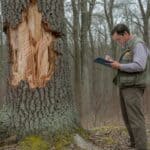
I spend several hours — sometimes a full day on larger properties — systematically covering the ground. I’m taking notes, measuring trees, photographing conditions, flagging stand boundaries, and building the observational record that the plan will be based on. I’m also listening to the landowner. The goals section of the plan can only be written after a real conversation about what that person wants their land to do.
After the field work, I compile the inventory data, draw or refine the stand maps, and write the plan. The writing takes time. A management plan that’s going to guide decisions for the next decade has to be clear, specific, and accurate. I don’t use generic language. I describe what I actually found and what I actually recommend for that specific property.
The finished plan is reviewed with the landowner before it’s finalized. I want to make sure the goals section reflects what they told me, that the recommendations are understood, and that the landowner feels confident about the path forward. A plan they don’t understand doesn’t help anyone.
For 480-a enrollment in New York, the completed plan is submitted to the NYSDEC for review and approval. That review typically takes several weeks. Once approved, the plan is the binding document for the enrollment period — the management activities listed in the schedule are what the landowner is expected to carry out and document.
Forest Management Plans and New York’s 480-a Forest Tax Law
This is the section most New York landowners need to read twice.
New York’s 480-a Forest Tax Law is a state program that provides an 80% reduction in the assessed value of qualifying forest land in exchange for a commitment to active, sustainable forest management. For a landowner paying property taxes on forested acreage, this is one of the most significant financial benefits available — and it is almost entirely unknown outside of forestry circles.
Here is how the numbers work in practice. If your forest land is assessed at $100,000 and you’re taxed at the full rate, you’re paying taxes on $100,000. Under 480-a, you’re taxed on $20,000. On a property with significant forested acreage, the annual tax savings can run into thousands of dollars. Over a 10-year enrollment period, that compounds into a very meaningful sum.
The requirements to qualify:
- A minimum of 50 contiguous acres of forest land — adjacent parcels under the same ownership can be combined to reach the threshold
- An approved forest management plan prepared by a licensed NYS forester
- Active management consistent with the approved plan — meaning the scheduled activities must actually be carried out and documented
- Enrollment application submitted to the local assessor’s office with the approved plan
The commitment is real. If you enroll and then don’t follow through on the management activities, you can face recapture of the tax benefits. But if you were going to manage your forest anyway — and you should be — the 480-a program essentially pays you to do it.
I am licensed to prepare 480-a management plans in New York. Preparing these plans, working with the NYSDEC review process, and helping landowners through the enrollment and annual documentation requirements is a core part of what I do. If you own 50 or more acres of forest land in New York and you’re not enrolled in 480-a, call me. The first conversation is free.
Learn more about the 480-a program and how I can help you enroll at eforestproducts.com/services/480a-forest-tax-law.
Forest Management Plans and Timber Sales
I want to be direct about something landowners don’t always hear from the people trying to buy their timber.
A timber buyer’s job is to purchase your timber for as little as possible while still closing the deal. That is their business. It is not a criticism — it’s just how the transaction works. The question is whether you want to enter that transaction with a professional assessment of what you have, or whether you want to take whatever they offer.
A forest management plan — combined with a timber appraisal — tells you the current market value of your standing timber before anyone names a price. It identifies which trees are mature and ready for harvest versus which ones are still growing in value. It establishes which harvest method is appropriate for the stand, and what the logging contract needs to say to protect the residual trees and the land.
Landowners who sell timber without this preparation routinely receive substantially less than fair market value. Some receive even less. High-grading — removing the best trees and leaving the worst — is standard practice without a forester involved to specify what gets cut. The forest that results takes a generation to recover, if it recovers at all.
A management plan doesn’t guarantee you’ll never make a bad decision about your timber. But it gives you the information you need to make a good one.
Forest Management Plans for Wildlife and Habitat Goals
Not every landowner’s primary goal is timber or tax savings. A significant number of the landowners I work with in Sullivan, Ulster, and Orange Counties own wooded land primarily because they love wildlife — deer, turkey, grouse, woodcock, songbirds — and they want their property to hold and support it.
A forest management plan written with habitat goals as the primary objective looks somewhat different from a timber-focused plan — but the structure is the same. The inventory is the same. The stand maps are the same. What changes is the management recommendations.
A habitat-focused plan prioritizes:
- Identifying and protecting mast-producing trees — oaks, beech, hickory, black cherry
- Creating structural diversity through timber stand improvement and canopy gap work
- Establishing or maintaining early successional habitat for grouse, woodcock, and songbirds
- Snag retention and downed log management for cavity-nesting species
- Invasive species control to restore native shrub and ground layer
- Riparian buffer and wetland protection
The good news for wildlife-oriented landowners: a well-managed forest for habitat is also a well-managed forest for long-term timber value. These goals are not opposites. A structurally diverse, species-rich, regenerating forest is both better habitat and a more resilient, productive timber stand. The management plan is the tool that holds both goals at once.
How Often Does a Forest Management Plan Need to Be Updated?
A standard forest management plan covers a 10-year management horizon. At the end of that period, the plan needs to be revised and updated based on current stand conditions and any changes in the landowner’s goals.
Mid-plan revisions are sometimes necessary as well. A major storm event, an unexpected pest outbreak, a significant change in timber markets, or a change in ownership can all require revisiting the plan before the 10-year mark. For 480-a enrollments, the NYSDEC review process also provides checkpoints where documented management activity is evaluated.
I stay in contact with the landowners whose plans I’ve prepared. A brief annual check-in — even just a phone call — is usually enough to confirm that the schedule is on track and flag anything that warrants a closer look. A forest changes every year. The plan should stay current enough to be useful.
What a Forest Management Plan Costs — And What It Returns
I’m straightforward about cost when landowners ask, and they should ask.
The cost of a forest management plan depends on property size, stand complexity, and whether 480-a enrollment processing is included. For a typical small property — 20 to 50 acres — plan preparation runs in the low-to-mid hundreds of dollars. Larger properties with multiple complex stands cost more. I provide a clear estimate before any work begins.
The return on that investment is harder to put a single number on — because it varies so much by situation. For a landowner enrolling in 480-a, the first year of tax savings alone often covers the entire cost of the plan. A landowner who avoids a bad timber sale because they knew what they actually had, the return is far larger. For a landowner who makes a management decision today that protects the value of their timber for the next generation — the return is measured in decades, not dollars.
I’ve never had a landowner come back to me and say the plan wasn’t worth it. I have had landowners come back to me after selling timber without a plan, wishing they’d done it differently. That conversation is harder than it needs to be.
Frequently Asked Questions
Do I need a licensed forester to prepare a forest management plan?
In New York, a licensed NYS forester is required to prepare a management plan that qualifies for the 480-a Forest Tax Law. Outside of 480-a, there’s no legal requirement — but the practical answer is still yes. A plan prepared by someone without the credentials, field experience, and regional knowledge to back it up is not worth the paper it’s on. The plan is only as good as the assessment behind it, and a competent assessment requires professional training and field experience.
How is a forest management plan different from a timber appraisal?
A timber appraisal quantifies the current market value of standing timber — what your trees are worth if sold today. A forest management plan is broader: it covers the entire property, all management goals, stand health, habitat, invasive species, regeneration, and a 10-year action schedule. The two complement each other and are often prepared together when a timber sale is being considered, but they answer different questions and serve different purposes.
Can I get a forest management plan if my property is less than 50 acres?
Yes. The 50-acre minimum applies only to New York’s 480-a Forest Tax Law enrollment. A management plan is useful and appropriate for properties of any size. I’ve prepared plans for properties as small as 10 acres. The plan may be simpler and less expensive on a small property, but the value — knowing what you have and having a professional roadmap — is the same regardless of acreage.
What is the difference between a forest management plan and a forest stewardship plan?
The terms are often used interchangeably, and in practice they describe the same type of document. “Forest stewardship plan” is language used in some USDA programs and by some state agencies; “forest management plan” is more commonly used in the context of New York’s 480-a program and in standard forestry practice. Both describe a written, site-specific, professionally prepared document that guides the long-term management of private woodland. If you’re applying for a specific program, I’ll use the terminology and format that program requires.
How long does it take to get a forest management plan prepared?
From the initial field assessment to the completed written plan, the process typically takes four to six weeks for most properties. For 480-a enrollment, add the NYSDEC review period — typically several additional weeks. If you have a pending timber sale or a tax filing deadline, let me know at the first call. I work around landowner timelines when I can, and I’ll tell you honestly if the schedule isn’t achievable.
How Environmental Forest Products Can Help
I’ve been preparing forest management plans for private landowners in Sullivan, Orange, and Ulster Counties in New York — and in Pike and Wayne Counties in Pennsylvania and Sussex County in New Jersey — for over 30 years. Every plan I write starts with a full property walk. Every recommendation I make is site-specific. And every landowner I work with gets a direct line to me throughout the process.
What I offer for forest management planning:
- Complete forest management plan preparation — 10-year plans covering all stands, all goals, all program requirements
- 480-a Forest Tax Law enrollment — plan preparation, NYSDEC submission, and ongoing compliance documentation
- Timber appraisal and sale preparation — know what you have before anyone makes an offer
- Wildlife habitat planning — management plans with habitat objectives built in alongside timber and tax goals
- Plan updates and revisions — for landowners with existing plans that need refreshing
- Annual monitoring and documentation — ongoing support to keep your plan current and your 480-a enrollment in good standing
The first step is a conversation. Request an estimate and tell me about your property — acreage, county, and what you’re trying to accomplish. I’ll give you a straight answer about what I can do for you and what it will cost.
(845) 754-8242
henry@eforestproducts.com
Westbrookville, NY 12785
Serving Sullivan, Orange, and Ulster Counties NY | Pike and Wayne Counties PA | Sussex County NJ
Henry Kowalec is a licensed consulting forester and member of the Society of American Foresters with over 30 years serving private landowners in the Hudson Valley and Catskills. Environmental Forest Products | Westbrookville, NY 12785 | Licensed in NY, PA, NJ.