New York State requires a licensed forester to write any forest management plan submitted for 480-a enrollment. That’s not a bureaucratic technicality. It’s a protection — for the integrity of the plan, for the soundness of the management it prescribes, and ultimately for the landowner who depends on that plan to make good decisions about their woodland.
The licensing requirement also raises a question landowners ask me regularly: what exactly does “licensed forester” mean, and does the person offering to help me qualify? A timber buyer who mentions he has “forestry experience.” A logging company employee who offers to put together paperwork. A neighbor who took a few forestry courses. None of these people meet the requirement — and using them has real consequences.
Here’s exactly who can write a qualifying forest management plan in New York, what credentials to look for, and why the distinction matters beyond just regulatory compliance.
The Short Answer — Yes, for 480-a Enrollment
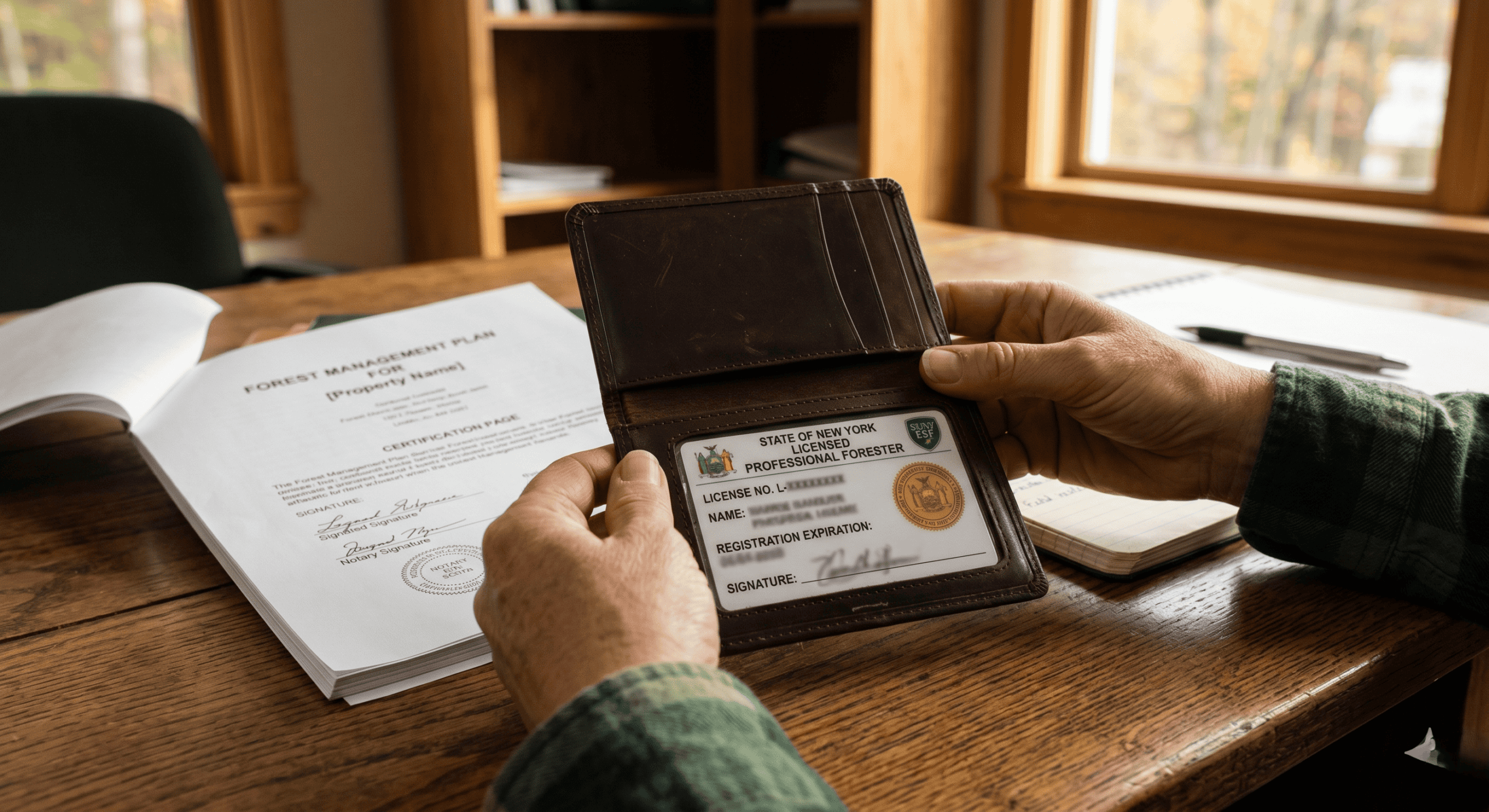
For any forest management plan submitted to NYSDEC for 480-a Forest Tax Law enrollment, New York State requires the plan to come from a licensed forester. The New York State Education Department issues that license under its professional licensing framework. The license requires demonstrated competency in forest inventory, silviculture, and management planning — and continuing education to keep it active.
There is no workaround. No exception for small properties. No grandfather clause for long-standing timber buyer relationships. NYSDEC will not approve a 480-a management plan that a licensed forester did not write and sign. If the plan lacks a licensed forester’s signature and license credential, the regional reviewer returns it without approval.
For a non-regulatory management plan — a personal management reference with no 480-a or cost-share program purpose — no licensing requirement exists. But as I explain later, that kind of plan also provides little of the protection a properly written plan delivers.
What the Licensing Requirement Actually Means
A New York State forester license is not a certificate of completion from a short course. It requires a degree in forestry or a closely related field from an accredited program, documented field experience, and passage of a professional competency examination. Licensees must complete continuing education to maintain the license in good standing.
That training produces a forester who can read a stand — assess species composition, log grade, stocking levels, regeneration potential, and silvicultural options — with the accuracy that a management plan requires. It produces a forester who understands how prescribed management activities interact with each other over a ten-year planning horizon. And it produces a forester who carries professional accountability for what the plan says.
That accountability is the part most landowners don’t think about. When a licensed forester signs a management plan, that signature carries professional liability. If the plan’s field data is fabricated, if the prescriptions are silviculturally indefensible, or if the plan misrepresents conditions on the ground, the forester’s license is at risk. That risk creates a powerful incentive to produce accurate, defensible plans. An unlicensed plan writer carries no such accountability.
Why a Logger or Timber Buyer Cannot Write Your Plan
This is where the most common confusion — and the most common risk — shows up in practice. Timber buyers and logging companies sometimes offer to help landowners with management paperwork as part of a timber sale arrangement. That offer is not benign.
The Conflict of Interest Problem
A timber buyer’s income depends on buying timber at the lowest price a landowner will accept. A management plan written by that buyer — or by a forester employed by a logging company — will reflect that financial interest. The harvest prescription may favor removing more timber than is silviculturally appropriate. The stand descriptions may understate timber quality. The activity schedule may be structured to advance the buyer’s access to your timber rather than your forest’s long-term health.
A consulting forester works for you. His fee comes from you. His professional obligation runs to your interests, not to a mill’s inventory needs. That’s not a minor procedural distinction. It’s the difference between someone who answers to you and someone who profits from what you agree to. For a full explanation of why this matters across every aspect of timber management, see my article on timber buyers vs. consulting foresters.
The Competency Problem
Beyond the conflict of interest, most timber buyers and logging company employees do not hold the silvicultural training that a management plan requires. Knowing what timber is worth to buy is different from knowing how a stand should be managed over 20 years. Knowing how to skid logs efficiently is different from knowing how regeneration dynamics, invasive species pressure, and forest health threats interact across a planning horizon.
A management plan written without that training produces prescriptions that may be inaccurate, incomplete, or actively harmful to the stand’s long-term productivity. It also won’t pass NYSDEC review — which is the most immediate practical consequence.
What Credentials to Look For in a Forest Management Plan Consultant
When you engage a forester to write your management plan, ask these questions before the engagement begins.
Do you hold a current New York State forester license? This is non-negotiable for any plan with a regulatory purpose. Ask for the license number and verify it at the NYS Education Department’s online license verification system at op.nysed.gov. A legitimate licensed forester will give you this information without hesitation.
Have you submitted 480-a management plans to the NYSDEC regional office covering my county? Regional familiarity matters. A forester who has submitted multiple plans to your regional office knows what the reviewer expects and builds plans that clear review without unnecessary delays or revision requests.
Are you a member of the Society of American Foresters? SAF membership is not a licensing requirement, but it’s a reliable signal of professional engagement. SAF members subscribe to a code of professional ethics and participate in continuing education through the organization. Most experienced consulting foresters maintain SAF membership throughout their careers.
Do you work for a logging company or timber buyer? If yes, ask directly: who pays your fee for this plan? If the answer is the logging company or the buyer — not you — the conflict of interest problem applies regardless of the forester’s credentials.
The Difference Between a Consulting Forester and a Company Forester
Not every licensed forester is a consulting forester. Some licensed foresters work for logging companies, mills, or timber buyers. They may hold valid NYS licenses. They are not independent.
A consulting forester works exclusively for landowner clients. The fee structure is straightforward: the landowner pays the forester, and the forester’s professional obligation runs entirely to the landowner. No commission from the buyer. No revenue from the mill, no stake in how much timber gets cut or what price it sells for.
A company forester — even if licensed — works for an employer whose interests may diverge from yours. A company forester who writes your management plan is producing a document that serves two masters. The professional liability obligation runs to the license. The practical loyalty runs to the employer.
For a regulatory plan — 480-a, EQIP, any program where the plan must reflect independent professional judgment — a consulting forester is the only appropriate choice. For the full explanation of how the consulting forester relationship protects landowners throughout the management process, see my article on when to call a consulting forester.
What Happens If You Use an Unqualified Plan Writer
The immediate consequence is NYSDEC rejection. A plan submitted without a licensed forester’s signature and credential does not pass regional review. The plan comes back without approval. No approval means no 480-a enrollment. No enrollment means continued full assessed value — and continued full property tax liability.
The longer-term consequences are more serious. A poorly written plan from an unqualified writer may prescribe inappropriate management that damages your stand over a multi-year period. A plan that misrepresents stand conditions creates a false baseline — every subsequent management decision built on that plan starts from inaccurate information.
If a plan was written by someone without a license and submitted for 480-a approval, NYSDEC will reject it. The landowner then needs to start over — a new forester, a new field inventory, a new plan. The time and money spent on the first plan are gone. The tax savings that would have accrued during the intervening period are permanently lost.
How to Find a Licensed Consulting Forester in New York
Three resources locate licensed consulting foresters in New York State.
NYS Education Department license verification: Confirm any forester’s current license status at op.nysed.gov. Search by name, license type (Forester), and state. Active license status is publicly verifiable.
Society of American Foresters member directory: The SAF maintains a consulting forester directory searchable by state and specialty at eforester.org. Members in the directory have self-identified as consulting foresters and maintain SAF membership in good standing.
NYSDEC Division of Lands and Forests: NYSDEC regional offices can provide referrals to licensed foresters familiar with 480-a requirements in their coverage area. Contact your regional DEC office directly.
For the full step-by-step process of engaging a forester and moving from first call to approved plan, see my article on how to create a forest management plan in New York.
Frequently Asked Questions
Does the forester who writes my plan have to be the same one who manages my timber sale?
No — there’s no regulatory requirement that the plan writer and the timber sale manager be the same person. In practice, however, continuity makes sense. The forester who wrote your plan knows your stands, your management history, and your goals. That forester can mark timber and oversee a sale in a way that conforms to the plan’s prescriptions and advances the 480-a compliance record. Bringing in a different forester for the sale creates a handoff that requires the second forester to get up to speed on the property at your expense.
Can a forester licensed in another state write my New York 480-a management plan?
No. NYSDEC requires a current New York State forester license for any plan submitted for 480-a enrollment. A forester licensed in Pennsylvania, New Jersey, or any other state does not satisfy the New York licensing requirement regardless of their experience or credentials. If you own property in multiple states, each state’s 480-a or equivalent program has its own licensing requirement — and you need a forester licensed in the state where the plan applies.
What if I already have a plan written by someone who isn’t licensed — can it be fixed?
Not by patching it. A plan that lacks a licensed forester’s field inventory and professional judgment cannot be retroactively “signed off” by a licensed forester who wasn’t involved in the field work. The licensed forester’s signature carries professional liability — no responsible licensed forester will sign a plan they didn’t produce. The practical answer is a new engagement: a licensed consulting forester conducts a fresh field inventory and writes a new plan. The prior document has no usable value for regulatory purposes.
How Environmental Forest Products Can Help
I hold a current New York State forester license. I’m a member of the Society of American Foresters. I’ve been writing management plans and submitting them to NYSDEC regional offices for 480-a approval across Sullivan, Ulster, and Orange Counties for over 30 years. Every plan I produce comes from my own field inventory — I don’t sign plans I didn’t write, and I don’t write plans I didn’t walk.
My fee comes from the landowner. I work for no logging company, no mill, and no timber buyer. That independence is not incidental — it’s what makes the plan useful as a management document and credible as a regulatory submission.
Here’s what I can do for a landowner who needs a qualified management plan:
- Verify my current NYS license and provide the credential information before any engagement begins
- Conduct the full field inventory — stand assessment, timber cruise, health evaluation, and access documentation
- Write a complete plan satisfying both NYSDEC 480-a requirements and USDA NRCS technical standards
- Submit the plan to the NYSDEC regional office and communicate through approval
- Provide ongoing compliance guidance and management supervision throughout the ten-year period
If you’re not sure whether a plan you’ve been offered was written by a qualified forester, call me before you submit it. A five-minute conversation can save you the cost of starting over after a NYSDEC rejection.
Request a Free Consultation with a Licensed Forester
Call me directly: (845) 754-8242
Email: henry@eforestproducts.com
Serving Sullivan County NY, Ulster County NY, Orange County NY, Pike County PA, Wayne County PA, and Sussex County NJ.
Henry Kowalec is a licensed consulting forester and member of the Society of American Foresters with over 30 years serving private landowners in the Hudson Valley and Catskills. Environmental Forest Products | Westbrookville, NY 12785 | Licensed in NY, PA, NJ.