The landowners who get the most from their woodland are not the ones who call a consulting forester after something goes wrong. They’re the ones who call before a decision gets made — before a timber buyer gets their ear, before a sale gets signed, before a management opportunity closes.
Most landowners wait too long. They call after they’ve accepted a timber offer and are starting to wonder if it was fair. They call after they’ve let a buyer mark their own trees. Then, They call after ten years of 480-a non-enrollment, when the forfeited tax savings are already gone.
Calling a consulting forester early doesn’t cost you anything significant. Calling late — or not calling at all — often costs tens of thousands of dollars. Here are seven specific situations that tell you it’s time to make the call.
What a Consulting Forester Actually Does
Before the seven signs, a quick clarification. A consulting forester is a licensed professional who works for the landowner — not for a mill, not for a logging company, not for a buyer. That’s the defining distinction.
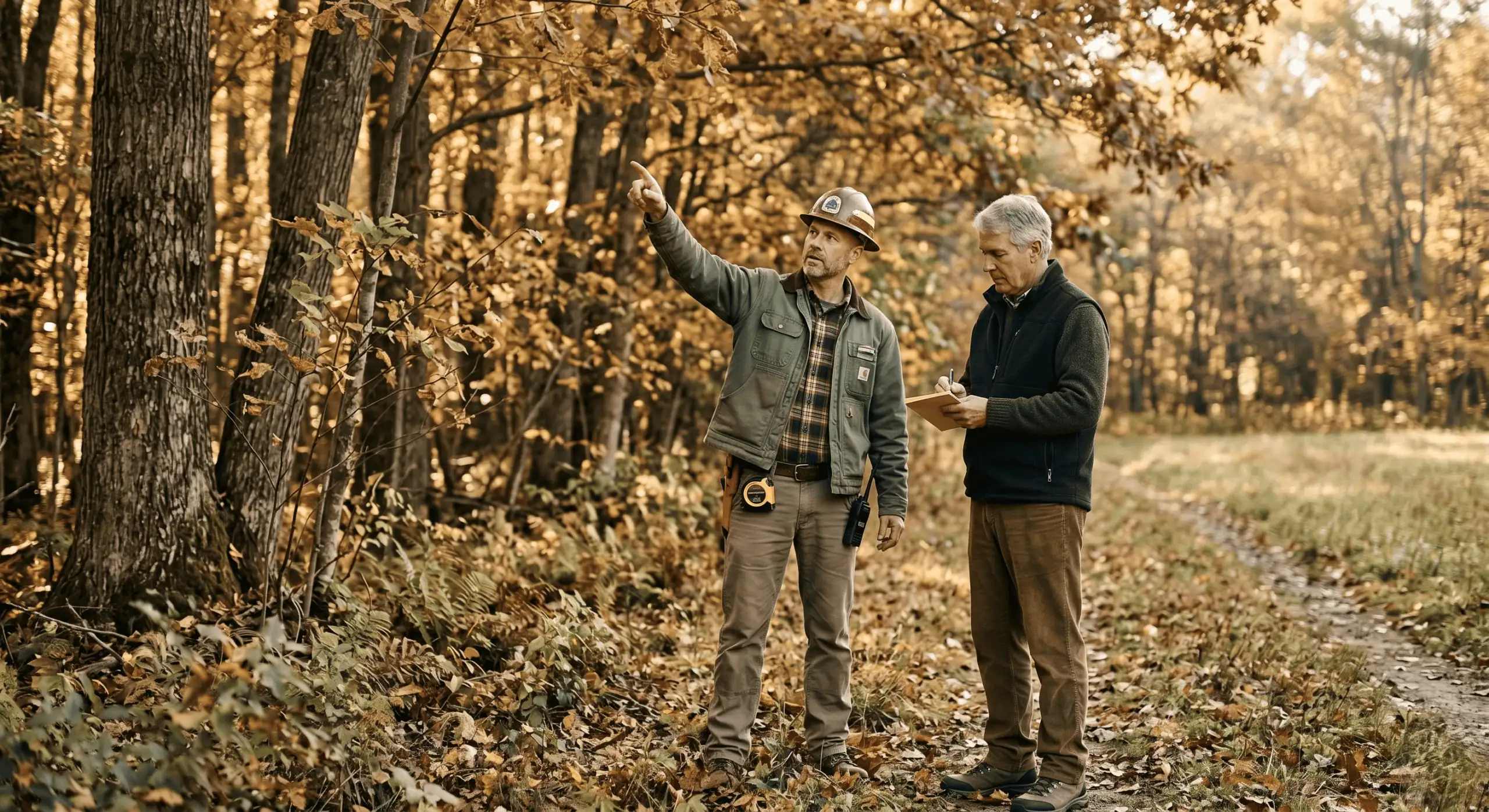
A consulting forester walks your property, assesses stand conditions, writes management plans, marks timber for harvest, manages the sale process on your behalf, and oversees harvests to make sure contracts are followed. He charges a fee paid by the landowner. His professional obligation runs to you — not to whoever wants to buy your trees.
That independence is what makes the relationship valuable. A forester who profits from your timber sale has a conflict of interest. A consulting forester working on a landowner fee has none. For a full explanation of this distinction, see my article on timber buyers vs. consulting foresters.
The 7 Signs It’s Time to Call
Sign 1 — A Timber Buyer Has Contacted You
This is the most urgent situation on this list. A timber buyer’s contact — whether it’s a knock on the door, a letter, or a phone call — means someone already knows you have timber worth pricing. He has an information advantage. He knows what your timber is worth. You don’t.
Don’t respond until you have an independent timber appraisal. That appraisal tells you what you have and what it’s worth at current market prices. It’s the baseline you need to evaluate any offer — and the document that tells you whether to accept, negotiate, or walk away. See my article on how to get a timber appraisal for what that process involves.
Sign 2 — You’ve Just Inherited Wooded Land
Inherited woodland is one of the highest-risk situations for costly early mistakes. New landowners often don’t know what they have, don’t know what it’s worth, and don’t know that buyers are monitoring public deed records for exactly this kind of ownership change.
A forester walk in the first 60 to 90 days of ownership gives you the orientation you need before any decision gets made. It tells you what the property contains, what its management history appears to be, and what immediate opportunities or threats exist. For a complete guide to this situation, see my article on what to do with inherited wooded land.
Sign 3 — You’re Paying Full Property Taxes on Woodland
If your property has 50 or more contiguous acres of productive forest land in New York and you’re not enrolled in the 480-a Forest Tax Law, you’re paying more property tax than you need to. The program reduces assessed value by up to 80%. The annual savings are real and recurring.
Enrollment requires a forest management plan written by a licensed forester and approved by NYSDEC. The plan cost is typically recovered in the first year or two of enrollment. Every year you delay is a year of savings you cannot recover retroactively. For the full 480-a picture, see my article on forest stewardship and 480-a tax savings.
Sign 4 — You Haven’t Walked Your Property with a Management Plan
If you own wooded land and you’ve never had a forester assess it — no management plan, no timber cruise, no professional walk — you’re managing blind. You don’t know what your timber is worth. You don’t know what forest health threats exist. And you don’t know what management activities would improve the stand or when they should happen.
A first forester visit resolves all of that. It gives you a professional assessment of what you have, what it needs, and what the realistic management options are for your property and your goals. For the beginner’s guide to what that first visit involves, see my article on forest land management for beginners.
Sign 5 — You Have Ash Trees Showing Crown Decline
This one is genuinely time-sensitive. Emerald ash borer is present throughout New York State. Ash trees with crown dieback are already in decline — and the timber salvage window for those trees closes faster than most landowners expect. Once crown loss exceeds 50%, sawlog value drops sharply. Dead ash has no timber value.
If you see ash trees with thinning crowns, woodpecker activity on the upper trunk, or D-shaped exit holes in the bark, call a forester now — not after the next growing season. A one-season delay can cost you all the salvage value those trees carry. For the full EAB picture, see my article on emerald ash borer for NY landowners.
Sign 6 — You Want Better Deer Habitat but Don’t Know Where to Start
Wildlife habitat improvement on private woodland is not complicated — but it requires knowing what you have before you know what to do. Crop tree release for mast production, canopy openings for browse, bedding cover structure — all of these start with a property assessment that identifies what’s there and what the stand needs.
A forester who understands both silviculture and wildlife habitat can assess your property and develop a prescription that improves deer habitat while also advancing timber management goals. The two are more compatible than most landowners expect. For the full habitat management guide, see my article on managing woods for deer.
Sign 7 — You’re Thinking About Selling the Land
If you plan to sell your wooded property — whether in one year or five — a forester visit before the sale process begins is one of the highest-return investments you can make. Here’s why.
Timber value is a component of raw land value. Buyers factor timber into what they’ll pay. If you sell without an independent timber appraisal, you’re negotiating a major asset without knowing a key component of its worth. A consulting forester can also assess whether a timber sale before the land sale would increase your total net proceeds — capturing timber value separately rather than letting a land buyer price it into his offer.
Either way, the forester’s assessment gives you information. That information makes the land sale negotiation more productive and protects you from leaving value on the table.
What a First Forester Visit Costs — and What It Returns
A first consulting forester visit — a property walk and verbal assessment — is typically an hourly engagement. On a 50- to 100-acre property, the walk and discussion run two to four hours. The fee is modest relative to any significant timber sale, 480-a enrollment, or land transaction the visit informs.
The return on that investment is almost always disproportionate to the cost. On a timber sale, a forester’s representation through the competitive bid process returns significantly more than the fee through better stumpage prices. On a 480-a enrollment, the first year’s tax savings cover the plan cost and then some. And on a land sale, knowing the timber component of land value gives you negotiating information worth far more than a consulting fee.
The situations where a forester visit does not pay for itself are rare. On very small properties — under 15 acres of woodland with minimal timber value — the economics may be tight. For most private woodland owners in Sullivan, Ulster, and Orange Counties, the call pays for itself before the conversation is over.
Frequently Asked Questions
How do I find a licensed consulting forester in New York?
The Society of American Foresters maintains a directory of consulting foresters searchable by state and specialty at eforester.org. NYSDEC also maintains a list of licensed foresters in New York State. When evaluating any forester, confirm they hold a current New York State forester license, ask about their experience with properties in your county, and ask specifically whether they have submitted 480-a management plans to your NYSDEC regional office before. Regional familiarity matters — review timelines and prescriptive expectations vary by office.
Is a consulting forester worth the cost on a small woodland property?
It depends on what you’re trying to accomplish. For a timber sale — even on a smaller property — a consulting forester’s competitive bid management typically returns significantly more than the fee through better stumpage prices. Then for 480-a enrollment, you need 50 contiguous acres to qualify, so smaller properties don’t access that benefit. For a one-time walk-and-assessment on a smaller woodlot, the value is in the information — knowing what you have, what forest health threats exist, and what management activities make sense. On properties under 15 acres with minimal timber, the economics are tighter. On anything over 20 acres with merchantable timber, the call almost always pays for itself.
What should I bring to a first forester visit?
Bring whatever documents you have about the property — deed, survey map, any prior timber sale contracts, and any existing forest management plan if one was written. Then, bring a list of your goals for the land: timber income, wildlife habitat, tax reduction, or some combination. Bring your questions. The more context you give a forester at the start of a walk, the more useful the assessment becomes. You don’t need to know anything about forestry — that’s what the forester is there for. Come with questions, not answers.
How Environmental Forest Products Can Help
I’m a licensed consulting forester serving private woodland owners across Sullivan, Ulster, and Orange Counties. I’ve been doing this work for over 30 years. Every situation on this list is a situation I handle regularly — timber sales, inherited land, 480-a enrollment, EAB assessment, habitat planning, and pre-sale land valuation.
My fee comes from the landowner. My professional obligation runs to the landowner. That’s the only way this relationship makes sense — and it’s what separates a consulting forester from anyone else who might offer to “help” with your woodland.
Here’s what I can do depending on your situation:
- Walk your property and give you a plain-language assessment of what you have and what it needs
- Conduct a timber cruise and written appraisal before any buyer conversation
- Write a forest management plan for 480-a enrollment and manage the NYSDEC submission process
- Manage a timber sale — marking, competitive bids, contract, and harvest oversight
- Assess EAB stage on ash trees and advise on treatment or salvage timing
- Develop a wildlife habitat improvement plan integrated with timber management goals
- Advise on pre-sale timber valuation and sequencing for landowners considering a property sale
If any of the seven signs in this article describe your situation, the right move is a phone call. The first conversation costs nothing and gives you the information foundation for every decision that follows.
Request a Free Consulting Forester Visit
Call me directly: (845) 754-8242
Email: henry@eforestproducts.com
Serving Sullivan County NY, Ulster County NY, Orange County NY, Pike County PA, Wayne County PA, and Sussex County NJ.
Henry Kowalec is a licensed consulting forester and member of the Society of American Foresters with over 30 years serving private landowners in the Hudson Valley and Catskills. Environmental Forest Products | Westbrookville, NY 12785 | Licensed in NY, PA, NJ.