Every year I talk to landowners who already sold their timber. Most of them got less than it was worth. They didn’t know the value going in. The logger knew. The landowner didn’t.
That’s the problem this article addresses. Before you accept a single bid from a timber buyer, you need an independent estimate. Here’s what that process looks like — and why it matters.
Why Most Timber Owners Don’t Know What They Have
Most private landowners I work with have never had their timber inventoried. They might know they have some big oaks or a nice stand of black cherry. But they don’t have numbers. No volumes, no grades, no stumpage estimates.
When a logger calls and offers cash, it sounds reasonable. But that offer is based on the logger’s estimate — not yours. A logger’s estimate protects his margin, not your equity.
I’m not saying loggers are dishonest. Their job is to buy timber at a price that keeps their operation profitable. Your job — before any conversation starts — is to know what you’re sitting on.
What a Timber Value Estimator Actually Measures
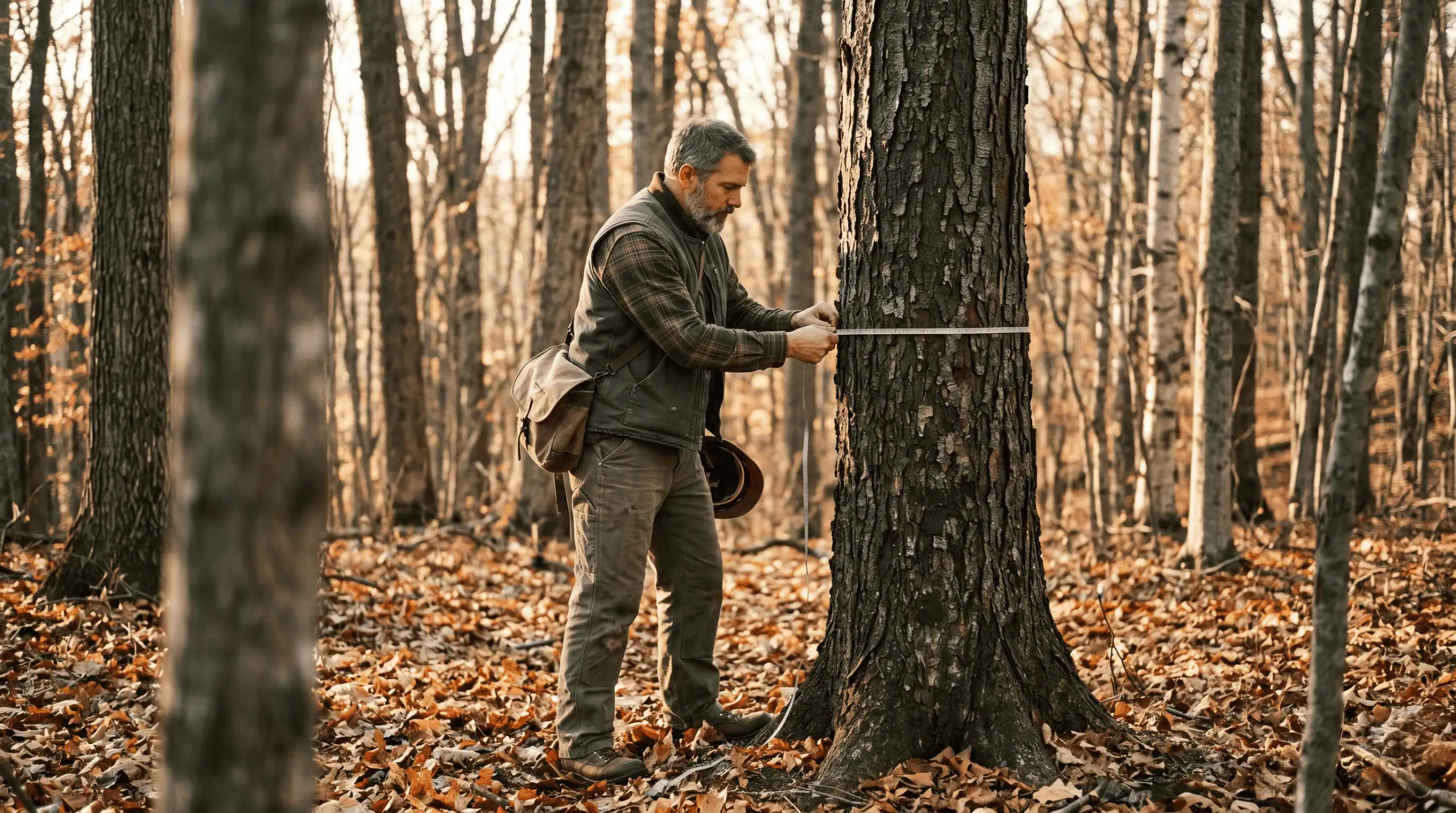
A timber value estimator calculates the worth of standing timber before a sale. Done right, it starts with a timber cruise — a systematic walk of your woodlot where every merchantable tree gets measured and recorded.
During a timber cruise, I record:
- Species — black cherry, red oak, hard maple, white ash, and others
- Diameter at breast height (DBH) — measured at 4.5 feet above ground
- Estimated log height — how many 8-foot or 16-foot logs the tree will yield
- Log grade — based on knots, straightness, sweep, and visible defect
From that data, I calculate board foot volume. I use standard log rules — Doyle or International are most common for hardwoods in this region. Then I apply current stumpage prices for each species and grade.
Stumpage is the price a buyer pays you per thousand board feet of standing timber. It varies by species, grade, and market conditions. A prime black cherry log brings far more than a cull log of the same species. Grade matters as much as volume.
The Factors That Shift Timber Value Most
Two woodlots with the same acreage can have very different timber values. Here’s what I look at when I walk a property.
Species composition is the biggest driver. Black cherry and hard maple are valuable in this region. Red oak has a solid market. White ash prices have dropped due to emerald ash borer pressure. Beech is nearly worthless commercially right now. Knowing your species mix matters before you talk to any buyer.
Log quality separates average timber from premium timber. A straight, clear 18-inch black cherry can be worth three times a knotty stem of the same diameter. Defect cuts value by 50% or more on individual trees.
Access and terrain affect what a logger can afford to pay you. Steep slopes, wet ground, and poor road access raise operating costs. Those costs come out of your stumpage price. Good skid trail access and a dry landing add real value.
Market timing plays a role. Hardwood prices in the Northeast have been volatile since 2020. What your neighbor got a few years ago may not apply today.
Why a Logger’s Bid Is Not a Timber Appraisal
A logger’s verbal offer is not an appraisal. It is a purchase offer. Those are very different things.
A purchase offer tells you what one buyer will pay. That’s on one day, under one set of conditions. It doesn’t tell you what your timber is worth. It doesn’t tell you whether you’re leaving money on the table.
An independent timber appraisal from a licensed consulting forester gives you the floor. It tells you what the timber should bring in a competitive market. It gives you data to evaluate any bid you receive.
I’ve seen first offers come in 30% below what a competitive bid process produced. The timber wasn’t worth less. The landowner just had no basis to negotiate.
What the Estimate Process Looks Like on Your Property
When a landowner in this region calls me about timber value, here’s my approach.
I start by walking the property to assess stand composition and overall timber quality. That first walk gives me a working sense of value before I put any tallies on paper.
For a formal timber cruise and estimate, I establish systematic sample plots across the stand. I measure trees and record species, grade, and volume. The results go into a written estimate with stumpage calculations based on current regional prices.
That estimate becomes your negotiating document. It’s the number you bring to the table when a buyer makes an offer. It tells you whether to accept, counter, or walk away.
This step comes first — before you call a logger, before you accept any offer. For a broader look at what drives timber value in New York, see my full guide: How Much Is My Timber Worth? A Landowner’s Guide.
Frequently Asked Questions
What is a timber value estimator?
A timber value estimator is a field-based process for calculating the worth of standing timber before a sale. It combines a systematic timber cruise — measuring species, volume, and log grade in the field — with current stumpage prices. The result is a written estimate you can use before any buyer is involved. An independent estimate from a licensed consulting forester gives you an objective number with no conflict of interest.
How much does a timber cruise cost in New York?
Costs vary by property size, terrain, and stand complexity. Most landowners in Sullivan, Orange, and Ulster Counties pay a few hundred to a few thousand dollars for a professional timber cruise and written estimate. That fee is almost always recovered in a higher stumpage payment at the time of sale. Contact me for an estimate based on your specific property.
Can I use a free online timber calculator instead?
Online timber calculators can give a rough sense of volume if you already know your species mix and tree sizes. But they don’t account for log grade, terrain, access, or current regional stumpage prices. They won’t tell you whether your black cherry is prime or cull. For a number you can actually negotiate with, you need a field-based estimate from a forester who knows what buyers in this market are paying.
How Environmental Forest Products Can Help
I offer independent timber value estimates and timber cruise services for private landowners in Sullivan County, Orange County, and Ulster County. I also serve Pike County and Wayne County in Pennsylvania, and Sussex County in New Jersey.
My estimates are based on field measurement — not guesses. I use regional stumpage data and I know what buyers in this market are actually paying. My job is to protect your interests, not a buyer’s margin.
Services I provide for timber sellers:
- Timber Value Estimator — field-based estimate before any sale
- Timber cruise and stand inventory
- Competitive bid process management
- Timber sale contract review
Ready to find out what your timber is actually worth? Request a timber estimate here — or call me directly.
(845) 754-8242
henry@eforestproducts.com
I serve landowners across Sullivan County, Orange County, and Ulster County NY, as well as Pike County and Wayne County PA, and Sussex County NJ.
Henry Kowalec is a licensed consulting forester and member of the Society of American Foresters with over 30 years serving private landowners in the Hudson Valley and Catskills. Environmental Forest Products | Westbrookville, NY 12785 | Licensed in NY, PA, NJ.