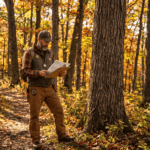
I get called out to look at overgrown fields and wooded lots all over Sullivan, Orange, and Ulster Counties. Almost every time, the landowner has already picked a clearing method before I show up. Half the time, they picked wrong.
Forestry mulching and traditional land clearing are not interchangeable. One grinds standing vegetation into mulch and leaves it on the ground. The other removes trees, stumps, and roots completely. Pick the wrong one and you pay for it twice — once for the work, and again when you fix what the first method couldn’t do.
Here’s how I walk landowners through the choice, based on what I’ve actually seen work and fail on properties across the Hudson Valley and Catskills.
What’s the Difference Between Forestry Mulching and Traditional Land Clearing?
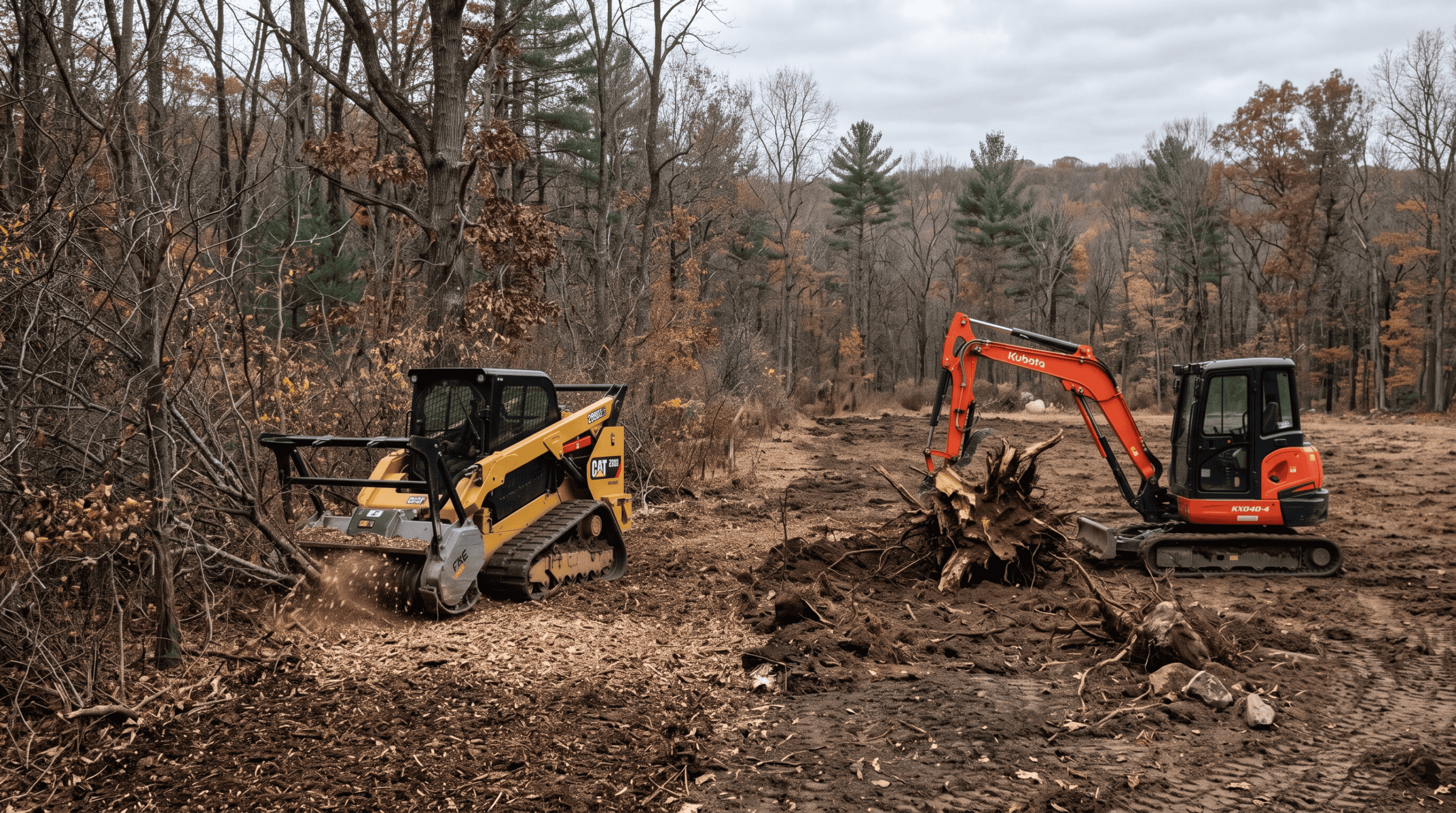
Forestry mulching uses a machine with a rotating drum head to grind trees, brush, and vegetation into mulch on site. Traditional land clearing uses excavators, dozers, and grapple equipment to pull out trees, stumps, and roots and haul the debris away.
Mulching leaves the ground covered and mostly undisturbed. Traditional clearing leaves bare soil. That single difference drives almost every decision I help landowners make.
I use mulching most often on properties where the owner wants to open up land without touching the topsoil. I use traditional clearing when the land needs to be truly bare — for a foundation, a septic field, or a driveway.
How Does Forestry Mulching Actually Work?
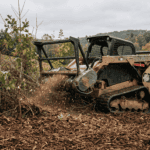
A mulching head mounted on a skid steer or excavator grinds standing brush and small trees into wood chips as it moves across the ground. The chips stay where they fall.
This works fast. I’ve cleared multiflora rose and autumn olive thickets in a single day that would have taken a crew a week to cut and haul by hand.
Mulching knocks back the visible growth of invasive brush in one pass. On properties in Sullivan County choked with Japanese barberry and multiflora rose, that’s often the first step. It does not always kill the plant outright.
How Does Traditional Land Clearing Work?
Traditional clearing pulls the whole plant out of the ground. An excavator digs out the stump and root ball. A dozer pushes debris into piles. Trucks haul what’s left off site, or the crew burns it, depending on the county and the burn permit rules.
This method costs more time and more machine hours. It also leaves exposed soil until something is planted or graded.
I recommend our traditional land clearing service when the end use of the land requires a stable, buildable surface. Mulching cannot give you that.
What Happens to Stumps and Roots With Each Method?
This is the question I get asked most, and it’s the real dividing line between these two methods.
Forestry mulching grinds the visible stump down close to grade, but the stump tissue below ground stays alive. That matters most with invasive shrubs. Japanese barberry and multiflora rose are not root-suckering plants — Penn State Extension confirms that if you kill the stem tissue, the roots die with it. The problem is that mulching alone usually doesn’t kill the stem tissue. It just removes what’s above ground.
Traditional land clearing removes the stump and the major root structure entirely. That’s why it’s the only real option before construction, septic work, or grading. You cannot pour a foundation over a root ball you didn’t pull.
When Does Forestry Mulching Fail?
Mulching fails when the landowner expects it to permanently kill invasive shrubs on its own. Penn State Extension is direct about this: mechanical mowing or top removal alone will not successfully control Japanese barberry, because it resprouts from stump tissue left in the ground.
I’ve walked back onto properties two seasons after a mulching job and found barberry pushing new stems right up through the mulch layer. The plant didn’t come back from spreading roots. It came back from the stump.
Mulching also struggles on land with heavy rock or ledge close to the surface. The mulching head can’t grind through stone, and operators end up skipping problem areas.
Mulching is the wrong call if your goal is permanent removal of established invasive shrubs in one visit. It’s the right call if your goal is opening sightlines, improving wildlife habitat, or knocking back brush as a first step before follow-up treatment.
Will the Land Grow Back the Same Way?
Land cleared by mulching tends to show new growth faster than traditionally cleared land, because stump and root tissue stays alive underground.
Japanese barberry and multiflora rose commonly resprout from the stump the same season or the next. Maine’s Department of Agriculture, Conservation and Forestry notes that cutting these shrubs causes re-sprouting, and persistent cutting or mowing across multiple growing seasons is needed to eventually kill the plant. Mulching without a follow-up plan just resets the clock.
Traditionally cleared land, with the stump and roots physically removed, doesn’t resprout from the old plant. Whatever grows back has to come from seed, which gives the landowner more control over what fills the space.
Which Method Costs More?
Cost depends on acreage, terrain, and what you’re clearing. Forestry mulching is generally faster per acre. Traditional clearing takes longer because of the digging, hauling, and disposal involved. [Specific dollar ranges TK — pending Henry confirmation. See our dedicated cost breakdown for current per-acre and per-hour pricing.]
The cheaper method up front is not always the cheaper method overall. If mulched invasive brush needs a second or third treatment to actually kill it, the total cost can pass what traditional clearing would have run.
Which Method Is Right for Your Property?
I ask landowners one question before recommending either method: what are you doing with this land afterward?
Forestry mulching fits these situations:
- Opening up overgrown fields or fence lines
- Improving deer and wildlife habitat
- Clearing brush as a first step before targeted invasive treatment
- Reducing wildfire fuel load near structures
Our land clearing services fit these situations:
- Preparing a site for a house, garage, or driveway
- Clearing for a septic system or leach field
- Removing invasive stumps and root systems permanently
- Any project requiring bare, buildable ground
When I walk a property, I look at the end goal first, then the terrain, then the vegetation. The method follows from those answers — not the other way around.
Frequently Asked Questions
Does forestry mulching remove stumps?
No, forestry mulching grinds the visible stump down but leaves the stump and root tissue alive in the ground. If you need the stump and roots fully removed, you need traditional land clearing.
Is forestry mulching cheaper than traditional land clearing?
Forestry mulching is usually faster per acre than traditional clearing. [Exact pricing TK — pending Henry confirmation.] Total cost depends on your acreage, terrain, and what’s growing on the land.
Can I build on land after forestry mulching?
Not without additional work. Mulching leaves stumps and root systems intact, which won’t support a stable foundation, septic system, or driveway base.
Will invasive brush grow back after forestry mulching?
Often, yes. Japanese barberry and multiflora rose are not root-suckering plants, but they commonly resprout from stump tissue left behind after mulching. Persistent follow-up treatment over more than one season is usually needed to kill them for good.
How Environmental Forest Products Can Help
I’ve spent over 30 years walking properties across Sullivan, Orange, and Ulster Counties, helping landowners choose the right clearing method for their goals — not just the fastest or cheapest one.
Before you hire anyone to clear your land, I can walk the property with you and tell you straight whether mulching or traditional clearing fits what you’re trying to do. If there’s merchantable timber on the property, I’ll also tell you whether it’s worth recovering before any clearing starts.
Learn more about our land clearing services, or request an estimate to get started.
Call (845) 754-8242 or email henry@eforestproducts.com. I serve landowners throughout Sullivan, Orange, and Ulster Counties, NY, plus Pike and Wayne Counties, PA, and Sussex County, NJ.
Henry Kowalec is a licensed consulting forester and member of the Society of American Foresters with over 30 years serving private landowners in the Hudson Valley and Catskills. Environmental Forest Products | Westbrookville, NY 12785 | Licensed in NY, PA, NJ.