Landowners ask me the same question almost every visit: what’s this going to cost? I understand why. Forestry mulching prices online range from a few hundred dollars an acre to several thousand, and none of those numbers tell you what your property will actually run.
That range exists because forestry mulching cost isn’t one number. It’s five or six variables stacked on top of each other — density, diameter, terrain, access, and acreage. Get the variables right and you can predict your budget within a reasonable range before I ever walk the property.
Here’s what actually drives the price, based on what I look at on every job across Sullivan, Orange, and Ulster Counties.
What Actually Drives Forestry Mulching Cost?
Forestry mulching cost comes down to how long the machine has to work and how hard it has to work while it’s there. Five factors set that: vegetation density, tree diameter, terrain, site access, and total acreage.
I walk every property before I quote it, because a satellite photo can’t tell me what’s actually growing on the ground. Two 5-acre parcels can price completely differently depending on what’s standing on them.
Our land clearing services price every job this way — by what’s actually on the ground, not a flat per-acre rate pulled from a national average.
Is Forestry Mulching Priced Per Acre or Per Hour?
Forestry mulching gets quoted both ways, depending on the job. [Specific dollar figures for both pricing methods TK — pending Henry confirmation.]
Per-acre pricing works best for larger, more uniform jobs — an old hayfield growing back in, or a fence line overrun with brush. The density is consistent across the parcel, so a per-acre number is a fair way to quote it.
Per-hour pricing works better for smaller or mixed-condition jobs, where density changes a lot across a short distance. A half-acre building envelope with scattered mature trees is a per-hour job, not a per-acre one.
How Does Vegetation Density Change the Price?
Density is the single biggest driver of forestry mulching cost. Light brush and small saplings move fast. Dense stands of small-diameter hardwood or thick invasive shrub cover move slow.
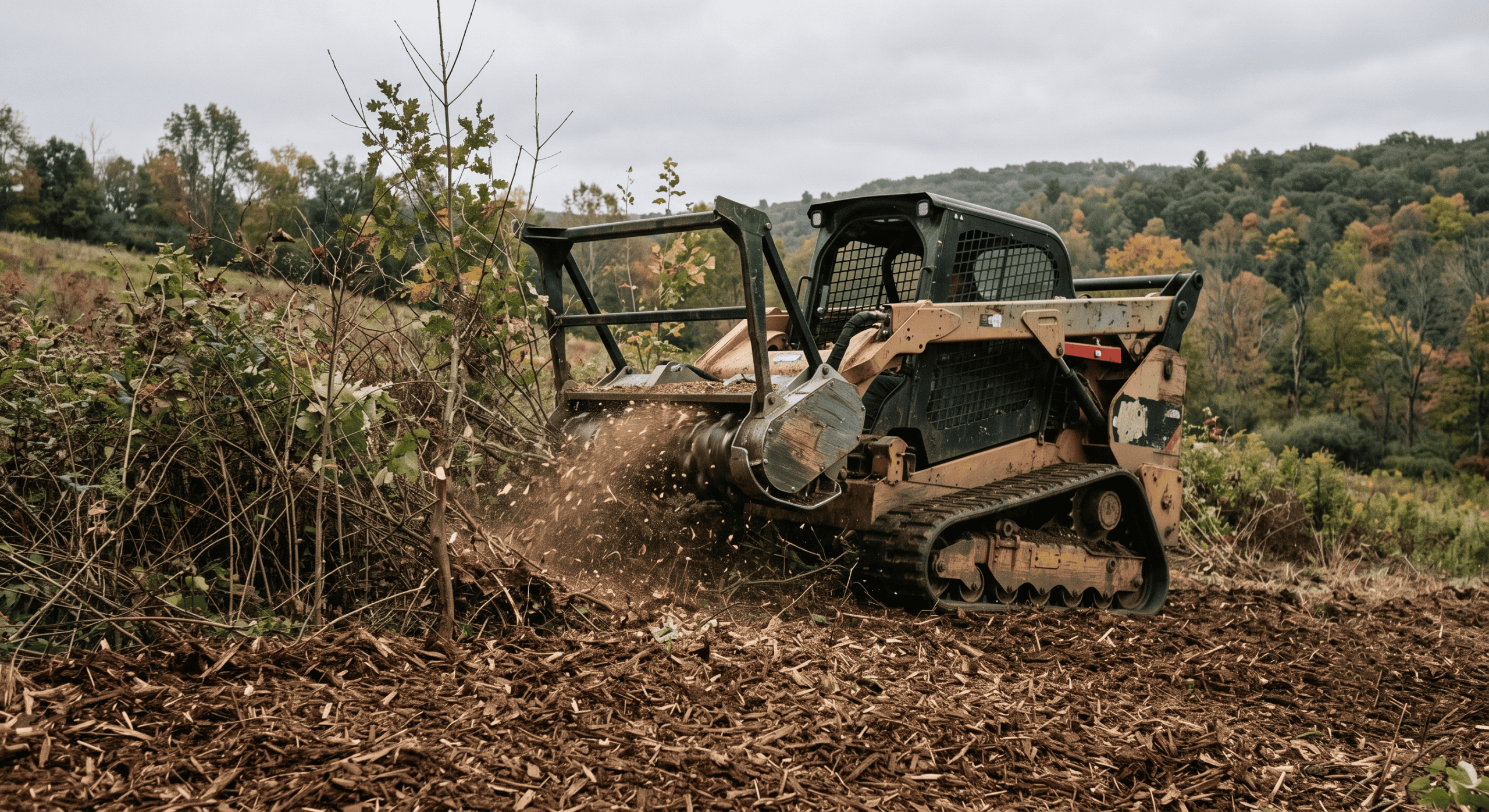
I’ve mulched an acre of old hayfield regrowth — mostly saplings under 4 inches across — in under an hour. A dense acre of mixed hardwood with heavy limb cover and closed canopy can take a full day with the same machine.
That’s not a small difference. It’s the difference between a quick job and a multi-day one on the same size parcel.
Does Tree Diameter Affect the Cost?
Yes. Tree diameter, measured at breast height (DBH), is a standard way foresters and equipment operators size up a job before the machine ever shows up.
Fecon, a forestry mulching equipment manufacturer, breaks this down by machine class: a standard-flow skid steer head handles brush and trees up to about 4 inches DBH, a high-flow head handles 6 to 8 inch trees comfortably, and extra-high-flow setups reach into 10-inch material. Larger excavator-mounted heads handle bigger material still, though the exact upper limit depends on the specific machine.
A property with mostly saplings and brush mulches with a standard or high-flow head. A property with scattered larger hardwoods needs a bigger head class, which changes the machine-hour cost.
Does Terrain or Access Change the Price?
Terrain and access change how much ground the machine can cover in a day, which changes the price.
Flat, dry, accessible ground is the easiest and fastest condition to work in. Steep slopes, wet or soft ground, and rocky terrain all slow the machine down and increase wear on the equipment.
Remote sites, or sites with no clear equipment access, sometimes carry a mobilization cost on top of the mulching work itself. [Mobilization fee specifics TK — pending Henry confirmation.]
Does Acreage Size Change the Per-Acre Rate?
Generally, yes. Larger jobs tend to run a lower per-acre rate than small ones, because mobilization and setup time get spread across more acreage.
A one-acre job still requires the same trailer, transport, and setup time as the first acre of a ten-acre job. On a larger project, that fixed cost is a smaller share of the total price.
[Specific volume-discount ranges TK — pending Henry confirmation.]
Is Forestry Mulching Cheaper Than Traditional Land Clearing?
Usually, per acre, yes — mulching eliminates the hauling, disposal, and multi-machine crew that traditional clearing requires. But that comparison only holds if mulching actually accomplishes what you need done.
Mulching leaves the stump and root system in the ground… I cover this trade-off in detail in my article on forestry mulching versus traditional land clearing — link to come once that article publishes at its live blog.eforestproducts.com URL.
Frequently Asked Questions
How much does forestry mulching cost per acre?
[Answer pending Henry confirmation — dollar figures TK.] Price per acre depends mainly on vegetation density, tree diameter, and terrain, which is why a flat national number doesn’t apply to every property.
Is forestry mulching charged by the hour or the acre?
Both, depending on the job. Larger, uniform-density parcels are usually quoted per acre, while smaller or mixed-condition sites are often quoted per hour.
Does tree size affect forestry mulching cost?
Yes. Standard mulching heads handle trees up to about 6 to 8 inches in diameter efficiently, while larger trees require heavier equipment or separate cutting, which adds cost.
Is forestry mulching cheaper than traditional land clearing?
Usually cheaper per acre, since it skips hauling and disposal. But mulching leaves the stump and roots in place, so it isn’t a substitute for traditional clearing if you need bare, buildable ground.
How Environmental Forest Products Can Help
I’ve priced forestry mulching jobs across Sullivan, Orange, and Ulster Counties for over 30 years, and I don’t quote a property until I’ve walked it. A satellite image or a national average number won’t tell you what your land actually needs.
If you want an accurate number for your specific property, I’ll walk it with you and account for density, diameter, terrain, and access before I give you a figure.
Learn more about our land clearing services, or request an estimate to get started.
Call (845) 754-8242 or email henry@eforestproducts.com. I serve landowners throughout Sullivan, Orange, and Ulster Counties, NY, plus Pike and Wayne Counties, PA, and Sussex County, NJ.
Henry Kowalec is a licensed consulting forester and member of the Society of American Foresters with over 30 years serving private landowners in the Hudson Valley and Catskills. Environmental Forest Products | Westbrookville, NY 12785 | Licensed in NY, PA, NJ.