More than once, I’ve walked onto a property where the landowner already booked an excavator. Nobody checked if the job needed a permit first. That’s a backwards way to plan.
In New York, wetland rules and local ordinances can stop a land clearing job cold. The fines for clearing without a permit are real.
This isn’t a simple yes-or-no question. What you need depends on what’s on your property, how big it is, and which town you’re in. Here’s how I walk landowners through it, and where the rules actually come from.
What Permits Does Land Clearing in New York Actually Require?
Land clearing in New York can trigger permits at three levels. NYSDEC regulates state wetlands. The Army Corps of Engineers regulates federal wetlands. Your town or county may add its own ordinance on top of both.
There is no single statewide “land clearing permit” that covers every property. Find out which of these three actually touch your parcel before you schedule any land clearing work.
Does NYSDEC Regulate the Wetlands on My Property?
The state doesn’t regulate every wetland in New York. Under the Freshwater Wetlands Act (Environmental Conservation Law Article 24), NYSDEC’s Freshwater Wetlands Program generally covers wetlands 12.4 acres or larger. It also covers smaller wetlands DEC designates as “Unusual Importance.” [Regulatory thresholds TK — Henry to confirm current figures before publish.]
NYSDEC finalized revised regulations at the end of 2024. Those regulations drop the acreage threshold to 7.4 acres starting January 1, 2028. Two separate wetlands can also count as one wetland for jurisdiction purposes. That happens when they’re hydrologically connected and sit within about 50 meters of each other.
Federal wetland regulation runs separately from the state’s. The Army Corps of Engineers can apply its rules regardless of a wetland’s size. A property can clear state jurisdiction and still face federal wetland restrictions.
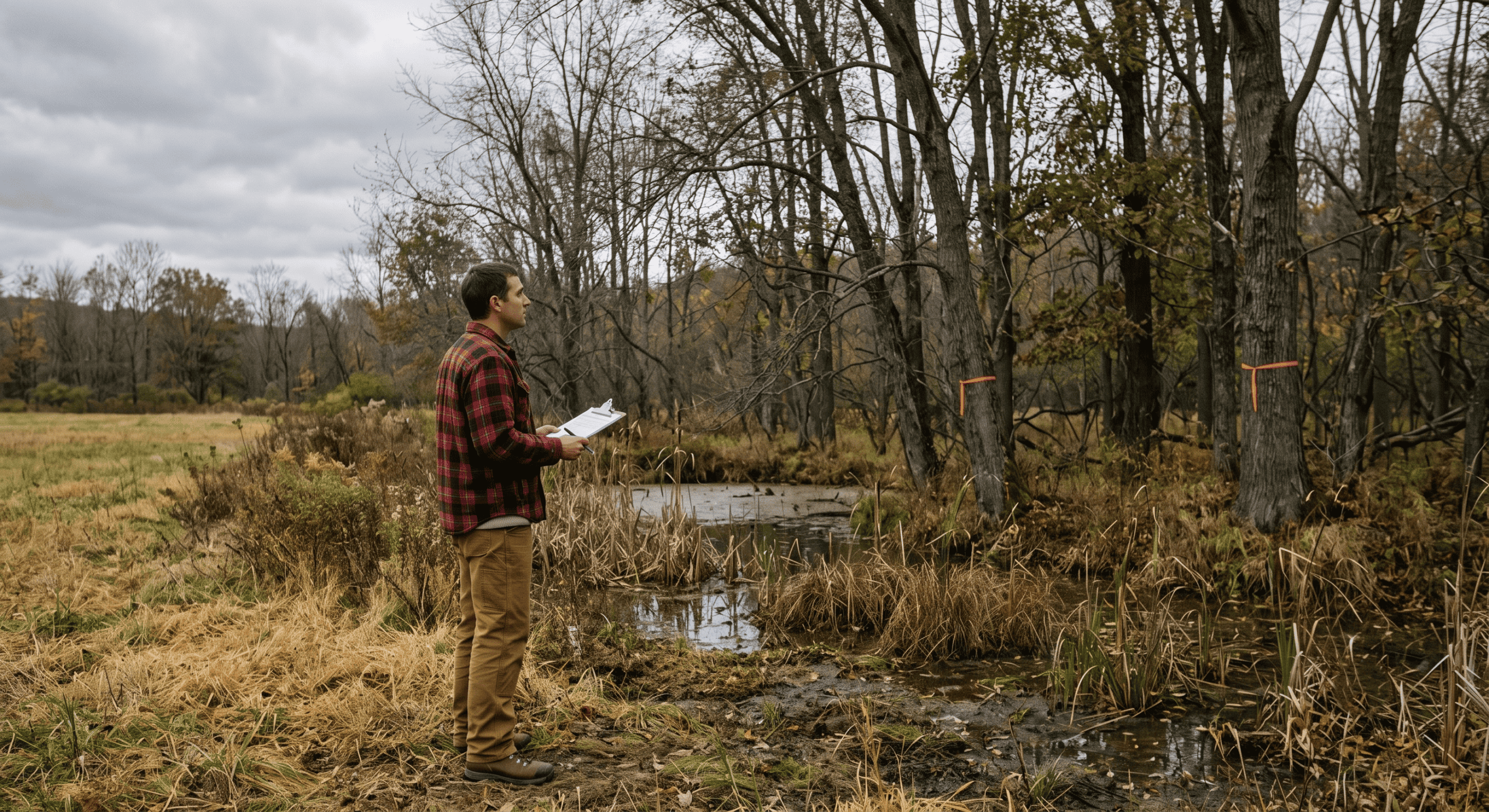
What Is the 100-Foot Adjacent Area, and Does It Affect Land Clearing?
Yes, it does. NYSDEC regulates a 100-foot adjacent area around every jurisdictional wetland. DEC measures this buffer horizontally from the wetland boundary, according to NYSDEC’s Freshwater Wetlands Permits page. DEC treats activities inside that 100 feet the same as activities inside the wetland itself.
DEC can extend that buffer beyond 100 feet for certain sensitive wetlands. Nutrient-poor bogs and vernal pools that support amphibian breeding are two examples. DEC makes that call case by case. [Specific buffer distances for any given property TK — confirmed through a jurisdictional determination, not assumed from general rules.]
This is the part landowners miss most often. Your project doesn’t have to touch the wetland directly to need a permit. If it falls inside that adjacent area, DEC regulates it.
Is Cutting Trees on My Own Land Always Regulated?
No, not always — but the exemption is narrower than most landowners assume. Article 24 excludes selective timber cutting from the permit requirement. That exclusion only applies if the land is in active agricultural or silviculture use.
The exclusion does not cover clear cutting. NYSDEC’s own Freshwater Wetlands Permits page lists clear cutting inside a wetland as a regulated activity. It requires a permit. The line between “selective cutting” and “clear cutting” is exactly where I see landowners run into trouble.
Ask yourself one question. Are you removing everything, or harvesting selectively? If you’re clearing everything inside a wetland or its adjacent area, assume you need a permit until you confirm otherwise.
Do Local Towns Have Their Own Clearing Rules?
Often, yes. Many New York towns run their own tree clearing, site plan, or land disturbance ordinances. These apply on top of DEC rules. [Specific town and county ordinance thresholds TK — vary by municipality; Henry confirms current local requirements per project.]
Local rules can be stricter than the state’s. They apply even on properties with no wetlands at all. Your property can sit completely outside DEC’s jurisdiction and still need town approval before you clear it.
What Happens If I Clear Land Without a Required Permit?
NYSDEC can pursue civil penalties for unpermitted clearing. The Department can also require you to restore any wetland functions the clearing damaged, per its Freshwater Wetlands Enforcement Policy (DEE-6). [Specific penalty amounts TK — Henry confirms current figures before publish.]
The Department’s stated goal is straightforward. Restore what the violation damaged, and remove any benefit the landowner gained by skipping the permit process. A landowner who clears without checking first often pays twice — once for the violation, once for the cleanup.
I’d rather get this right before the equipment shows up. Our land clearing team checks jurisdiction before we schedule work, not after.
How Do I Find Out If My Property Has Regulated Wetlands?
Request a Jurisdictional Determination (JD) from NYSDEC. In this formal review, the Department confirms whether a state-regulated wetland sits on your property. If one does, DEC maps its boundary and adjacent area.
New York generally offers two levels of review: a simpler parcel-level check, and a full boundary delineation. [Exact JD process steps flagged for re-verification directly against NYSDEC’s own JD request page before publish — see hallucination check.] Start with the simpler review if you just need a yes-or-no answer.
Frequently Asked Questions
Do I need a permit to clear land in New York?
It depends on your property and your town. Check whether you have a state or federal wetland, and whether your town has its own clearing ordinance. No single statewide permit covers every property.
How close can I clear trees to a wetland in New York?
NYSDEC regulates a 100-foot adjacent area around jurisdictional wetlands. That buffer can run larger for certain sensitive wetland types. DEC treats clearing inside that area the same as clearing inside the wetland.
Can I cut trees on my own property without a permit?
Often, yes, for selective timber cutting on land in active agricultural or silviculture use. Clear cutting inside a regulated wetland or its adjacent area doesn’t qualify for that exclusion, and it typically requires a permit.
How do I find out if my property has a regulated wetland?
Request a Jurisdictional Determination from NYSDEC. This formal review confirms whether a state-regulated wetland exists on your parcel, before you plan any clearing work.
How Environmental Forest Products Can Help
I’ve walked properties across Sullivan, Orange, and Ulster Counties for over 30 years. Permit questions come up on almost every job near water, wetlands, or town-regulated parcels.
Before you schedule equipment, I can help you sort out what you actually need. That might mean a DEC permit, a local town approval, or both. I can also tell you whether a jurisdictional determination is worth requesting first.
Learn more about our land clearing services, or request an estimate to get started.
Call (845) 754-8242 or email henry@eforestproducts.com. I serve landowners throughout Sullivan, Orange, and Ulster Counties, NY, plus Pike and Wayne Counties, PA, and Sussex County, NJ.
Henry Kowalec is a licensed consulting forester and member of the Society of American Foresters with over 30 years serving private landowners in the Hudson Valley and Catskills. Environmental Forest Products | Westbrookville, NY 12785 | Licensed in NY, PA, NJ.