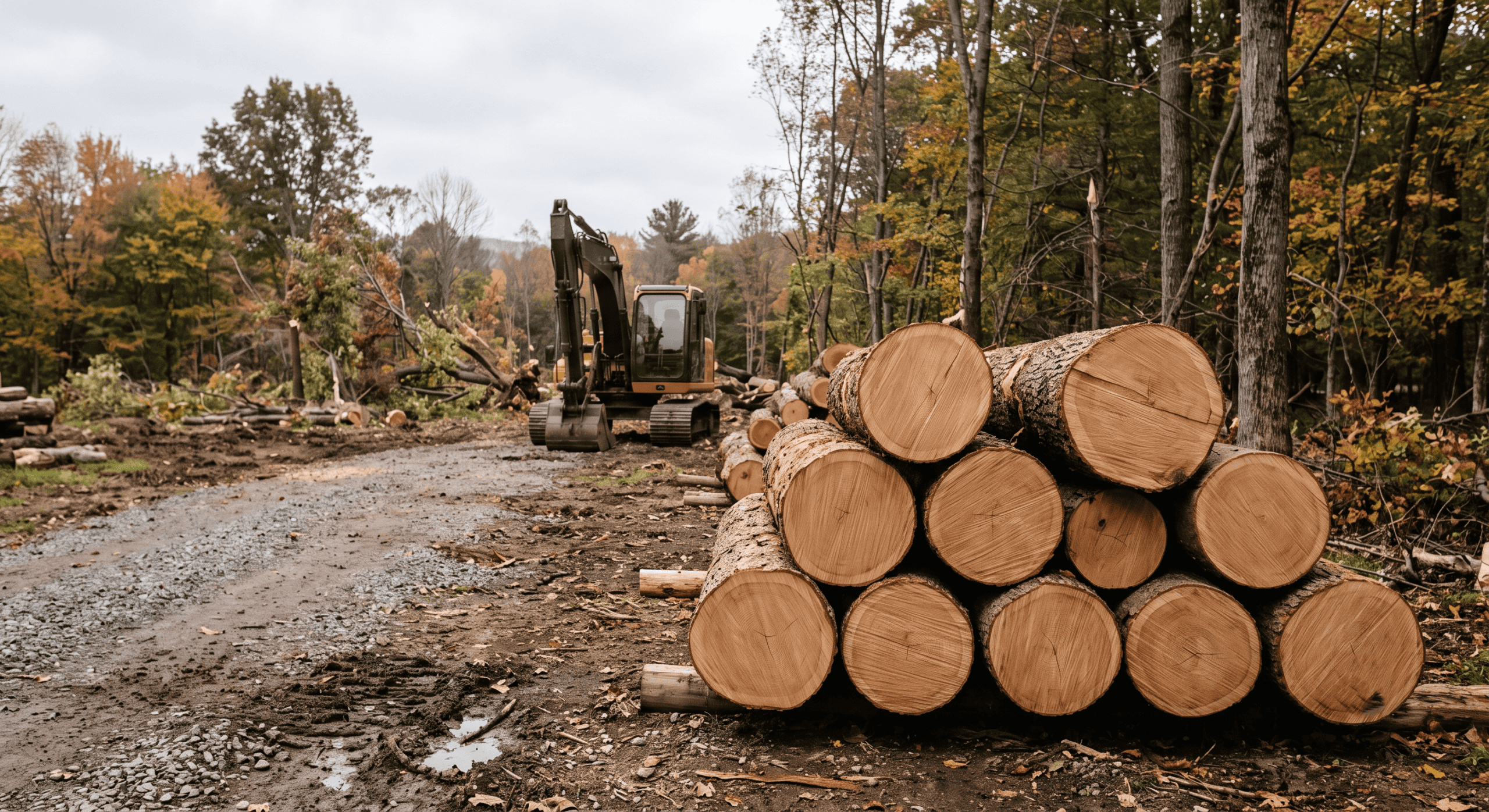
I’ve stood on the edge of a property in Sullivan County and watched a excavator push a stand of mature oak and cherry into a burn pile. Nobody had looked at what that timber was worth first. That wood had real value, and it went up in smoke along with the brush.
Not every clearing job has merchantable timber worth recovering. But when it does, the difference between a forester-led job and a straight excavator job can be the difference between clearing costing you money and clearing paying for part of itself.
Does Land Clearing Really Have Merchantable Timber Value?
Sometimes, yes, and it depends entirely on what’s standing on the lot. Mature hardwood — oak, cherry, maple, ash — can have real sawlog or veneer value. Small-diameter trees, brush, and low-grade timber usually don’t.
New York State publishes a Stumpage Price Report through NYSDEC twice a year, broken out by region, including the Delaware/Catskill and Hudson/Mohawk regions that cover our service area. The report itself is direct about its limits: it’s a rough guide to standing timber values, not a substitute for an appraisal by a forest professional. That’s exactly the point. A regional average tells you timber has value in this area. It doesn’t tell you what your specific stand is worth.
What Happens to Timber When a Clearing Contractor Handles It Directly?
Most land clearing contractors are equipped to remove trees, not market them. Their job is to open up the ground, and the fastest way to do that is to push everything into a pile and burn or haul it as debris.
That’s not a knock on clearing contractors. It’s not their job to know what a stand of cherry is worth to a sawmill or veneer buyer. But if nobody looks at the timber before the excavator starts, merchantable wood gets treated the same as brush, every time.
How Do You Find Out What Your Timber Is Worth Before Clearing?
Have a licensed forester walk the property and assess the stand before any clearing equipment is scheduled. That assessment tells you what species and volume you actually have, not just what the regional stumpage average suggests.
Our land clearing services start with that walk-through on any property with mature timber, before we recommend a clearing plan. Some jobs are worth a full timber sale first. Others aren’t, and I’ll tell you that directly instead of running a sale that isn’t worth the effort.
Does a Consulting Forester’s Fee Pay for Itself?
Often, yes, when there’s real merchantable timber involved. New York State’s own forestry program materials state plainly that a timber harvest almost always generates more income when a forester assists with the marketing, and that professional assistance frequently pays for itself through the increased return on the sale.
A key reason for that: an independent consulting forester works for the landowner, not for a timber buyer. According to New York’s Find a Forester guidance, that’s a meaningful distinction — a forester marketing your timber to multiple buyers is working to get you the best price, where a single buyer or a clearing contractor handling the wood directly has no obligation to do that.
[Specific forester fee structures and expected returns TK — Henry to confirm his own rate structure and typical outcomes before publish.]
What’s the Difference Between a Timber Sale and Land Clearing?
A timber sale is a marketed sale of standing timber to the highest qualified bidder, run by a forester who represents the landowner. Land clearing is a site-prep service focused on opening up ground, where any timber removed is usually treated as debris unless someone flags it beforehand.
On a property with real merchantable timber, I generally recommend running the timber sale first, then bringing in clearing equipment for what’s left. Doing it in that order means the equipment operator isn’t burning wood that should have gone to a mill.
When Is There Little or No Timber Value to Recover?
If the property is mostly brush, saplings, or low-grade timber, there often isn’t much to recover, and a full timber sale process wouldn’t be worth the time it takes to run one. I tell landowners this directly rather than running an appraisal that won’t change the outcome.
The same is true on small parcels, or stands that have been heavily high-graded in the past, leaving mostly poor-quality trees behind. A quick walk-through is usually enough to tell which situation you’re in before you spend money finding out formally.
Frequently Asked Questions
Does clearing land ever pay for itself through timber value?
Sometimes, if the property has mature merchantable timber like oak, cherry, or maple. Properties with mostly brush or small-diameter trees usually don’t have much recoverable timber value.
Should I get my timber appraised before clearing?
Yes, if there’s visibly mature timber on the property. A forester’s walk-through before clearing starts is the only way to know whether a timber sale is worth running first.
What’s the difference between hiring a forester and hiring a clearing contractor?
A consulting forester works for you and markets your timber to multiple buyers to get the best price. A clearing contractor’s job is opening up the ground, and any timber they remove is typically treated as debris unless it’s flagged beforehand.
Does a forester’s fee cost more than it’s worth?
Often it pays for itself when real merchantable timber is involved, since a marketed sale to multiple buyers typically returns more than treating the timber as debris. On properties with little merchantable timber, the fee may not be worth it, and I’ll tell you that upfront.
How Environmental Forest Products Can Help
I’ve walked properties across Sullivan, Orange, and Ulster Counties for over 30 years, looking at what’s standing before any clearing equipment shows up. Some jobs have real timber value worth recovering. Others don’t, and I’ll tell you which one you’re looking at honestly.
If there’s merchantable timber on your lot, I’ll assess it before recommending a clearing plan, and I’ll run the timber sale first if it makes sense to.
Learn more about our land clearing services, or request an estimate to get started.
Call (845) 754-8242 or email henry@eforestproducts.com. I serve landowners throughout Sullivan, Orange, and Ulster Counties, NY, plus Pike and Wayne Counties, PA, and Sussex County, NJ.
Henry Kowalec is a licensed consulting forester and member of the Society of American Foresters with over 30 years serving private landowners in the Hudson Valley and Catskills. Environmental Forest Products | Westbrookville, NY 12785 | Licensed in NY, PA, NJ.