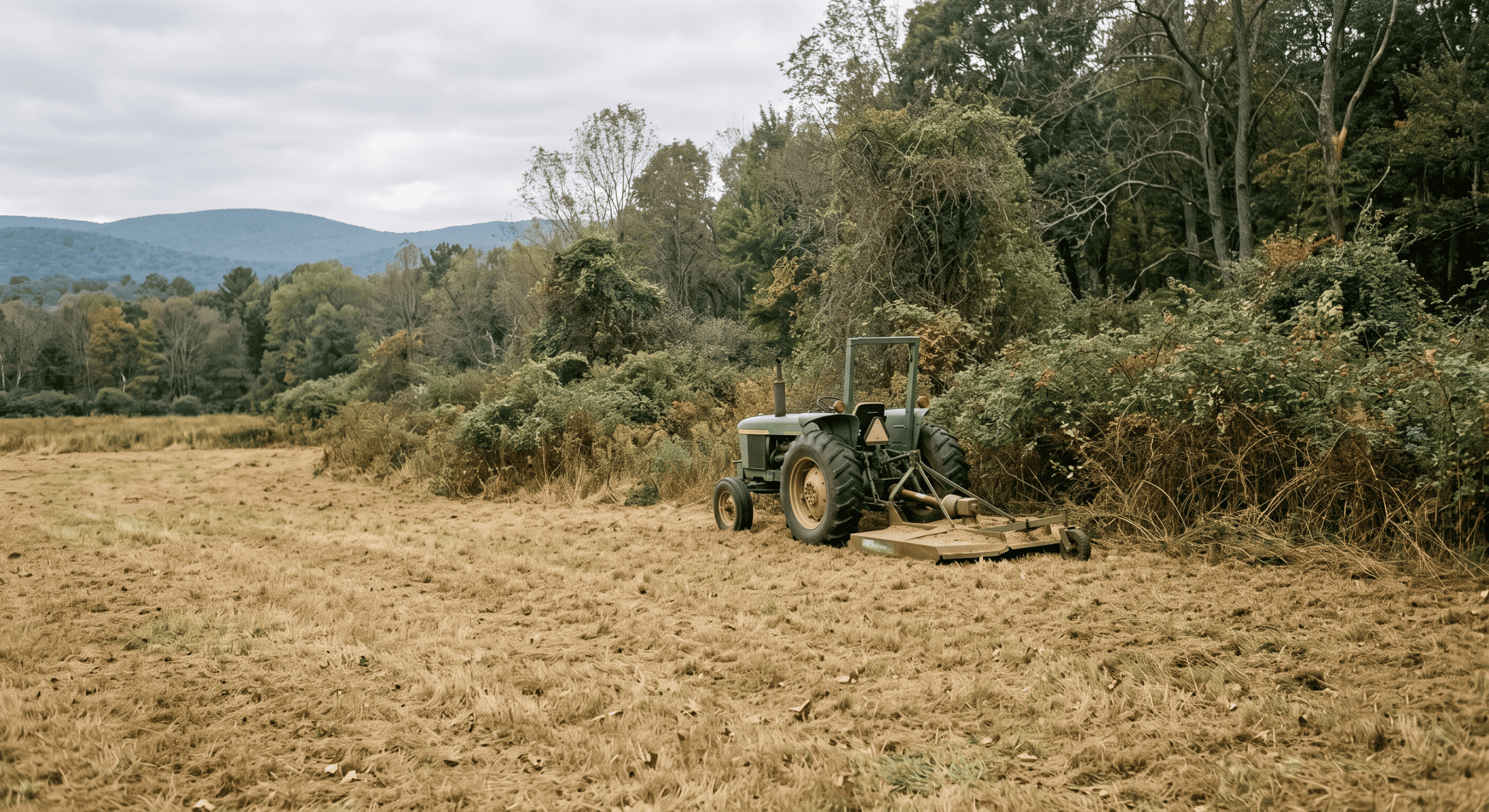
I get called out to old hayfields and pastures all over Sullivan County that haven’t been mowed or grazed in five, ten, sometimes twenty years. The owner wants it back to open field. What they usually don’t expect is how much of that brush is going to fight to come back.
Reclaiming overgrown pasture isn’t just running a bushhog through it once. Done right, it’s a sequence: clear it, treat the regrowth, and keep it from reverting. Skip a step and you’re mowing the same brush again in two years.
What Does “Reclaiming” Overgrown Pasture Actually Involve?
Reclaiming a field means removing woody brush and invasive shrubs down to the point where grass and forage can compete again, then keeping that brush from coming back. That’s different from a one-time brush hog pass, which knocks vegetation down but usually doesn’t kill it.
The USDA Natural Resources Conservation Service classifies this work under Brush Management (Conservation Practice 314), a national standard for reducing or removing woody vegetation on pasture, range, and associated agricultural land. Our land clearing services follow that same sequence: clear the brush, then plan for what stops it from returning.
Why Do Fields and Pastures Grow Back In With Brush in the First Place?
Fields grow back in because nothing is stopping them. Mowing, grazing, or haying all interrupt woody plants before they establish. Once that stops, brush and invasive shrubs move in within a few seasons.
On Sullivan County properties I’ve walked, the usual offenders are multiflora rose, autumn olive, and Japanese barberry. All three spread fast in an unmanaged field, and all three are tough to remove completely once they’re established.
Does Mowing Alone Reclaim Overgrown Pasture?
No, not by itself. Penn State Extension is direct on this point: none of the common invasive shrubs found in this region are root-suckering species, meaning if you kill the stem tissue, the roots die with it. But a single mowing pass doesn’t kill that stem tissue. It just knocks the plant down.
For species like Japanese barberry specifically, Penn State Extension notes that mechanical mowing or top removal alone will not successfully control the plant, since it resprouts from stump tissue left in the ground. Repeated mowing across more than one growing season is what eventually exhausts the plant, not a single pass.
What Is NRCS Brush Management, and Does It Apply to Your Field?
NRCS Brush Management is a federal conservation practice standard covering the removal of woody, invasive, and noxious plant species from pasture, range, and forest land to restore desired plant communities. It’s implemented through mechanical, chemical, or biological methods, alone or combined.
Some brush management work on agricultural land can qualify for federal cost-share support through NRCS programs. [Program eligibility and current funding availability TK — Henry to confirm current status with the local NRCS office, since program funding and criteria change.] Whether a specific property qualifies depends on the resource concern and current program funding, which changes year to year.
What Drives Brush Clearing Cost on a Reclamation Job?
Brush density and how established the invasive shrubs are drive most of the cost difference on a reclamation job. A field with scattered young brush clears faster and cheaper than a field with a decade of established multiflora rose and autumn olive thickets.
Whether the job is a one-time clearing pass or a full reclamation sequence changes the cost picture too. A property that needs a first clearing pass, a follow-up treatment, and ongoing mowing to hold the line costs more upfront than a quick brush hog job, but it’s the difference between the field staying open and reverting in two years. [Specific dollar figures TK — pending Henry confirmation.]
How Do You Keep Reclaimed Pasture From Growing Back In?
Ongoing mowing, grazing, or haying is what keeps a reclaimed field open. Whatever stopped in the first place needs to resume, or the same brush cycle starts over.
On pastures with active grazing, NRCS’s own Prescribed Grazing standard outlines managing livestock movement and rest periods to maintain desired forage and plant cover over time. On fields without livestock, a regular mowing schedule does the same job of preventing woody plants from re-establishing.
Frequently Asked Questions
Does mowing get rid of brush permanently?
No, a single mowing pass knocks brush down but usually doesn’t kill it. Species like multiflora rose and Japanese barberry resprout from stump tissue after mowing and need repeated treatment across more than one growing season.
How much does it cost to clear brush from an overgrown field?
[Answer pending Henry confirmation — dollar figures TK.] Cost depends mainly on brush density, how established the invasive shrubs are, and whether the job includes follow-up treatment or just a one-time clearing pass.
Is there funding available to clear brush from pasture?
Sometimes, through NRCS Brush Management cost-share programs, depending on the resource concern and current program funding. Eligibility and funding availability change, so check with your local NRCS office directly.
How do I keep a reclaimed field from growing back in with brush?
Resume whatever stopped the brush from establishing in the first place — regular mowing, haying, or grazing. Without that upkeep, the same woody species typically return within a few seasons.
How Environmental Forest Products Can Help
I’ve reclaimed overgrown fields and pastures across Sullivan, Orange, and Ulster Counties for over 30 years, and I plan every job as a sequence, not a single pass.
Before we clear a field, I’ll walk it with you and tell you honestly what it’ll take to keep it open, not just what it takes to knock the brush down once.
Learn more about our land clearing services, or request an estimate to get started.
Call (845) 754-8242 or email henry@eforestproducts.com. I serve landowners throughout Sullivan, Orange, and Ulster Counties, NY, plus Pike and Wayne Counties, PA, and Sussex County, NJ.
Henry Kowalec is a licensed consulting forester and member of the Society of American Foresters with over 30 years serving private landowners in the Hudson Valley and Catskills. Environmental Forest Products | Westbrookville, NY 12785 | Licensed in NY, PA, NJ.