When a timber buyer knocks on your door and offers to buy your trees, he is not working for you. He works for a mill or a logging operation. His job is to buy your timber at the lowest price that keeps you from walking away.
That’s not a criticism. That’s his job. The problem is that most landowners in Sullivan, Ulster, and Orange County don’t know this going in. They think they’re getting a fair assessment. They’re getting an offer.
A consulting forester is the other side of that equation — the professional who works for you. Understanding the difference between these two roles is the most important thing you can know before a single tree is marked on your property.
What a Timber Buyer Actually Does
A timber buyer represents a mill, a sawyer, or a logging company. His employer needs raw material. The buyer’s job is to secure that material at a price that keeps the operation profitable.
Timber buyers are often knowledgeable about wood. Many have walked thousands of acres. Some can cruise a stand and estimate board footage accurately. That knowledge serves their employer — not you.
A timber buyer has no legal obligation to tell you your timber is worth more than he’s offering. He has no obligation to identify your best trees or advise you on what to hold back. His offer is what his company will pay — it is not an appraisal, and it is not a guarantee you’re getting fair market value.
In New York State, timber buyers are not required to hold a forestry license. There is no state certification that guarantees a buyer’s knowledge of silviculture, forest health, or long-term stand management. A buyer can operate with nothing more than a business relationship with a mill.
What a Consulting Forester Does — and Who Pays Them
A consulting forester is hired by the landowner. Full stop. I don’t work for mills. I don’t take commissions from logging companies. My fee comes from you — which means my advice goes to you.
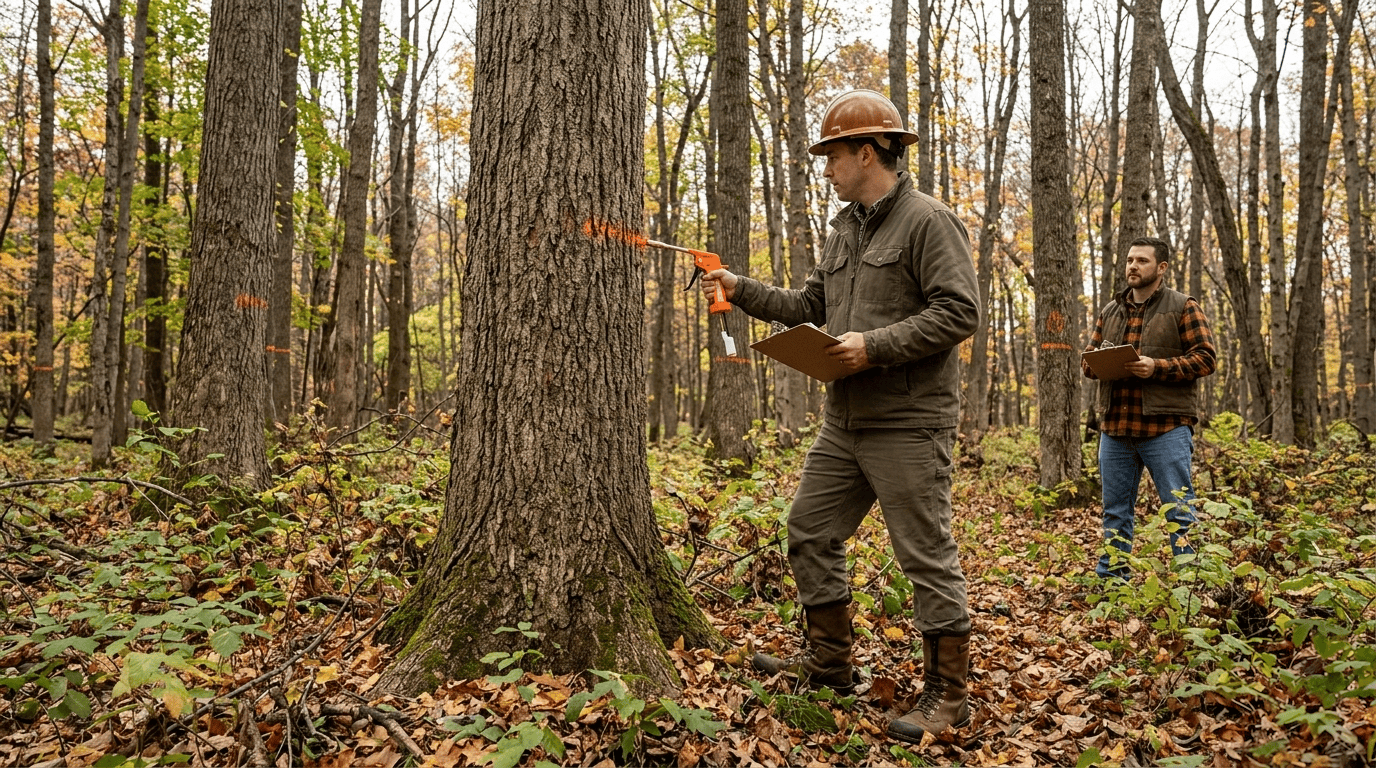
On a timber sale, a consulting forester typically handles the entire process:
- Walking and cruising the stand to estimate timber volume and value
- Marking trees for harvest based on silvicultural goals — not just what’s most valuable to a buyer
- Writing a timber sale contract that protects your property and your residual stand
- Putting the sale out for competitive bid among multiple buyers
- Monitoring the harvest on the ground to make sure the contract is followed
That competitive bid process alone often pays for the forester’s fee many times over. When buyers compete for your timber, you get market price. When one buyer names his own number without competition, you often don’t.
You can see exactly how I structure timber harvest services at Environmental Forest Products’ timber harvesting page.
The Conflict of Interest Nobody Talks About
Here’s the problem that rarely gets said out loud: a timber buyer who also marks your trees is working both sides of the transaction.
He decides which trees get cut. He decides what price to offer for them. And he works for the company that profits from paying you less.
I’ve seen this play out on properties across the Catskills. A landowner lets a buyer mark the timber. The best trees get cut — sometimes the only trees worth real money. The landowner walks away thinking they got a fair deal because they got a check. They don’t know what they left on the table, because nobody told them.
This isn’t fraud in most cases. It’s just asymmetric information. The buyer knows what your timber is worth. You don’t. A consulting forester closes that gap.
This is closely related to the risks I cover in my article on selective timber harvesting — specifically the difference between a properly marked harvest and a diameter-limit cut that strips your best timber.
What You Stand to Lose Without a Forester
The dollar figures are real. On a typical woodlot timber sale in Sullivan or Ulster County, a competitive bid process managed by a consulting forester commonly returns 15% to 40% more than a single-buyer offer. On a $30,000 sale, that’s $4,500 to $12,000 in additional income — for a service that typically costs a fraction of that.
Beyond the immediate dollars, there’s the forest you leave behind. Without a forester marking the harvest, your best trees go first. Your residual stand — the trees that will grow for the next 20 years — is what’s left after the buyer takes what he wants. That determines the value of every future harvest on your property.
I’ve walked properties in Orange and Sullivan Counties where one unmanaged timber sale set the woodlot back 30 years. The trees that were left were the ones nobody wanted. That’s not a recoverable situation in any short timeframe.
When a Timber Buyer Alone Might Be Acceptable
I’ll be straight with you: there are situations where working directly with a timber buyer carries lower risk.
If you have a very small woodlot — under 10 acres of merchantable timber — the forester’s fee may approach or exceed the value of the sale. In that case, I’d still recommend at least a one-time consultation to understand what you have before you negotiate.
If you have a long-standing relationship with a reputable local logging operation, and you’ve done multiple sales over years, you may have enough market knowledge to evaluate an offer yourself. That situation is rare, but it exists.
In most cases — a woodlot over 20 acres, a first timber sale, or any situation where you don’t have independent knowledge of current stumpage prices — hiring a consulting forester is the financially sound decision. The fee pays for itself.
For a full breakdown of how timber harvests are structured from start to finish, see my complete timber harvesting guide for private landowners.
Frequently Asked Questions
Does a timber buyer work for me?
No. A timber buyer works for a mill, logging company, or their own business. Their job is to acquire your timber at a price that works for their operation. They have no legal or professional obligation to represent your interests, advise you on what to hold back, or tell you your timber may be worth more than they’re offering.
How does a consulting forester get paid on a timber sale?
Most consulting foresters charge either a flat fee, an hourly rate, or a percentage of the timber sale proceeds — typically 8% to 15%. I work on a fee basis paid by the landowner. I take no commissions from buyers or mills. That structure keeps my advice entirely on your side of the transaction.
Can I negotiate directly with a timber buyer without a forester?
You can — but you’ll be negotiating without knowing the true market value of what you’re selling. A timber buyer knows current stumpage prices, log grades, and mill demand. Most landowners don’t. A consulting forester levels that information gap and runs a competitive bid process that puts market pressure on the buyer’s offer.
How Environmental Forest Products Can Help
I’ve managed timber sales across Sullivan, Ulster, and Orange Counties for over 30 years. I work for one party in every transaction: the landowner. Never the buyer. Never the mill.
If a timber buyer has already approached you — or if you’re thinking about a timber sale and want to know what your property is actually worth — call me before you sign anything.
Here’s what I can do:
- Walk your property and give you an honest assessment of your timber’s value
- Manage the full sale process: marking, bidding, contract, and harvest oversight
- Advise on whether your property qualifies for 480-a Forest Tax Law enrollment alongside the harvest
- Protect your residual stand so your next harvest is worth as much as this one
Request a Free Timber Sale Consultation
Call me directly: (845) 754-8242
Email: henry@eforestproducts.com
Serving Sullivan County NY, Ulster County NY, Orange County NY, Pike County PA, Wayne County PA, and Sussex County NJ.
Henry Kowalec is a licensed consulting forester and member of the Society of American Foresters with over 30 years serving private landowners in the Hudson Valley and Catskills. Environmental Forest Products | Westbrookville, NY 12785 | Licensed in NY, PA, NJ.