Every year, private landowners in New York sell timber and walk away with far less than their trees were worth — because they didn’t know what they had, didn’t know what it was worth, and had no one in their corner when it counted. This guide changes that.
I’ve been working with private landowners on timber sales across Sullivan, Ulster, and Orange Counties for over 30 years. In that time, I’ve seen every version of how a timber transaction can go. Some go well — the landowner gets fair value, the forest comes out in good shape, and the relationship between the landowner and the logger stays professional throughout. Many don’t go that way.
The difference almost always comes down to preparation. Landowners who do their homework before anyone picks up a chainsaw protect their timber value, their forest, and their financial interests in the transaction. Those who skip that step often don’t realize the cost until it’s too late to do anything about it.
This guide covers everything a private landowner needs to know before a timber harvest — what the process looks like, what the risks are, what a forester does to protect you, and what questions to ask before you sign anything.
Why Timber Harvesting Is Different From Every Other Decision You’ll Make About Your Land
Most decisions you make about your property are reversible. You can change your mind about where to put a fence. You can take down a structure you built in the wrong place. Or you can plant trees in a field that didn’t perform the way you expected.
A timber harvest is not reversible. The trees that come down stay down. If the wrong trees were removed — if the best timber left on a low price because the landowner didn’t know its value, or if the logger cut outside the agreed boundary, or if the residual stand was damaged in ways that affect its growth trajectory for decades — none of that gets fixed by going back and having a conversation. The consequences live in the forest for 30 to 50 years.
That permanence is why timber harvesting deserves a level of preparation that most other land decisions don’t. It’s also why the professional you work with before a harvest matters more than almost any other land decision you’ll make.
Understanding What You Have: The Timber Inventory
Before any conversation with a timber buyer, logger, or mill, you need to know what you’re actually selling. That requires a timber inventory — a systematic, field-based assessment of the species, sizes, volumes, and quality of the standing timber on your property.
A timber inventory tells you:
- Which species are present and in what volumes
- What size classes the merchantable timber falls into — critical for determining product type and value
- The quality grade of individual trees — defect, form, and log yield estimates
- Current market value of the standing timber by species and product
- Which trees are ready for harvest and which should be left to grow
Without a timber inventory, you have no way to evaluate any offer you receive. Instead, you’re negotiating based on what the buyer tells you your timber is worth — which is not an independent assessment of its value. A buyer’s job is to acquire your timber for as little as the transaction will bear. That’s not criticism; it’s how the business works. Your job, therefore, is to know what it’s actually worth before the conversation starts.
A licensed consulting forester conducts the inventory, prepares a timber appraisal, and delivers a documented, defensible assessment of your timber’s current market value. That document is your baseline for every negotiation that follows.
What Is a Timber Appraisal and Why It’s Non-Negotiable
A timber appraisal is a formal, written estimate of the market value of standing timber prepared by a licensed consulting forester. It quantifies what your trees are worth at current market prices, by species and product, before any sale agreement is made.
The appraisal serves multiple functions in a timber transaction:
It establishes your negotiating floor. Once you know what your timber is worth on the open market, you have a basis for evaluating any offer. If a buyer offers $30,000 for timber the appraisal values at $55,000, you know the offer is significantly below market — and you can either negotiate from that position or seek competing bids.
It identifies what to sell and what to keep. Not all timber is equally ready for harvest. Some trees are at peak market value now; others are still growing in value and should stay. As a result, the appraisal identifies which trees to include in the sale and which to reserve for future rotations — a distinction with enormous implications for the long-term productivity and value of your stand.
It documents the pre-harvest condition. If a logging operation causes damage — to residual trees, stream crossings, or areas outside the agreed cutting boundary — the appraisal provides the pre-harvest baseline needed to establish the value of that damage and pursue appropriate remedies.
It supports competitive bidding. A landowner with a timber appraisal can solicit competing bids from multiple buyers — mills, logging contractors, and timber companies. Competitive bidding consistently produces higher sale prices than single-source negotiations. Without an appraisal, competitive bidding isn’t possible because you have no common basis for comparing offers.
Choosing a Harvest Method: What It Means for Your Forest’s Future
The harvest method you choose — or allow a logger to choose for you — determines what your forest looks like for the next generation. It’s one of the most consequential decisions in woodland management, and most private landowners make it without understanding the options.
Selection Harvest
A selection harvest removes individual trees or small groups of trees across the stand, leaving the majority of the canopy intact. It’s the right method for stands managed on an uneven-aged basis — where the goal is to maintain multiple age classes and a continuous canopy cover. Selection harvesting favors shade-tolerant species like sugar maple and beech, which can regenerate under a partially closed canopy.
Done correctly, a selection harvest improves stand structure, releases crop trees from competition, creates regeneration gaps, and generates income — all simultaneously. Done poorly — or substituted for by high-grading, which removes only the best trees without regard to stand structure — it degrades the forest over time.
Shelterwood Harvest
A shelterwood harvest removes timber in two or more cuts over a period of years. The first cut opens the canopy enough to establish regeneration under the remaining trees. Subsequent cuts remove the sheltering trees once the regeneration takes hold. Shelterwood is the preferred method for regenerating species that need partial shade for establishment but more light as they grow — including oaks, which are the highest-value mast producers and some of the most important commercial timber species in the Hudson Valley and Catskills.
Shelterwood requires more planning and a longer time horizon than a single-entry harvest. It’s the right choice when regenerating a stand for the next rotation is as important as the immediate timber income.
Clearcut
A clearcut removes all merchantable timber from a defined area in a single operation. It’s the most misunderstood harvest method in private forestry — simultaneously overused by timber buyers who want maximum volume removed and unfairly condemned by landowners who associate it with ecological damage.
A well-designed clearcut on the right site — with appropriate size limits, proper slash management, and stream protections in place — is a legitimate silvicultural tool. For shade-intolerant species like aspen and birch, it’s the preferred regeneration method. Early successional wildlife habitat also benefits greatly from a well-placed clearcut. The problem isn’t the method itself; it’s applying the method to sites and situations where it doesn’t belong.
High-Grading: What It Is and Why It Damages Your Forest
High-grading is not a legitimate harvest method. It’s the practice of removing only the best-quality, highest-value timber from a stand — the straightest trees, the cleanest logs, the most desirable species — and leaving everything else behind. The forest that results has lost its most valuable genetic material. The trees that remain — the worst-formed, most disease-prone, lowest-value individuals — are what reproduce and dominate the next stand.
High-grading is common on private woodland in this region because it looks like a harvest and pays like a harvest in the short term. Buyers who high-grade don’t always advertise what they’re doing. In fact, some pitch it as “improvement cutting” or “cleaning up the woods.” The way to prevent it is to have a forester mark the harvest before any cutting begins — which takes the selection decision out of the buyer’s hands entirely.
The Role of a Consulting Forester in a Timber Sale
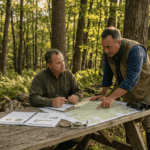
A timber buyer represents the buyer. A logging contractor represents the contractor. In a timber transaction, the only professional whose job is to represent you is a licensed consulting forester — and they’re the one most private landowners leave out of the process.
Here is what a consulting forester does in a timber sale:
Marking the Harvest
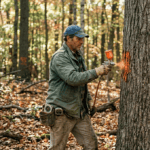
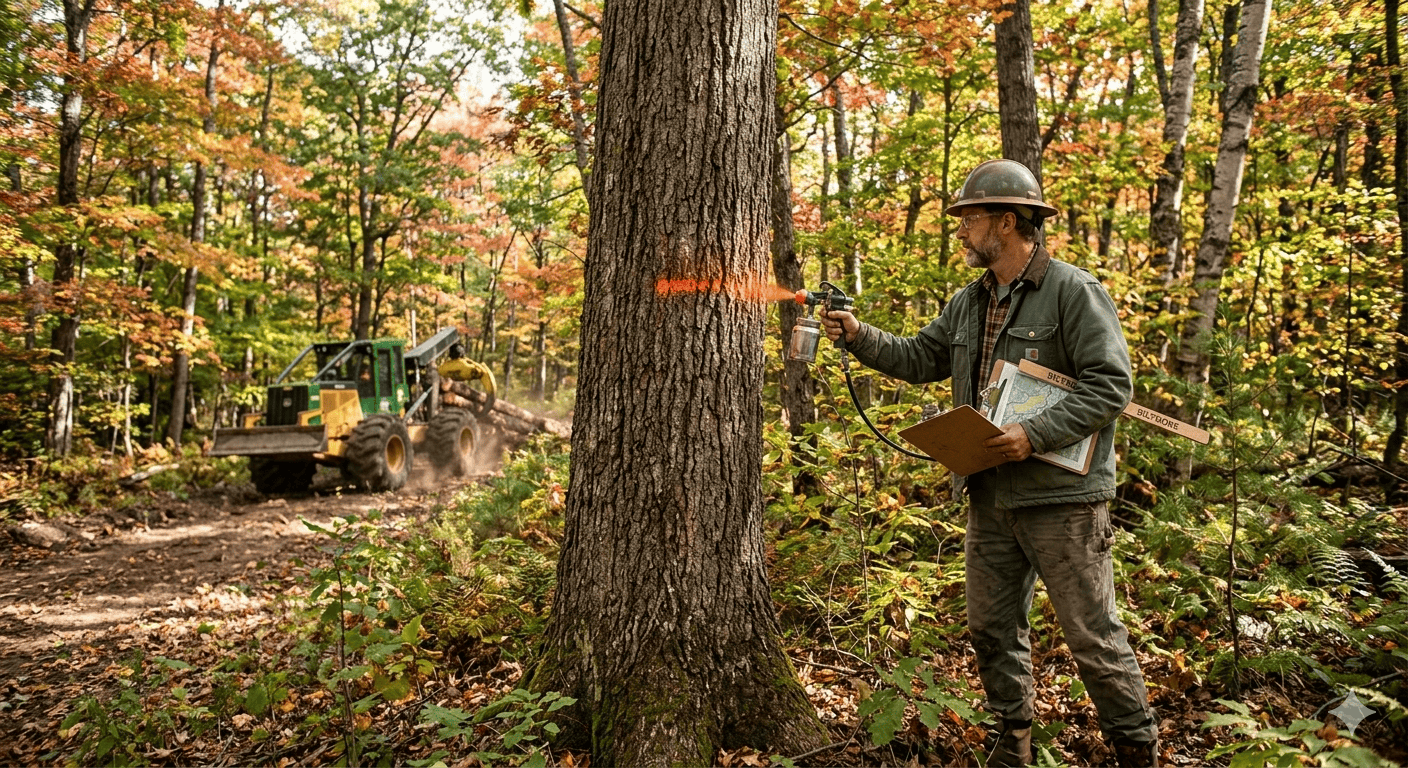
The forester walks the property and marks every tree to be cut — with paint, flagging, or both. The marked trees define the harvest. Each tree that falls should be marked; each marked tree should fall. Anything outside the marking is a contract violation. This single step is the most important protection a landowner has against high-grading and boundary violations.
Preparing the Timber Sale Contract
The timber sale contract is a legally binding document between the landowner and the buyer. It specifies the trees or volume sold, the sale price and payment terms, and the harvest method. It also names the logging practices required, the stream and wetland buffer requirements, the equipment restrictions, the cleanup and restoration obligations, and the dispute resolution process. A handshake agreement is not a contract. Neither is a one-page form the buyer’s company drafted. The forester should review the contract, and for significant sales, a real estate or timber law attorney should as well — because the contract needs to protect the landowner’s interests, not the buyer’s.
Soliciting Competitive Bids
With a marked harvest and an appraisal in hand, the forester solicits sealed bids from multiple qualified buyers. Competitive bidding consistently produces sale prices 20 to 40 percent higher than single-source negotiations on comparable timber volumes. The landowner reviews all bids, the forester advises on the relative merits of each offer, and the landowner makes the final decision.
On-Site Supervision
The forester makes site visits during the harvest operation — at minimum at the start of the job and at key decision points throughout. Site visits catch problems early: a logger working outside the marked boundary, a skid trail being pushed through a wetland buffer, a residual tree being damaged by careless felling. Problems caught early can be corrected. Problems discovered after the operation ends cannot.
Completion Review
When the harvest ends, the forester conducts a completion review — confirming that the operation removed all marked trees, followed the agreed logging practices, left stream crossings and buffers intact, and handled slash and debris according to contract. That review is the basis for releasing final payment and closing out the sale.
New York Timber Harvesting Laws and Landowner Rights
New York does not require a permit for most private timber harvests. However, several legal frameworks govern how harvesting can occur on private land in this state, and landowners should understand the ones that apply to their property.
Stream Crossing Requirements
New York’s stream disturbance regulations require permits for activities that disturb regulated streams and their adjacent areas. Any timber harvest that crosses a regulated stream with equipment — or that involves work in the riparian buffer — must comply with NYSDEC stream disturbance permit requirements. Violations carry significant penalties and restoration obligations.
Wetland Protections
New York State Freshwater Wetlands Act protections cover wetlands of a certain size and their adjacent areas. Logging activity in or near regulated wetlands requires NYSDEC review and, in many cases, a permit before work begins.
Deed Restrictions and Conservation Easements
Many properties in Sullivan, Ulster, and Orange Counties carry deed restrictions or conservation easements that limit or govern timber harvesting. Before any harvest, review the deed and any easement documents to confirm that the planned work complies with all applicable restrictions. Violations of easement terms can be costly and difficult to reverse.
480-a Compliance
Properties enrolled in New York’s 480-a Forest Tax Law must conduct any timber harvest in compliance with the approved management plan. A harvest that deviates from the plan — different species, different volumes, different methods — can put the enrollment at risk and trigger recapture of the tax benefit.
Landowner Rights
New York landowners have the right to harvest timber from their own property, solicit competing bids, reject any offer, and require compliance with contract terms before releasing payment. In practice, a forester who understands the legal framework is the most effective way to exercise those rights — not just in theory, but in the field where decisions happen.
The Timeline of a Well-Managed Timber Sale
A timber sale done right takes time. Landowners who understand the timeline avoid the pressure tactics that timber buyers sometimes use — the “this offer is only good for 30 days” framing that’s designed to bypass the professional appraisal and bidding process.
Here is the realistic sequence for a professionally managed timber sale:
- Property assessment and management plan review — confirm the harvest fits the management goals and the approved plan (if the property is enrolled in 480-a): 2 to 4 weeks
- Timber inventory and appraisal — systematic field measurement and written appraisal: 3 to 6 weeks
- Harvest marking — walking and marking every tree to be harvested: 1 to 3 weeks depending on property size
- Competitive bidding — soliciting sealed bids from qualified buyers, reviewing offers, and making a selection: 3 to 4 weeks
- Contract preparation and execution — drafting, reviewing, and signing the timber sale agreement: 1 to 2 weeks
- Harvest operation — the actual logging, typically 2 to 8 weeks depending on volume and access
- Completion review and final payment — site inspection and payment release: 1 to 2 weeks
Total elapsed time for a professionally managed sale: roughly 3 to 6 months from the first property walk to final payment. That timeline protects the landowner at every step. A buyer who pressures you to compress it is asking you to skip the steps that protect your interests.
What a Good Timber Sale Leaves Behind
A well-executed timber harvest doesn’t just generate income. It leaves the forest better positioned for the next generation of growth.
After a good harvest, the residual stand contains the best-quality trees — the individuals with the most growth potential, the healthiest crowns, and the most valuable form. The canopy sits open enough in the right places to trigger regeneration. Skid trails follow planned routes that minimize soil compaction and erosion. Stream crossings have been removed or hardened according to contract. Slash lies on the ground in a way that doesn’t create fire hazard or block access.
Moreover, the trees that remain after a well-marked, well-supervised harvest grow faster than they did before — because they now have the light, water, and nutrients that lower-quality competitors once consumed. In a decade, those residual trees will be worth substantially more than the timber that came out. That’s the compounding return on a harvest done right.
By contrast, the trees left behind after a high-grading operation are the worst-quality individuals — growing slowly in a degraded stand with no recovery trajectory. The next generation of timber from that stand, if there is one, will be worth a fraction of what the current generation was.
Frequently Asked Questions
How do I know if my timber is ready to harvest?
Timber readiness depends on species, current market conditions, and your management goals — not on how old the trees are or how big they look from the road. A timber inventory and appraisal will tell you which trees are at peak value now, which are still growing in value, and which are declining in quality due to defect or disease. In general, oaks and cherry reach peak value in the 16-to-24-inch diameter range for sawlogs; other species have different optimal harvest windows. The right answer for your property requires a forester to walk it.
What is the difference between a timber buyer and a consulting forester?
A timber buyer represents the purchasing side of the transaction — a mill, a logging company, or a speculative buyer. Their goal is to acquire timber at the lowest price that closes the deal. A consulting forester represents you. Their job is to protect your financial interest and your forest’s long-term health throughout the transaction. They conduct the appraisal, mark the harvest, write or review the contract, supervise the operation, and do the completion review — all on your behalf. These are opposite roles with opposite incentives.
Can I just negotiate directly with a timber buyer without hiring a forester?
You can, legally. But in practice, you’ll be negotiating without knowing what your timber is worth, without a marked harvest to protect against high-grading, without competitive bids to establish market price, and without a forester on site when problems arise during the operation. Landowners who sell timber without professional representation routinely receive substantially less than fair market value and sometimes end up with a damaged forest as well. The cost of a consulting forester is a fraction of the value they protect.
When is the best time of year to harvest timber?
Winter harvesting — when the ground is frozen — is generally preferred for most hardwood timber on upland sites in this region. Frozen ground reduces soil compaction and rutting from logging equipment, protects root systems of residual trees, and makes skid trail access more predictable. Summer harvesting on well-drained sites can be appropriate for certain operations, particularly salvage work after storm damage. Harvesting during wet spring conditions on most sites is best avoided because of the damage to soil structure and residual trees. Your forester will work with you on the timing that fits both the forest and the market.
How much should I expect to receive from a timber sale?
Timber sale revenue depends on species composition, log quality, current market prices, sale volume, and site access — and it varies significantly from one property to the next. A timber appraisal gives you the most accurate pre-sale estimate of what your specific timber is worth at current market prices. What I can say from 30 years of managing timber sales in this region: landowners with a current appraisal, a marked harvest, and competitive bids consistently receive more for their timber than landowners who sell without any of those elements. Sometimes significantly more.
How Environmental Forest Products Can Help
Protecting landowners in timber transactions is one of the most important things I do. Over 30 years working in Sullivan, Orange, and Ulster Counties in New York — and into Pike and Wayne Counties in Pennsylvania and Sussex County in New Jersey — I’ve managed timber sales across the full range of property sizes, species mixes, and market conditions. Every sale starts with an honest assessment of what you have and what it’s worth.
What I offer for timber harvesting on private land:
- Timber inventory and appraisal — field-measured, written assessment of your timber’s current market value before any offer is evaluated
- Harvest marking — tree-by-tree selection of what to cut and what to keep, marked in the field before any contractor is engaged
- Competitive bid solicitation — sealed bids from qualified buyers with forester review and recommendation
- Timber sale contract preparation — a contract written to protect the landowner’s interests, not the buyer’s
- On-site supervision — site visits throughout the harvest operation to catch and correct problems before they become permanent
- Completion review — final inspection and payment release when the work is done right
- Timber value assessment for landowners considering a sale — know what you have before you decide anything
- Forest management plan preparation — a 10-year plan that puts any harvest in the context of your full management goals
If you’re thinking about a timber sale — or if a buyer has already approached you — the first call should be to a forester, not a logger. Request an estimate — tell me your acreage, species mix if you know it, and county. I’ll give you a straight answer about what your timber is worth and what the right next step is.
📞 (845) 754-8242
✉️ henry@eforestproducts.com
📍 Westbrookville, NY 12785
Serving Sullivan, Orange, and Ulster Counties NY | Pike and Wayne Counties PA | Sussex County NJ
Henry Kowalec is a licensed consulting forester and member of the Society of American Foresters with over 30 years serving private landowners in the Hudson Valley and Catskills. Environmental Forest Products | Westbrookville, NY 12785 | Licensed in NY, PA, NJ.