Most landowners who own wooded property in New York have heard the term “forest stewardship plan” at least once — from a neighbor, from a tax assessor, from a timber buyer who mentioned it in passing. What they usually don’t know is what the document actually contains, what it costs to get one written, or why it matters for the economics of land ownership.
A forest stewardship plan is not a formality. It’s not a bureaucratic checkbox. The document that tells you what your woodland needs, in what order, and why. It’s also the required entry point for New York’s most valuable property tax reduction program for woodland owners.
Here’s exactly what a forest stewardship plan is, what goes into one, what it costs, and when you need one.
What Is a Forest Stewardship Plan?
A forest stewardship plan is a written document that describes the current condition of your woodland and prescribes specific management activities over a defined planning horizon. A licensed consulting forester produces it after a field inventory of your property.
The plan documents what species are present, how the stands are structured, what forest health issues exist, and what management activities are recommended over the planning period. Those activities include timber harvests, invasive control, wildlife habitat improvements, and timber stand improvement. The plan gives your woodland a direction. Without one, management decisions are reactive. With one, they’re sequential and purposeful.
Think of it as a business plan for your woodland. A business without a plan operates on instinct. A woodland without a stewardship plan gets managed the same way — one decision at a time, without a framework connecting those decisions to long-term goals.
The terms “forest stewardship plan” and “forest management plan” are interchangeable in most contexts. In New York, both refer to the same type of written document. The 480-a program language uses “forest management plan” — but the content requirements match what foresters call a stewardship plan.
Forest Stewardship Plan vs. Forest Management Plan — Is There a Difference?
In practice, no. The two terms describe the same document.
“Forest management plan” is the term New York’s 480-a Forest Tax Law uses, along with most state and federal regulatory contexts. “Forest stewardship plan” is the term USDA Forest Service programs use — specifically the Cooperative Forest Management program — and the term most university extension and conservation organizations prefer.
The content is the same. The required components are the same. A plan that satisfies 480-a requirements is a stewardship plan in everything but name. When you see either term, treat them as referring to the same document.
One distinction is worth knowing. Some federal cost-share programs — particularly USDA NRCS EQIP — require a plan that meets specific technical standards. A forester writing your plan with federal cost-share eligibility in mind will build it to satisfy those standards. Not all plans do. Ask specifically if federal program eligibility matters to you.
What a Forest Stewardship Plan Actually Contains
A complete forest stewardship plan is a specific document with required components. Here’s what every plan written for a private woodland owner in New York should include.
Stand Descriptions and Maps
The plan begins with a description of your property divided into management units called stands. A stand is a distinct area of forest with similar species composition, age, and structure that a forester can manage as a unit.
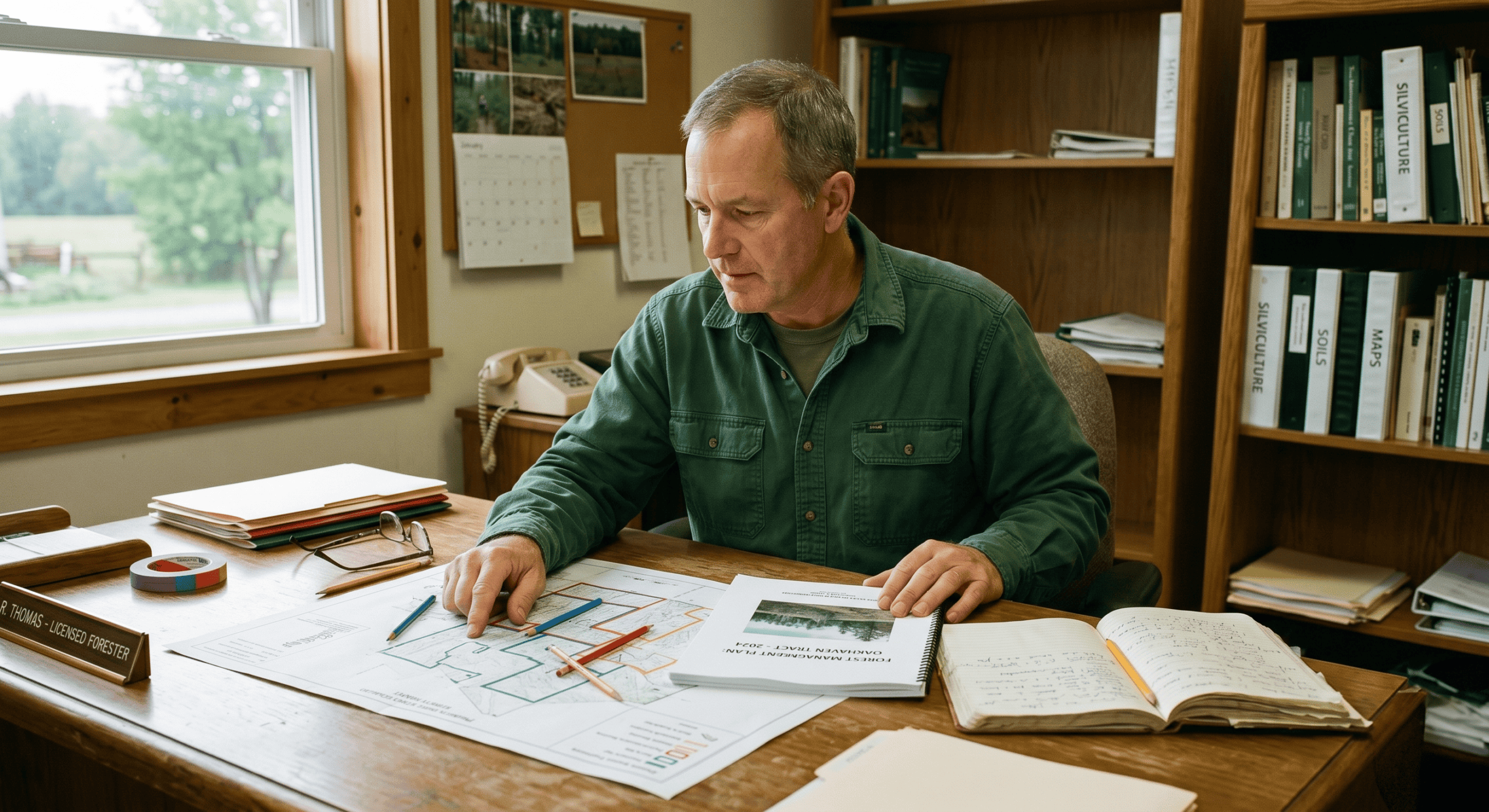
Each stand gets its own description. That description covers dominant species, estimated age, basal area or stocking level, site quality, and notable features — stream buffers, wetlands, rock outcrops, old field areas. A property map shows stand boundaries, access roads, water features, and property lines.
This stand-by-stand inventory is the foundation of everything that follows. It tells you what you have, where it is, and how different parts of your property differ from each other. On most private woodlots in Sullivan and Ulster Counties, I identify between three and eight distinct stands per property depending on size and diversity.
Management Objectives and Activity Schedule
Once the stands are described, the plan prescribes management activities for each one. The forester organizes these prescriptions around your stated objectives — timber production, wildlife habitat, tax enrollment, or some combination of all three.
A typical activity schedule includes:
- Timber harvests — which stands, what type of harvest, approximate timing, and silvicultural objectives for the residual stand
- Timber stand improvement — crop tree release, invasive control, vine removal, with priority areas identified and sequenced
- Wildlife habitat improvements — mast tree release, early successional habitat creation, travel corridor maintenance
- Forest health monitoring — stands to watch for EAB, hemlock woolly adelgid, beech bark disease, or other active threats
- Regeneration management — where natural regeneration of desirable species is expected and what treatments support it
The activity schedule runs across the full planning period — typically ten years for 480-a plans. Each activity carries a target year, a silvicultural rationale, and expected outcomes. That schedule converts a description of your woodland into a roadmap for managing it.
The Written Narrative and Forester Certification
Beyond the maps and schedule, the plan includes a written narrative covering the property’s management history, current forest health status, and the forester’s professional rationale for each prescription. The forester signs and dates the completed document. That signature carries professional accountability. It also satisfies the NYSDEC requirement that a licensed forester author every 480-a-qualifying management plan.
Why New York Landowners Need One — The 480-a Connection
The single most financially significant reason to get a forest stewardship plan in New York is enrollment in the 480-a Forest Tax Law.
The 480-a program reduces the assessed value of enrolled forest land by up to 80%. On a 100-acre property in Sullivan County assessed at $2,000 per acre, that’s the difference between paying taxes on $200,000 of assessed value and paying on $40,000. The annual savings are real and recurring. They compound over the entire enrollment period.
A forest management plan approved by NYSDEC is a non-negotiable requirement for 480-a enrollment. You cannot enroll without one. A licensed forester must write it, submit it to NYSDEC for approval, and the landowner must follow it — completing the management activities it prescribes on schedule.
For most landowners, the 480-a tax savings justify the plan cost within the first year or two of enrollment. Every year after that, the tax savings are pure return on the plan investment. For a full picture of how 480-a fits into the income potential of wooded land, see my article on how to make money from wooded land.
Beyond 480-a, a stewardship plan also opens the door to USDA NRCS cost-share programs that pay landowners to implement qualifying conservation practices. Current 480-a program requirements are at dec.ny.gov.
What a Forest Stewardship Plan Costs — and What It Returns
Plan costs vary by property size, stand complexity, and the inventory detail the situation requires. A straightforward plan on a 50-acre woodlot with two or three distinct stands costs less than a plan on a 200-acre property with diverse stand types, stream buffers, and multiple management objectives.
Typical Cost Range
Forest stewardship plans on private woodland in New York typically run from several hundred dollars for smaller, simpler properties to several thousand dollars for larger, more complex ones. The forester’s field inventory time drives the primary cost. The written document and NYSDEC submission process add time but represent a smaller share of the total.
The Return Calculation
The return math is straightforward. If the plan costs $1,500 and it qualifies a 75-acre Sullivan County property for 480-a enrollment saving $2,500 per year in property taxes, the plan pays for itself in seven months. After that, the savings continue every year — at no additional plan cost — until the ten-year renewal.
For most landowners with 50 or more acres, the plan is not a cost. It’s an investment with a predictable and favorable return.
Who Can Write a Forest Stewardship Plan in New York?
New York State requires that a licensed forester write every forest management plan submitted for 480-a enrollment. The State Education Department issues the forester license. That license requires demonstrated competency in forest inventory, silviculture, and management planning. Foresters must also complete continuing education to keep the credential active.
A timber buyer cannot write a 480-a-qualifying management plan. A logging contractor cannot write one either. Neither holds the professional license NYSDEC requires for plan acceptance.
When you engage a forester to write your plan, ask two questions. First: do you hold a current New York State forester license? Second: have you submitted plans to NYSDEC for 480-a approval before? The submission process carries specific requirements. A forester who knows those requirements produces plans that move through NYSDEC review without delays or revision requests.
I’ve been writing 480-a management plans and submitting them to NYSDEC for approval across Sullivan, Ulster, and Orange Counties for over 30 years. The process is straightforward when the plan is correct the first time.
How Long Is a Forest Stewardship Plan Valid?
For 480-a enrollment, a forest management plan covers a ten-year planning period. At the end of that period, the forester updates the plan to reflect current stand conditions and prescribes the next decade of management activities.
The ten-year renewal is not just a paperwork requirement. It’s genuinely useful. A lot changes in a woodland in ten years. Stands that were scheduled for harvest have been cut and are now regenerating. Invasive species conditions have shifted. New forest health threats have emerged. The renewal process documents those changes and updates the management direction accordingly.
Between renewals, the plan works as a living reference document. When a prescribed activity year arrives — a TSI treatment, an invasive control treatment, a harvest — the plan tells you what the stand needs and why. It keeps management sequential rather than reactive.
What Happens If You Don’t Follow the Plan?
This is the question most landowners don’t ask until they’re already in trouble. The answer matters.
Non-Compliance Risk Under 480-a
For 480-a-enrolled landowners, falling behind on prescribed management activities puts the enrollment at risk. NYSDEC can remove non-compliant properties from the program. When a property leaves the program for non-compliance, the landowner owes back taxes — the taxes that would have been due without the 480-a reduction, for the years the reduction was in place. That liability can be substantial depending on the property tax rate and the length of enrollment.
This is not a theoretical risk. Helping landowners get back into compliance before a NYSDEC review is one of the most common calls I receive from existing 480-a enrollees. They’ve fallen behind on a prescribed activity and they need a plan amendment or a completed treatment before the review date.
The Solution Is Simple
Stay current with the plan. Complete prescribed activities in or near their target years. Keep documentation of what work was done. Communicate with your forester when circumstances change. A forester who wrote your plan can amend it if your situation changes — that’s far better than non-compliance.
For the full framework on active woodland management across all your management goals, see my complete guide for private forest landowners and my overview of timber stand improvement practices that commonly appear in stewardship plan prescriptions.
Frequently Asked Questions
Can I get a forest stewardship plan for free in New York?
In some cases, yes — partially. The USDA Forest Service Cooperative Forest Management program, administered in New York, has historically provided cost assistance for forest management plans on qualifying private woodland. Availability and eligibility requirements change with federal and state funding levels. Ask a consulting forester whether cost-share plan assistance is currently available in your county before paying full cost out of pocket. Even when cost-share is available, however, plan quality varies. A plan written to minimum program standards may not be as detailed or as useful as one written specifically for your property’s needs.
How long does it take to get a forest stewardship plan written?
Field work on a typical 50-acre property takes one to two days. The forester then needs two to four weeks to write the plan document — stand descriptions, maps, management prescriptions, and the activity schedule. NYSDEC review for 480-a approval adds additional time — often four to eight weeks depending on regional office workload. Total time from initial forester contact to an approved 480-a plan is typically three to six months. Plan accordingly if your goal is enrollment before a specific tax year.
Do I need a forest stewardship plan if I’m not planning a timber sale?
Yes — if your property has 50 or more contiguous acres and you want the 480-a property tax reduction, you need a plan regardless of your timber sale intentions. Beyond 480-a, a stewardship plan is useful for any woodland owner who wants to make management decisions based on accurate field information rather than guesswork. It’s the difference between managing reactively and managing proactively with a clear picture of what your woodland needs and when.
How Environmental Forest Products Can Help
Writing forest stewardship plans and managing 480-a enrollment is a core part of my practice. I’ve been doing this work across Sullivan, Ulster, and Orange Counties for over 30 years. Every plan I write starts with a thorough field inventory, covers each stand in detail, and prescribes management activities that are realistic for your acreage, your goals, and your budget.
Here’s what I provide for landowners pursuing a stewardship plan:
- Complete field inventory — stand mapping, species composition, stocking, and forest health assessment
- Written forest stewardship plan with stand descriptions, property map, and ten-year activity schedule
- NYSDEC submission and 480-a enrollment support — I handle the submission process and communicate with the regional office through approval
- Ongoing management guidance — when prescribed activity years arrive, I’m available to mark trees, supervise TSI work, or manage a timber sale under the plan
- Plan amendments when your situation changes — if a storm damages a stand or a health threat shifts the priority order, I update the plan to reflect current conditions
- Cost-share program evaluation — I’ll tell you whether current EQIP or cooperative forestry assistance is available for your property before you commit to full plan cost
If you own 50 or more acres of woodland in Sullivan, Ulster, or Orange County and you’re not enrolled in 480-a, call me. The plan cost is the only thing standing between your property and years of annual tax savings.
Request a Free Forest Stewardship Plan Consultation
Call me directly: (845) 754-8242
Email: henry@eforestproducts.com
Serving Sullivan County NY, Ulster County NY, Orange County NY, Pike County PA, Wayne County PA, and Sussex County NJ.
Henry Kowalec is a licensed consulting forester and member of the Society of American Foresters with over 30 years serving private landowners in the Hudson Valley and Catskills. Environmental Forest Products | Westbrookville, NY 12785 | Licensed in NY, PA, NJ.