I get this question regularly. A landowner calls and says they need “a stewardship plan” — then it turns out what they really need is a management plan for 480-a enrollment. Or they’ve been told they have a management plan, but they’re trying to access a USDA cost-share program that asks for a stewardship plan. The terminology causes real confusion.
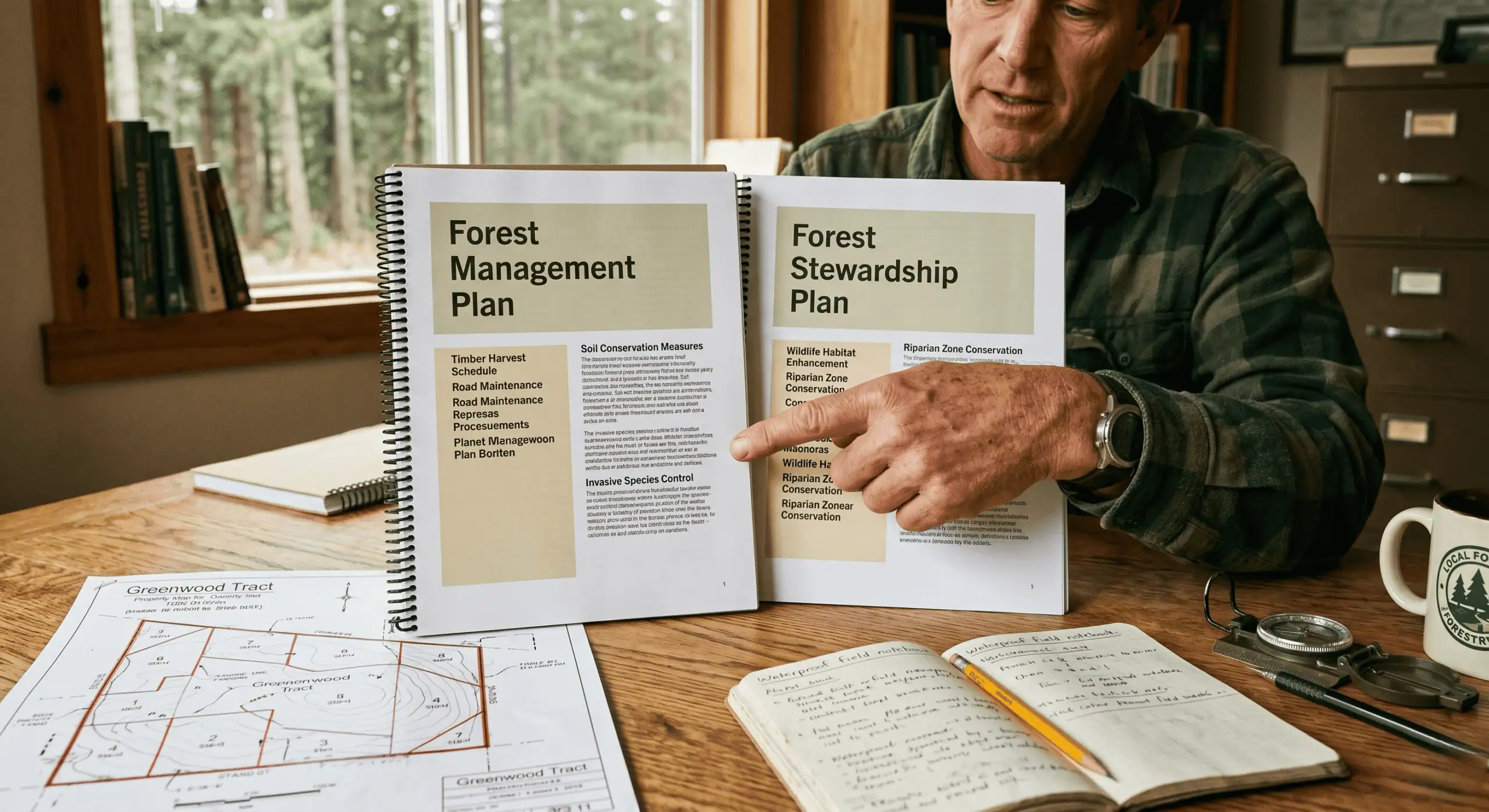
Here’s the truth: in most situations, a forest stewardship plan and a forest management plan are the same document with two different names. The difference is almost entirely about which agency or program uses which term — not about the content of the plan itself.
But there is one real difference that matters to certain landowners. Understanding it will save you time, money, and confusion when you’re trying to qualify for New York’s tax programs or federal cost-share funding.
The Short Answer — They’re Mostly the Same Document
Both a forest stewardship plan and a forest management plan are written documents that describe your woodland’s current condition and prescribe specific management activities over a planning period. Both require a licensed forester to produce them. Both cover stand descriptions, species composition, management objectives, and a schedule of prescribed activities.
The content requirements are nearly identical. A forester writing one is, for practical purposes, writing the other. The terminology depends on the context — which agency, which program, which funding source is involved.
If you’ve read my article on what a forest stewardship plan is, you already have the foundation. This article addresses the specific question of when the terminology distinction actually matters — and when it doesn’t.
Where the Terms Come From
“Forest management plan” is the older and more broadly used term. State forestry programs — including New York’s 480-a Forest Tax Law — use it. Most state agency communications use it. When NYSDEC talks about what you need to enroll in 480-a, they call it a forest management plan.
“Forest stewardship plan” came into widespread use with the USDA Forest Service’s Forest Stewardship Program, established under the USDA Forest Stewardship Program, launched in 1990. That program encouraged private landowners to manage their woodland for multiple values — timber, wildlife, water quality, recreation — and used the term “stewardship plan” to describe the required written document.
Over time, both terms entered common usage. Conservation organizations, land trusts, and university extension services adopted “stewardship plan” because it reflects a multiple-value management philosophy. State agencies and tax programs largely kept “management plan.” Today, foresters and landowners use both terms — often interchangeably — to describe the same basic document.
What Each Term Is Used For in New York
When “Forest Management Plan” Is the Right Term
Use “forest management plan” when dealing with New York State programs and agencies. Specifically:
- 480-a Forest Tax Law enrollment — NYSDEC requires a “forest management plan” written by a licensed forester and approved through its regional office. This is the document that qualifies your property for up to 80% reduction in assessed value.
- NYSDEC communications and submissions — All correspondence with DEC on enrolled properties uses “forest management plan” terminology. Use the same term when communicating with the regional forester who reviews your plan.
- Property tax assessment appeals — When presenting your plan to a tax assessor as documentation of active forest management, “forest management plan” is the term that appears in the relevant statutes.
When “Forest Stewardship Plan” Is the Right Term
Use “forest stewardship plan” when dealing with USDA programs and conservation organizations. Specifically:
- USDA Forest Service programs — The Forest Stewardship Program and related federal assistance programs use “stewardship plan” in their program language and application materials.
- Conservation organization partnerships — Land trusts, Audubon chapters, and similar organizations working with private woodland owners typically use “stewardship plan” when discussing management documentation requirements.
- USDA NRCS EQIP applications — Some EQIP practice standards reference a “forest stewardship plan” or an equivalent document meeting NRCS technical criteria. Using the right terminology in the application matters.
The One Real Difference That Matters — Federal Program Standards
Here’s where the distinction stops being purely semantic. USDA NRCS EQIP and some other federal programs require plans that meet specific NRCS technical standards. Not every state-approved 480-a management plan automatically satisfies those standards.
The difference is in the detail and documentation requirements. A plan written to minimum 480-a standards gives NYSDEC what it needs to approve enrollment. A plan written to NRCS technical standards may require additional components — more detailed inventory data, specific practice standards documentation, or format requirements that NRCS reviewers expect to see.
In practice, a good forester writes plans that satisfy both sets of requirements simultaneously. The additional work is modest. But a forester who only knows the 480-a requirements — and doesn’t understand NRCS technical standards — may produce a plan that gets 480-a approved but doesn’t qualify for EQIP cost-share. That gap costs landowners real money.
When you engage a forester, ask directly: will this plan qualify for both 480-a enrollment and USDA NRCS cost-share programs? A forester who has written plans for both purposes will answer that question clearly. One who hasn’t may not know there’s a difference.
Which Plan Do You Actually Need?
The answer depends on your goals. Here’s how to think through it.
If your primary goal is 480-a enrollment and annual property tax reduction, you need a forest management plan that meets NYSDEC requirements. That plan covers your stand descriptions, management objectives, and a ten-year activity schedule. A licensed NY forester writes it and submits it to the regional DEC office for approval. For the full income picture that 480-a makes possible, see my article on how to make money from wooded land.
If your goals include federal cost-share funding through USDA NRCS EQIP for practices like invasive species control, timber stand improvement, or wildlife habitat work, tell your forester upfront. The plan needs to satisfy NRCS technical standards, not just NYSDEC approval criteria. A forester familiar with both sets of requirements writes the plan to meet both from the start.
If your goals are primarily ecological — wildlife habitat, water quality, forest health — a stewardship plan framed around multiple management values may serve you better than one written narrowly around timber production. The content of the plan should reflect what you actually want to accomplish on your land.
If you’re unsure, the right move is a conversation with a licensed consulting forester before deciding anything else. That conversation costs nothing. It tells you which type of plan fits your situation — and whether you can satisfy multiple program requirements with one well-written document. For a complete overview of what active woodland management involves, see my complete guide for private forest landowners.
What Both Plans Must Include — The Non-Negotiables
Regardless of which term applies to your situation, any plan worth having covers these components:
- Property description and map — acreage, legal description, stand boundaries, access roads, water features, and property lines
- Stand-by-stand inventory — dominant species, estimated age, stocking level, site quality, and notable features for each management unit
- Management objectives — your stated goals for the property, whether timber production, wildlife habitat, tax enrollment, or a combination
- Prescribed management activities — timber harvests, TSI treatments, invasive control, wildlife habitat improvements — with target years and silvicultural rationale for each
- Forest health assessment — identification of active or potential threats including EAB, hemlock woolly adelgid, beech bark disease, and invasive species pressure
- Forester’s certification — the licensed forester’s signature, license credential and statement of professional independence
A plan missing any of these components will have trouble passing NYSDEC review for 480-a enrollment. It will also fail to give you a useful management roadmap — which is the whole point of having one. For a deeper look at what each component involves and why it matters, see my guide on what a forest stewardship plan actually contains.
Who Writes These Plans in New York — and Who Can’t
New York State requires a licensed forester to write every management plan submitted for 480-a enrollment. The State Education Department issues that license. The license requires demonstrated competency in forest inventory, silviculture, and management planning — along with continuing education to maintain it.
A timber buyer cannot write a qualifying plan. A logging contractor cannot write one. Neither holds the professional license the state requires. This matters because timber buyers sometimes offer to “put together paperwork” as part of a timber sale arrangement. That paperwork won’t satisfy NYSDEC requirements. It also won’t protect your interests — a plan written by someone who profits from your timber sale serves their interests, not yours.
A consulting forester works for you — not for a mill or a logging company. That professional independence is what gives the plan its integrity. It’s also what the forester’s certification at the end of the document represents.
For more on that distinction and why it matters for every aspect of woodland management, see my article on timber buyers vs. consulting foresters. And for the full timber harvesting framework that a good management plan supports, see my timber harvesting guide for private landowners.
Frequently Asked Questions
Does a forest stewardship plan qualify for 480-a enrollment in New York?
Yes — if a licensed New York State forester wrote it and it meets NYSDEC’s content requirements for forest management plans. The name on the document matters less than whether the content satisfies NYSDEC’s review criteria. A plan titled “Forest Stewardship Plan” that includes all required components — stand descriptions, ten-year activity schedule, forester certification — will qualify. A plan missing required components won’t qualify regardless of what it’s called.
Can the same forester write both types of plans?
Yes — and ideally, one forester writes one plan that satisfies both sets of requirements simultaneously. A consulting forester familiar with both NYSDEC 480-a standards and USDA NRCS technical criteria can write a single document that qualifies for state tax enrollment and federal cost-share programs at the same time. Ask your forester directly whether they have experience writing plans for both purposes before you engage them.
Do I need two separate plans if I want both 480-a enrollment and USDA cost-share funding?
No — not if your forester writes the plan to satisfy both sets of requirements from the start. The additional content required for NRCS technical standards is modest. A forester who understands both programs builds those requirements into the original document. You end up with one plan that qualifies everywhere. Where landowners run into trouble is when they get a 480-a plan written first — to minimum state standards — and then discover it doesn’t satisfy NRCS criteria for the EQIP practices they want to access.
How Environmental Forest Products Can Help
I’ve been writing forest management plans and stewardship plans across Sullivan, Ulster, and Orange Counties for over 30 years. Every plan I write is designed to qualify for 480-a enrollment and to meet USDA NRCS technical standards for cost-share programs — one document, one field visit, one set of fees.
I hold a current New York State forester license. I’ve submitted plans to NYSDEC’s regional offices for approval throughout my career. I understand exactly what the regional forester reviewers look for — and I write plans that move through the approval process cleanly.
Here’s what I can do for your property:
- Conduct a field inventory and write a plan that satisfies both NYSDEC 480-a requirements and USDA NRCS technical standards
- Handle the NYSDEC submission process and communicate with the regional office through approval
- Evaluate whether your property qualifies for EQIP cost-share funding for practices in the plan
- Advise on which plan type — or which combination of program requirements — best fits your specific goals
- Manage the ongoing management activities the plan prescribes — timber sales, TSI, invasive control — so your enrollment stays current
If you’re trying to sort out which plan you need and what it takes to get there, call me. It’s a ten-minute conversation that will clear up the confusion and tell you exactly where to start.
Request a Free Forest Plan Consultation
Call me directly: (845) 754-8242
Email: henry@eforestproducts.com
Serving Sullivan County NY, Ulster County NY, Orange County NY, Pike County PA, Wayne County PA, and Sussex County NJ.
Henry Kowalec is a licensed consulting forester and member of the Society of American Foresters with over 30 years serving private landowners in the Hudson Valley and Catskills. Environmental Forest Products | Westbrookville, NY 12785 | Licens