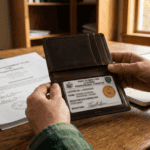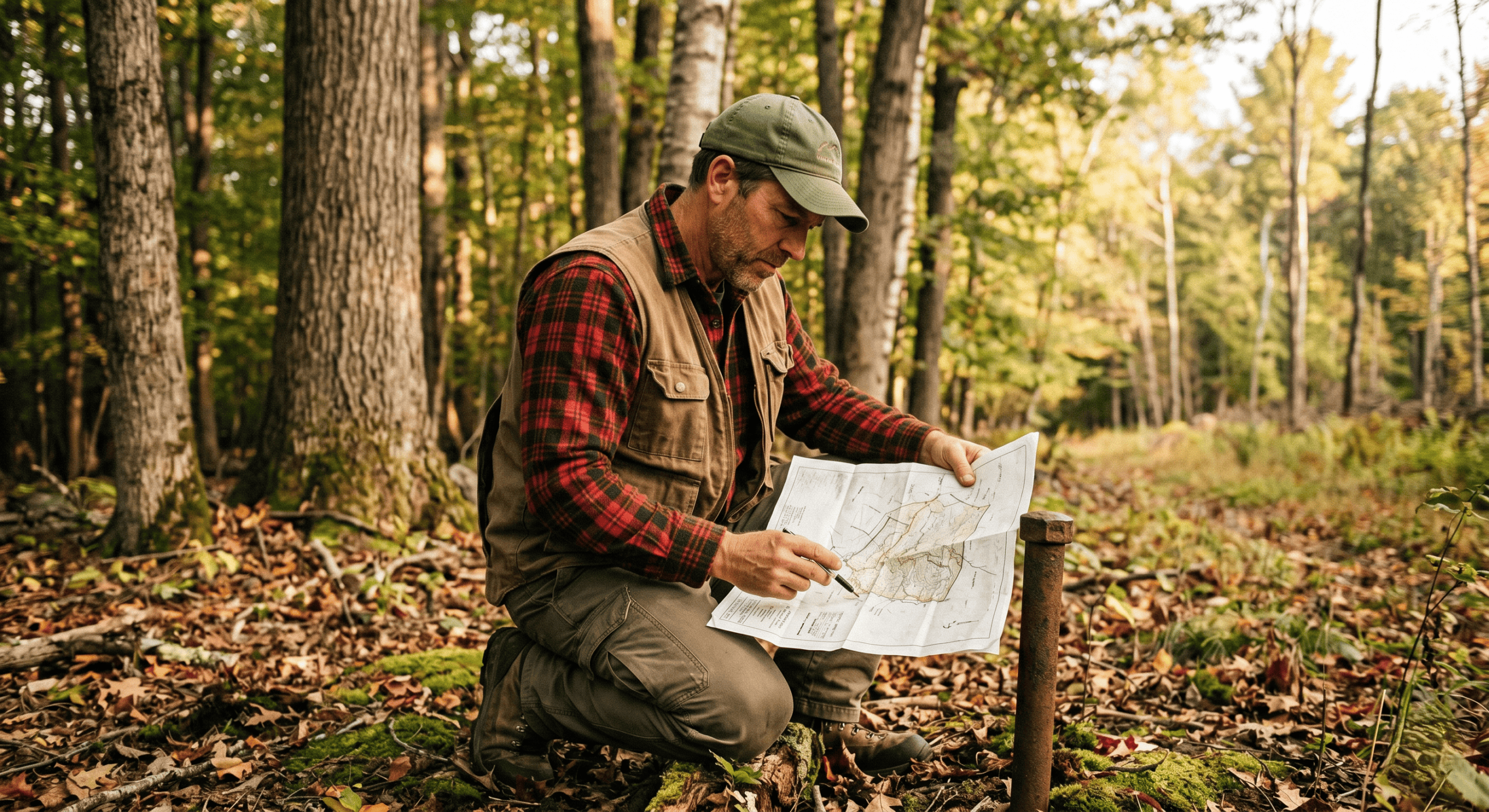
New York’s 480-a Forest Tax Law reduces the assessed value of enrolled woodland by up to 80%. On a 100-acre property in Sullivan County assessed at $2,000 per acre, that’s the difference between paying taxes on $200,000 and paying on $40,000. The annual savings are real, recurring, and — over a multi-decade ownership period — substantial.
Most private woodland owners in Sullivan, Ulster, and Orange Counties would qualify for this program. Most are not enrolled. The most common reason isn’t disqualification — it’s that the landowner never confirmed whether the property qualifies and never took the steps to find out.
Here’s every qualification requirement, explained plainly, so you can determine whether your property is eligible — and what to do if it is.
The Four Qualification Requirements — An Overview
480-a enrollment requires a property and a landowner to meet four conditions simultaneously. All four must be satisfied. Partial qualification doesn’t exist — you’re either in or you’re not.
- Minimum acreage: at least 50 contiguous acres of forest land
- Productive capacity: the land must be capable of growing commercial timber
- Approved management plan: a licensed forester must write and NYSDEC must approve a forest management plan for the property
- Long-term commitment: the landowner must commit to keeping the land in active forest use and following the management plan
Each requirement has specific nuances that determine whether a given property satisfies it. The four sections below cover each one in the detail a landowner needs to make an honest self-assessment before calling a forester.
Requirement One — Minimum Acreage
The property must contain at least 50 contiguous acres of forest land capable of producing timber. Contiguous means connected — the 50 acres cannot be spread across two disconnected parcels. They must form a single unbroken area of productive forest.
What Counts Toward the 50 Acres
Forested land capable of producing timber counts. Mixed hardwood woodland, softwood stands, and areas of young regenerating forest that will produce timber over the planning horizon all satisfy the productive forest criterion. A stand currently in early succession — coming back from a prior harvest or an old field — still counts if it has a realistic path to timber production over the next decade.
The 50 acres does not have to be a single stand type. Mixed hardwood and softwood areas on the same parcel count together. A property with 30 acres of mature hardwood and 25 acres of regenerating forest has 55 acres of productive forest land — qualifying acreage.
What Doesn’t Count
Several land types do not count toward the 50-acre minimum regardless of where they fall on the property:
- Wetlands and open water — marshes, ponds, streams, and seasonal wet areas
- Open fields and agricultural land — unmowed meadows, hayfields, or any area not currently forested
- Rock outcrops and unproductive barrens — land with no realistic timber production potential
- Structures and improved areas — buildings, driveways, lawns, and any developed footprint
- Road rights-of-way — public road corridors through the property
A forester’s field assessment determines which acreage qualifies and which doesn’t. Properties that appear to have 50 or more woodland acres on a deed or survey sometimes fall slightly short after non-qualifying areas are excluded. It’s better to confirm acreage qualification before investing in plan writing than to discover the shortfall after.
Requirement Two — Productive Forest Land
The enrolled acreage must be capable of producing commercial timber. This does not mean your forest must currently have merchantable timber on it. It means the land has the soil productivity, moisture regime, and growing conditions to support timber production over time.
Most mixed hardwood and softwood woodland in Sullivan, Ulster, and Orange Counties satisfies this requirement without difficulty. The region’s soils and climate support strong hardwood productivity. Severely degraded sites — rock barrens, extremely shallow soils, chronically waterlogged ground — may not qualify. But those situations are the exception, not the rule, in this region.
A forester conducting the field inventory evaluates site productivity as part of the standard assessment. Site quality — expressed as site index for the dominant species — goes into the stand descriptions. If site quality raises a productivity question, the forester addresses it in the plan and the NYSDEC reviewer evaluates it during the approval process.
Requirement Three — An Approved Forest Management Plan
This is the most active requirement. A licensed New York State forester must write a forest management plan for the property, and NYSDEC must review and approve it before enrollment begins. No plan, no enrollment. No licensed forester, no qualifying plan.
The management plan documents current stand conditions, prescribes management activities over a ten-year planning horizon, and maps the property with stand boundaries. NYSDEC reviews the plan to confirm it reflects genuine field conditions and prescribes genuine active management — not a minimal checklist designed only to satisfy the enrollment requirement.
For a complete explanation of what a qualifying management plan must contain, see my guide on what a forest stewardship plan is. For the step-by-step process of getting a plan written and approved, see my article on how to create a forest management plan in New York. Why the licensed forester requirement exists and what it means in practice, see my article on whether you need a licensed forester for your management plan.
Requirement Four — Long-Term Management Commitment
480-a is not a passive enrollment. It requires active forest management over the enrollment period. The landowner must commit to three things:
Following the management plan. The management activities the plan prescribes must be completed in or near their target years. A harvest scheduled for year three needs to happen around year three. A TSI treatment scheduled for year five needs to happen around year five. Falling significantly behind on prescribed activities puts the enrollment at risk.
Keeping the land in forest use. Enrolled land cannot be converted to development, agriculture, or any other non-forest use without triggering back-tax liability. 480-a is a program for landowners committed to keeping their land as productive woodland — not a temporary tax strategy for land that might be developed later.
Renewing the plan at ten years. The management plan covers a ten-year planning period. At the end of that period, the landowner must renew the plan — updated field inventory, updated stand descriptions, new ten-year activity schedule — to keep the enrollment active. A forester writes the renewal plan the same way they wrote the original.
For the full picture of how the management commitment and the tax savings interact over time, see my article on forest stewardship and 480-a tax savings.
What Disqualifies a Property from 480-a
Several situations disqualify a property outright or create significant enrollment complications.
Less than 50 contiguous qualifying acres. This is the most common disqualifier. Properties with 40 acres of productive woodland, or 60 acres with significant non-qualifying land reducing the net to below 50, don’t meet the minimum. No variance or exception exists for properties that fall short of the threshold.
Intent to develop or sell for development. 480-a requires a good-faith commitment to keeping land in forest use. A landowner who plans to subdivide and sell in five years should not enroll — the back-tax liability upon removal from the program would likely exceed the tax savings.
Non-productive land dominating the parcel. A property that is primarily wetland, rock, or open field — with only incidental forest cover — doesn’t satisfy the productive forest land requirement regardless of total acreage.
Ownership structures that complicate the commitment. Multiple heirs, LLC structures with unclear decision-making authority, or trust arrangements with uncertain long-term beneficiaries can complicate the enrollment commitment. These don’t necessarily disqualify a property — but they warrant a conversation with both a consulting forester and an attorney before proceeding.
How to Find Out If Your Property Qualifies
The most reliable way to determine qualification is a forester walk. A licensed consulting forester walks the property, identifies the qualifying and non-qualifying acreage, assesses site productivity, and gives you a clear answer about whether the property meets all four requirements before you invest in plan writing.
A forester walk typically takes two to four hours on a 50- to 100-acre property. The result is an honest assessment — either the property qualifies and the plan process makes sense to proceed, or it doesn’t and you’ve saved the cost of a management plan you couldn’t use.
I’ve walked properties across Sullivan, Ulster, and Orange Counties where the landowner was certain they qualified and the field assessment revealed they were slightly short on net qualifying acreage. I’ve also walked properties where the landowner assumed they didn’t qualify — the acreage looked borderline on paper — and the field assessment confirmed clear qualification. You need the walk to know for certain.
What Happens After You Confirm Qualification
Once a forester confirms your property qualifies, the path to enrollment follows a clear sequence:
- The forester conducts a full field inventory and writes the management plan
- The forester submits the plan to the NYSDEC regional office for review and approval
- After NYSDEC approval, the landowner files the 480-a enrollment application with the local tax assessor
- The assessor applies the reduced assessment to the enrolled acreage for the following tax year
- Annual tax savings begin — up to 80% reduction in assessed value on enrolled acreage
Total time from forester engagement to first reduced tax bill typically runs three to six months. For the complete step-by-step process, see my article on how to create a forest management plan in New York. For how 480-a fits into the full income picture of woodland ownership, see my article on how to make money from wooded land. Current NYSDEC 480-a program information is at dec.ny.gov.
Frequently Asked Questions
Can I qualify for 480-a with less than 50 acres?
No. The 50-contiguous-acre minimum is a hard threshold with no variance or exception. If your productive forest acreage falls below 50 acres after non-qualifying areas are excluded, the property does not qualify for 480-a enrollment. Some landowners explore whether adjacent parcels under common ownership can be combined to meet the threshold — that situation warrants a direct conversation with NYSDEC and a consulting forester familiar with the program’s parcel combination rules before assuming combination is possible.
What if my property has wetlands, fields, or other non-forest areas?
Those areas don’t count toward your qualifying acreage — but they don’t disqualify the rest of the property. Only the productive forest acreage enrolls. If your property has 80 acres total with 15 acres of wetland and 10 acres of open field, the remaining 55 acres of productive forest land qualifies — assuming it meets the productivity requirement. The enrolled acreage on the tax roll reflects only the qualifying forest portion, not the total property acreage.
How long does the 480-a qualification process take?
From first forester contact to active enrollment, the realistic timeline runs three to six months. The field inventory and plan writing take four to six weeks combined. NYSDEC review typically runs four to eight weeks from submission. Assessor application and processing runs two to four weeks after NYSDEC approval. If you’re targeting enrollment before a specific tax year, work backward from your township’s assessor application deadline and plan the forester engagement accordingly. Missing the assessor’s deadline by a few weeks can delay the first reduced tax bill by a full year.
How Environmental Forest Products Can Help
I’ve been evaluating properties for 480-a qualification and writing enrollment management plans across Sullivan, Ulster, and Orange Counties for over 30 years. The qualification assessment — the forester walk that confirms whether your property meets all four requirements — is where I start every 480-a engagement.
Here’s what I can do for a landowner evaluating 480-a qualification:
- Walk the property and give you an honest assessment of whether it meets all four qualification requirements before you invest in plan writing
- Identify and map qualifying vs. non-qualifying acreage so you know exactly what would be enrolled
- Write the forest management plan — field inventory, stand descriptions, property map, ten-year activity schedule — and submit it to NYSDEC for approval
- Guide the assessor application process so enrollment is in place for the earliest possible tax year
- Provide ongoing compliance guidance throughout the ten-year enrollment period
If you own what you think might be qualifying woodland in Sullivan, Ulster, or Orange County, call me before you assume you don’t qualify — and before you assume you do. The field assessment tells you for certain. That certainty is worth more than any amount of guessing from a desk.
Request a Free 480-a Qualification Assessment
Call me directly: (845) 754-8242
Email: henry@eforestproducts.com
Serving Sullivan County NY, Ulster County NY, Orange County NY, Pike County PA, Wayne County PA, and Sussex County NJ.
Henry Kowalec is a licensed consulting forester and member of the Society of American Foresters with over 30 years serving private landowners in the Hudson Valley and Catskills. Environmental Forest Products | Westbrookville, NY 12785 | Licensed in NY, PA, NJ.