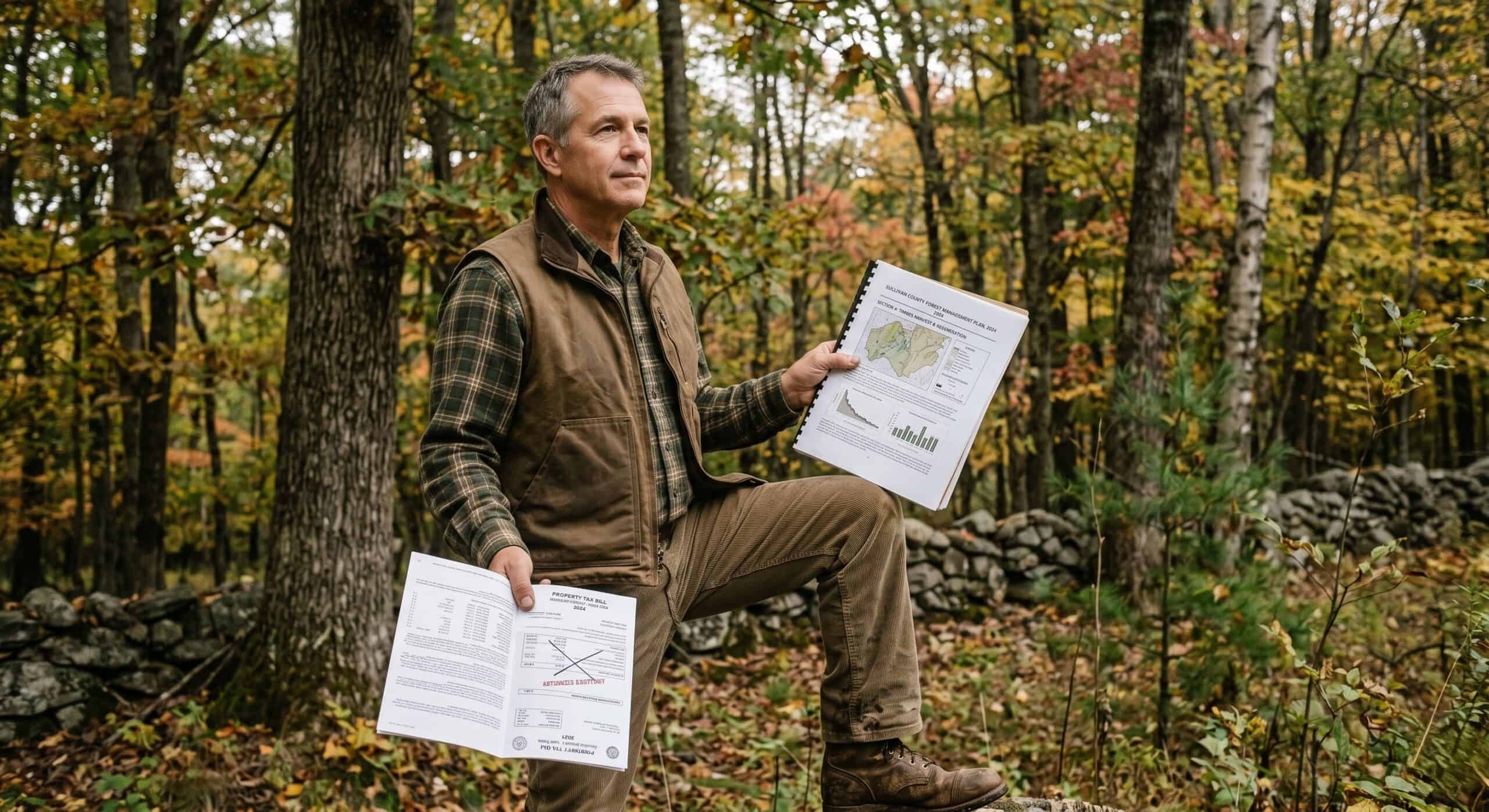
Every year, private woodland owners in Sullivan, Ulster, and Orange Counties pay full property taxes on forest land that qualifies for an 80% reduction in assessed value. They don’t know the program exists. Or they’ve heard of it but assume the requirements are too complicated. Or they’ve been meaning to look into it for years and haven’t gotten around to it.
Each of those years costs real money. A landowner with 100 acres of productive forest land in Sullivan County paying taxes on full assessed value instead of 480-a-reduced value loses $2,000 to $4,000 or more every single year. That loss compounds. After ten years of non-enrollment, the forfeited savings often exceed $20,000 to $40,000 — for a program the property would have qualified for the entire time.
New York’s 480-a Forest Tax Law is not complicated. It has clear requirements, a predictable process, and a straightforward cost-benefit calculation. Here’s how it works, what it requires, and why active forest stewardship is the mechanism that makes the tax savings possible.
What Is New York’s 480-a Forest Tax Law?
New York’s 480-a Forest Tax Law is a property tax reduction program for private woodland owners. It reduces the assessed value of enrolled forest land by up to 80%. The state legislature created it to encourage private landowners to keep forest land in productive, actively managed use rather than converting it to development.
The program works through a simple mechanism. Instead of taxing enrolled woodland at its full market or assessed value, the local tax assessor taxes it at a significantly reduced figure. That reduced figure reflects the land’s value as productive forest — not its potential value as developed real estate.
The program is voluntary. No landowner is required to enroll. But for qualifying woodland owners who plan to keep their land in forest use, enrollment is one of the most financially favorable decisions available. The tax savings are annual, recurring, and — over a multi-decade ownership period — substantial.
Current 480-a program requirements and application materials are at dec.ny.gov.
How Much Does 480-a Actually Save?
The savings depend on three variables: your acreage, the assessed value per acre in your township, and your local property tax rate. The math is straightforward once you know those numbers.
Here’s a concrete example. A 100-acre woodland property in Sullivan County assessed at $2,000 per acre carries a total assessed value of $200,000. Without 480-a, the landowner pays taxes on $200,000. With 480-a enrollment and an 80% reduction, the landowner pays taxes on $40,000. At a combined tax rate of $15 per $1,000 of assessed value — a reasonable mid-range figure for Sullivan County — that’s the difference between a $3,000 annual tax bill and a $600 annual tax bill. Annual savings: $2,400.
Over 20 years of enrollment, that’s $48,000 in cumulative tax savings on a single 100-acre property. On a 200-acre property with a higher assessed value, the cumulative figure climbs substantially higher.
These are not hypothetical numbers. They reflect the actual savings I’ve helped landowners across Sullivan, Ulster, and Orange Counties capture through 480-a enrollment over 30 years of practice. The program works exactly as advertised — but only for landowners who enroll.
For a complete picture of how 480-a fits alongside timber income and hunting lease revenue as part of a woodland income strategy, see my article on how to make money from wooded land.
Who Qualifies for 480-a Enrollment?
Not every wooded property qualifies. 480-a has specific eligibility requirements. Here is what the program requires of the land and the landowner.
Minimum acreage: The property must contain at least 50 contiguous acres of forest land capable of producing timber. Wetlands, open water, fields, and non-productive land do not count toward the 50-acre minimum. The 50 acres must be forested and productive.
Productive capacity: The land must be capable of growing commercial timber. Severely degraded sites, rock barrens, or land with no realistic timber production potential do not qualify. Most mixed hardwood woodland in Sullivan, Ulster, and Orange Counties meets this standard without difficulty.
Management plan: A licensed forester must write and submit a forest management plan for the property. NYSDEC must approve that plan before enrollment becomes effective. The plan is both the qualifying document and the roadmap for ongoing compliance.
Ownership commitment: The landowner must commit to keeping the land in forest use and following the management plan. This is not a short-term tax strategy. It’s a long-term commitment to active woodland stewardship.
What 480-a Requires — The Management Obligation
This is where many landowners have the most questions. 480-a is not a passive enrollment — it requires active management. Understanding exactly what “active management” means in practice removes most of the concern about compliance.
The Forest Management Plan
A licensed consulting forester writes the forest management plan. The plan covers stand-by-stand descriptions of your woodland, management objectives, and a ten-year activity schedule. That schedule prescribes specific management activities — timber harvests, timber stand improvement, invasive control, wildlife habitat improvements — with target years for each.
NYSDEC reviews the plan and approves it before enrollment begins. The regional forester who reviews plans in your area checks that the plan reflects actual field conditions and that the prescribed activities are silviculturally appropriate. A well-written plan from a forester familiar with the regional office’s expectations moves through review without delays.
For a complete explanation of what a forest management plan contains and what the writing process involves, see my guide on what a forest stewardship plan is.
The Annual Management Activities
Once NYSDEC approves the plan and enrollment begins, the landowner must complete the management activities the plan prescribes. Those activities fall into the target years the plan specifies. Common prescribed activities include:
- Timber harvests — selective harvests, crop tree release harvests, or salvage harvests prescribed in the plan and conducted under forester oversight
- Timber stand improvement — crop tree release, vine removal, wolf tree removal, and invasive species control in priority areas
- Invasive species management — treatment of Japanese barberry, multiflora rose, and other invasive shrubs in areas where they threaten stand regeneration
- Regeneration management — treatments that favor the establishment of desirable native species in areas targeted for stand renewal
- Forest health monitoring — documented observation of stands for EAB, hemlock woolly adelgid, beech bark disease, and other active threats
Not every activity appears every year. The plan prescribes a sequence. In some years the primary activity is a timber harvest. In other years it’s TSI work or invasive control. The key is completing each activity in or near its target year and keeping documentation of what was done.
For a detailed look at TSI activities and how they fit into a 480-a management plan, see my article on timber stand improvement.
How Forest Stewardship and 480-a Work Together
The relationship between forest stewardship and 480-a is not incidental. It’s the design of the program. New York created 480-a specifically to reward landowners who practice active, long-term forest stewardship. The tax reduction is the reward. The management plan and required activities are the practice.
This alignment means that good stewardship and 480-a compliance reinforce each other. When I write a management plan for a landowner enrolling in 480-a, I prescribe the activities that the stand actually needs — not the minimum required to satisfy the program. The prescribed activities improve timber quality, improve wildlife habitat, improve forest health. They also satisfy the compliance requirement.
A landowner who practices active stewardship is, by definition, compliant with 480-a. A landowner who enrolls in 480-a and follows the plan is, by definition, practicing active stewardship. The two are the same thing described from different directions.
The long-term financial picture reflects this alignment. Over a 20-year enrollment period, the 480-a tax savings compound. The management activities those years produce also compound — in timber volume, in timber quality, in stand health. When the next timber harvest comes around, the stand is more valuable than it would have been without management. The tax savings and the improved timber asset are both products of the same stewardship practice.
For the full stewardship framework that supports this long-term approach, see my guide on forest stewardship for private landowners. And for how timber harvests integrate with a 480-a management plan, see my timber harvesting guide.
Can You Sell Timber While Enrolled in 480-a?
Yes — and in most cases, the management plan prescribes timber harvests as part of the required management activities. A properly designed timber harvest under a 480-a management plan is not just permitted. It’s expected.
The harvest must conform to the plan. That means the right stands, the right silvicultural approach, and the right timing relative to the plan’s activity schedule. A timber sale that removes timber from stands not designated for harvest, or that uses methods inconsistent with the plan’s silvicultural prescriptions, can create compliance problems.
This is another reason why having a consulting forester manage the timber sale — not just write the plan — matters for enrolled landowners. I mark the trees, write the sale contract, and oversee the harvest. Every step confirms that the sale conforms to the management plan and satisfies the plan’s prescribed activity requirement. The landowner captures timber income and advances 480-a compliance simultaneously.
That dual outcome — income and compliance in the same operation — is one of the most financially efficient features of a well-structured 480-a enrollment. For more on how to manage a timber sale under a forester’s representation, see my article on how timber harvesting works for private landowners.
The Back-Tax Penalty — What Happens If You Fall Out of Compliance
This section gets more attention from landowners than any other 480-a topic. The concern is legitimate — the back-tax penalty is real, and it matters.
What Triggers Back Taxes
NYSDEC can remove a property from 480-a enrollment for two reasons: failure to complete prescribed management activities on schedule, or conversion of the enrolled land to a non-forest use. When removal happens, the landowner owes back taxes — the difference between what they paid under 480-a and what they would have paid without the reduction, for a period going back up to six years.
That liability can be substantial. A landowner who received $2,400 per year in tax savings for six years owes $14,400 in back taxes if the property is removed from the program. On larger properties or in higher-tax townships, the figure grows accordingly.
How to Avoid It
Avoiding back-tax liability is straightforward: stay current with the plan. Complete prescribed activities in or near their target years. Keep records of what work was done and when. Communicate with your forester when circumstances change — a severe storm, a disease outbreak, or a change in personal circumstances — so the plan can be amended before non-compliance becomes an issue.
A plan amendment is far better than non-compliance. NYSDEC allows plan amendments when conditions change. A forester who wrote your plan can amend it to reflect current stand conditions and reset the activity schedule. That flexibility exists for good reason — forests change, and management plans need to keep up.
The landowners who fall into back-tax trouble are almost always those who enrolled, captured the tax savings for several years, and then stopped paying attention to the compliance requirements. Active management and active attention to the plan schedule are what keep the enrollment in good standing and the back-tax risk at zero.
How to Apply for 480-a Enrollment
The 480-a application process runs through NYSDEC. Here are the steps, in order.
- Step one: Engage a licensed consulting forester to conduct a field inventory of your property and determine whether it meets the 50-acre minimum and productive capacity requirements.
- Step two: The forester writes the forest management plan — stand descriptions, management objectives, and ten-year activity schedule — and submits it to the NYSDEC regional office for review and approval.
- Step three: NYSDEC reviews the plan. The regional forester may request clarifications or minor revisions. A well-written plan from an experienced forester typically moves through review without significant delays.
- Step four: Once NYSDEC approves the plan, the landowner files an application for 480-a enrollment with the local tax assessor. The assessor applies the reduced assessment to the enrolled acreage for the following tax year.
- Step five: Enrollment begins. The landowner starts completing the management activities the plan prescribes and captures the annual tax savings going forward.
Total time from first forester contact to active enrollment typically runs three to six months — depending on field inventory scheduling, plan writing time, and NYSDEC review workload. Plan this timeline if enrollment before a specific tax year is a goal.
For a complete overview of what active woodland management involves across all your goals — timber, wildlife, tax savings — see my complete guide for private forest landowners. And if you’ve recently inherited woodland and need to understand the 480-a opportunity, see my article on what to do with inherited wooded land.
Frequently Asked Questions
How long does 480-a enrollment last?
480-a enrollment continues as long as the landowner follows the management plan and keeps the land in forest use. There is no fixed enrollment term that expires automatically. The management plan covers a ten-year planning period and requires renewal at the end of that period — but the enrollment itself continues through renewals as long as the landowner remains compliant. A landowner who enrolls and actively manages the property can maintain 480-a status indefinitely.
What happens to 480-a enrollment when I sell or transfer the property?
480-a enrollment does not automatically transfer to a new owner. When a property changes hands, the new owner must notify NYSDEC of the ownership change and commit to continuing the management plan to maintain the enrollment. If the new owner does not continue the enrollment, the property may be subject to back taxes. Buyers of 480-a-enrolled woodland should factor this into their due diligence before purchase — and sellers should disclose the enrollment status and the compliance obligations it carries.
Can I enroll in 480-a without hiring a forester?
No. NYSDEC requires that a licensed forester write and submit the forest management plan for 480-a enrollment. The license ensures the plan meets professional standards and reflects actual field conditions. A landowner cannot write their own qualifying plan. A timber buyer cannot write one. The licensed forester is the required professional in this process — and the forester who writes your plan also becomes your primary resource for managing compliance over the enrollment period.
How Environmental Forest Products Can Help
Writing 480-a management plans and managing long-term enrollment compliance is the core of my forestry practice. I’ve been doing this work across Sullivan, Ulster, and Orange Counties for over 30 years. Every plan I write is designed to satisfy NYSDEC’s approval requirements and to prescribe management activities that actually improve the property — not just check a compliance box.
Here’s what I provide for landowners pursuing 480-a enrollment:
- Field inventory and eligibility assessment — I walk the property and confirm it meets the 50-acre minimum and productive capacity requirements before you spend anything on plan writing
- Forest management plan writing — stand descriptions, property map, management objectives, and ten-year activity schedule, written to satisfy both NYSDEC 480-a requirements and USDA NRCS technical standards for cost-share programs
- NYSDEC submission and approval management — I handle the regional office submission and communicate with the review forester through approval
- Ongoing compliance management — when activity years arrive, I’m available to mark timber, supervise TSI work, or manage a sale under the plan
- Plan amendments when conditions change — storm damage, disease outbreaks, or ownership changes all warrant plan updates, and I handle those before they become compliance problems
- Cost-share program evaluation — I advise on whether your property qualifies for USDA EQIP funding that can offset the cost of prescribed management activities
If you own 50 or more acres of woodland in Sullivan, Ulster, or Orange County and you’re not enrolled in 480-a, every year you wait costs you money you cannot recover. Call me and let’s find out what your property qualifies for.
Request a Free 480-a Enrollment Consultation
Call me directly: (845) 754-8242
Email: henry@eforestproducts.com
Serving Sullivan County NY, Ulster County NY, Orange County NY, Pike County PA, Wayne County PA, and Sussex County NJ.
Henry Kowalec is a licensed consulting forester and member of the Society of American Foresters with over 30 years serving private landowners in the Hudson Valley and Catskills. Environmental Forest Products | Westbrookville, NY 12785 | Licensed in NY, PA, NJ.