Most landowners who ask about 480-a have heard the phrase “up to 80% reduction in assessed value.” That’s accurate — but it doesn’t tell you what 480-a would actually save on your property specifically. The real number depends on your assessed value per acre, your local tax rate, and how many qualifying acres you have.
I’ve helped landowners across Sullivan, Ulster, and Orange Counties enroll in 480-a for over 30 years. The savings range from modest on smaller, lower-assessed properties to genuinely transformative on larger holdings with higher assessed values. In every case, the savings exceed the management plan cost — usually within the first year or two of enrollment.
Here’s how to calculate what 480-a would save on your specific property — with real regional examples.
How the 480-a Reduction Works — The Mechanism
480-a doesn’t reduce your tax rate. It reduces the assessed value of your enrolled woodland — the number your tax rate multiplies against to produce your tax bill.
Standard property assessment values land at its market or use value. For woodland in the Hudson Valley and Catskills region, that assessed value often reflects development pressure, comparable sales of wooded parcels, or general land value in the township — not the land’s productive value as a managed forest.
Under 480-a, NYSDEC establishes a 480-a assessed value for enrolled forest land. That value reflects the land’s value as productive forest — significantly lower than standard market assessment in most townships. The enrolled acreage then appears on your tax roll at the 480-a value rather than the standard assessed value.
The result: your tax bill on the enrolled acreage drops by up to 80%. That reduction applies every year the enrollment stays in good standing — no reapplication, no annual paperwork, no annual negotiation with the assessor. The reduced assessment continues until you leave the program, let the plan lapse, or convert the land to another use.
The Variables That Determine Your Savings
Three numbers determine what 480-a saves on a specific property. You need all three to calculate your actual savings.
Your Property’s Assessed Value Per Acre
Assessed values for woodland in Sullivan, Ulster, and Orange Counties vary significantly by township, location, and proximity to development. In some Sullivan County townships, rural woodland assesses at $800 to $1,200 per acre. In other areas — particularly those with more development pressure or higher recent comparable sales — woodland may assess at $2,000 to $4,000 per acre or higher.
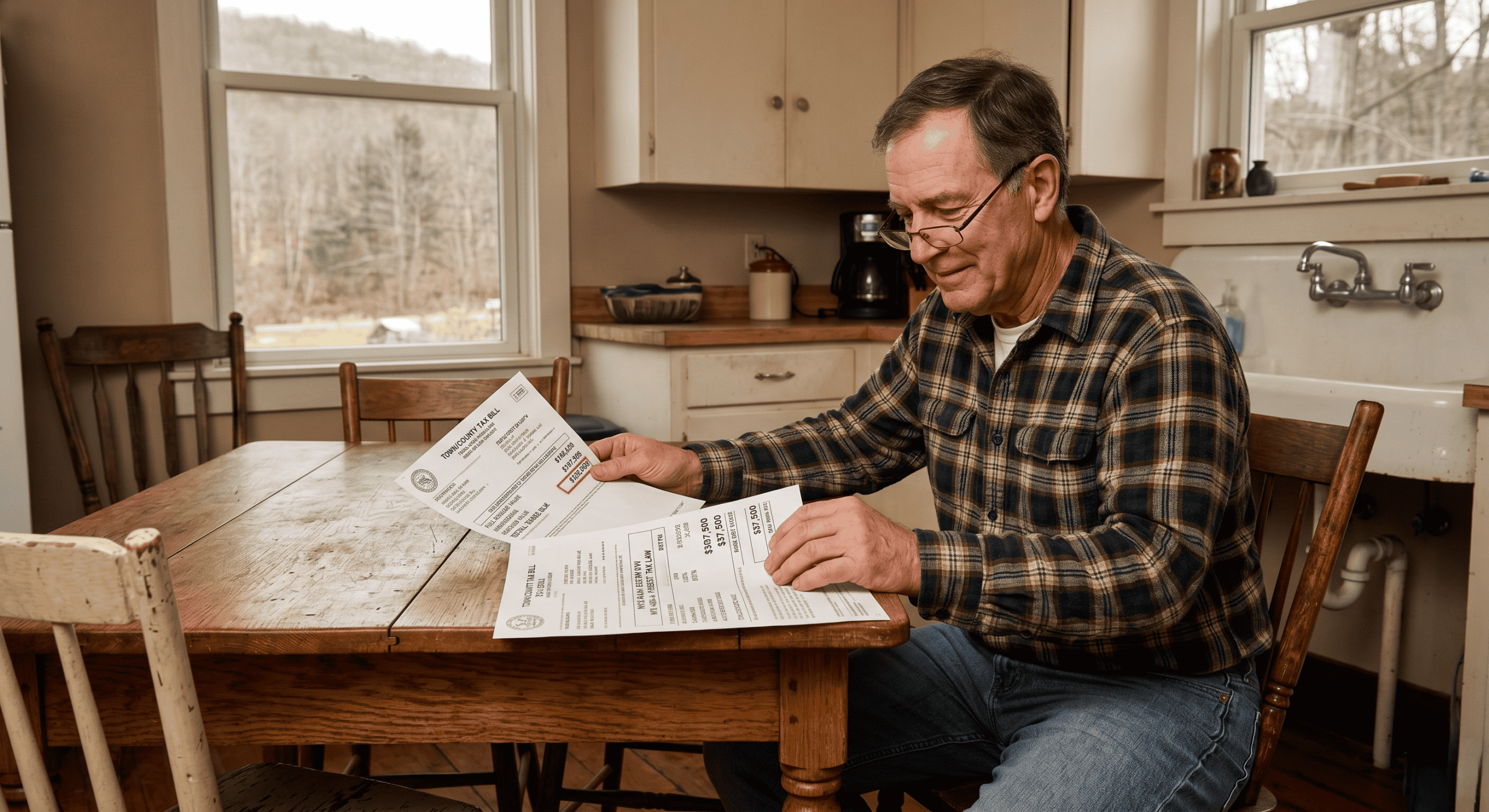
Your current assessed value per acre appears on your property tax bill or your county’s online assessment roll. That number is your starting point. The 480-a reduction applies to that number — so a higher assessed value per acre means larger absolute savings from enrollment.
Your Local Tax Rate
New York property taxes combine multiple rates — town, county, school district, and any special districts — into a combined rate expressed in dollars per $1,000 of assessed value. That combined rate varies significantly by township and school district.
In Sullivan County townships, combined tax rates typically run in the range of $12 to $25 per $1,000 of assessed value depending on the municipality and school district. For Ulster County, rates vary similarly. In Orange County, rates in some areas run higher. Your current tax bill shows the combined rate — or you can calculate it by dividing your current tax bill by your assessed value and multiplying by 1,000.
Your Qualifying Acreage
Only qualifying productive forest acreage enrolls. Wetlands, open fields, structures, and non-productive areas don’t count. The enrolled acreage is what receives the 480-a reduced assessment. A property with 100 total acres but only 70 qualifying forest acres enrolls 70 acres — and the savings calculation applies to those 70 acres only.
For a full explanation of what counts toward qualifying acreage and what doesn’t, see my article on how to qualify for the 480-a forest tax exemption.
Sample Savings Calculations for Sullivan, Ulster, and Orange Counties
Here are three illustrative examples representing different property sizes and assessed values commonly found in this region. All use the 80% reduction as the maximum — actual reduction percentages can vary by NYSDEC’s established 480-a value for your specific county and stand type.
Example One — 60-acre Sullivan County property, lower assessed value:
Assessed value: $1,200 per acre × 60 acres = $72,000 standard assessment
After 80% reduction: $14,400 enrolled assessment
At a combined rate of $15 per $1,000: $1,080 annual tax vs. $216 enrolled tax
Annual savings: $864 — over 20 years: $17,280
Example Two — 100-acre Sullivan County property, mid-range assessed value:
Assessed value: $2,000 per acre × 100 acres = $200,000 standard assessment
After 80% reduction: $40,000 enrolled assessment
At a combined rate of $15 per $1,000: $3,000 annual tax vs. $600 enrolled tax
Annual savings: $2,400 — over 20 years: $48,000
And, Example Three — 150-acre Ulster County property, higher assessed value:
Assessed value: $3,000 per acre × 150 acres = $450,000 standard assessment
After 80% reduction: $90,000 enrolled assessment
At a combined rate of $20 per $1,000: $9,000 annual tax vs. $1,800 enrolled tax
Annual savings: $7,200 — over 20 years: $144,000
These are illustrative examples. Your actual savings depend on your township’s specific assessed value and combined tax rate. The math, however, is straightforward — and you can run your own numbers using your current tax bill and assessed value.
The Long-Term Savings Picture
The annual savings number is significant on its own. The long-term cumulative number is the figure that most landowners find genuinely surprising.
A landowner who enrolls a 100-acre Sullivan County property at $2,400 in annual savings and holds the property for 25 years captures $60,000 in cumulative tax savings — from a single management plan investment that typically runs $1,500 to $2,500 for a property that size. The plan renews at year ten — another plan cost — but the savings continue. Over 25 years, the savings-to-plan-cost ratio runs somewhere between 15 and 30 to one.
Those savings also compound in a second way. The management activities the 480-a plan prescribes improve timber quality and forest health over the enrollment period. The timber asset that produces the next harvest in year 15 or 20 is more valuable than it would have been without active management. The tax savings and the improved timber asset are both products of the same stewardship practice.
For the full picture of how 480-a fits alongside timber income and hunting lease revenue, see my article on how to make money from wooded land.
What the Plan Cost Looks Like Against the Savings
Every landowner who asks about 480-a eventually asks: does the plan cost justify the savings? The answer is almost always yes — and the math makes it obvious.
A management plan for a 100-acre Sullivan County property typically runs $1,500 to $2,500. At $2,400 in annual savings, that plan cost recovers in seven to thirteen months. After that, the savings continue for the remaining nine-plus years of the plan period — with no additional plan cost until renewal.
At renewal, the landowner pays for an updated plan — typically less than the original because the forester already knows the property and much of the background documentation carries forward. The renewed enrollment then produces another decade of savings.
The only scenario where plan cost might not justify enrollment is a very small property — under 60 qualifying acres with a low assessed value and low local tax rate — where annual savings are modest. Even there, the break-even timeline is rarely more than two or three years. For a complete treatment of management plan costs and returns, see my article on forest management plan cost in New York.
What 480-a Savings Mean Alongside Timber Income
The 480-a savings don’t exist in isolation. They stack with other income streams from the same property — creating a combined financial picture that most unmanaged woodland never approaches.
On a 100-acre Sullivan County woodlot managed under a 480-a plan, a realistic ten-year financial picture might look like this:
- 480-a tax savings: $2,400 per year × 10 years = $24,000
- Selective timber harvest in year five: $15,000 to $30,000 in stumpage income
- Hunting lease revenue: $1,500 to $2,000 per year × 8 years (post-habitat improvement) = $12,000 to $16,000
- Total ten-year return: $51,000 to $70,000 from a property that cost $2,000 to $2,500 in plan fees to activate
That’s the real case for 480-a. Not just the tax savings in isolation — but the tax savings as the anchor of a multi-stream income approach that the management plan makes possible. For the complete guide to stacking these income streams, see my complete guide for private forest landowners.
What Reduces Your Savings Below the Maximum
The “up to 80%” language in the program description matters. The 80% figure is the maximum reduction — not a guaranteed floor. Several factors can reduce the actual savings below the maximum.
Lower-than-maximum 480-a assessed value. NYSDEC establishes 480-a assessed values by county and stand type. In some counties and for some stand types, the established 480-a value results in a reduction somewhat below 80%. The actual reduction percentage depends on the relationship between your standard assessed value and NYSDEC’s established 480-a value for your stand type and county.
Non-qualifying acreage excluded from enrollment. Wetlands, fields, and other non-qualifying areas on your property don’t receive the 480-a reduction — only the enrolled forest acreage does. The larger the proportion of non-qualifying land on your property, the smaller the share of your total tax bill that the 480-a reduction affects.
Changes in local tax rates or assessments. If your township raises its combined tax rate or reassesses property values upward over the enrollment period, both your standard tax liability and your 480-a tax liability increase proportionally. The 480-a reduction percentage stays the same — but the absolute dollar savings move with the tax rate and assessment changes.
Current 480-a program details and established values are at dec.ny.gov. For the full framework on how 480-a stewardship requirements interact with the tax savings, see my article on forest stewardship and 480-a tax savings.
Frequently Asked Questions
Does the 480-a reduction apply to the full property or just the woodland?
Only the enrolled qualifying forest acreage receives the 480-a reduction. The rest of your property — buildings, lawn, non-forest land, wetlands, open fields — continues to be assessed at standard rates. The 480-a reduction is specific to the acres that meet the productive forest land requirement and are enrolled in the program. Your tax bill will show the enrolled acreage at the 480-a value and the remaining acreage at standard assessed value.
Can my 480-a savings change over time?
Yes — in both directions. If your township raises its combined tax rate, your 480-a savings in absolute dollar terms increase because the gap between standard tax and enrolled tax widens. If assessments are adjusted downward — less common but it does happen — the absolute savings may decrease. NYSDEC can also periodically update the established 480-a values by county and stand type, which changes the reduction amount. Your forester can advise on how current established values apply to your specific stand conditions.
Do I get the tax savings while I’m waiting for NYSDEC approval?
No. The 480-a reduction begins after NYSDEC approves the management plan and the landowner files a successful enrollment application with the local tax assessor. The reduced assessment applies starting the following tax year after assessor approval. This is another reason to start the process well in advance of any tax year deadline — the approval and enrollment process takes three to six months, and missing the assessor’s application window delays the first savings by a full year.
How Environmental Forest Products Can Help
I’ve helped landowners across Sullivan, Ulster, and Orange Counties calculate their 480-a savings potential and get enrolled for over 30 years. Before I write any management plan, I estimate the realistic annual savings for the specific property — so the landowner knows what the enrollment will save before committing to any fees.
Here’s what I can do for a landowner evaluating 480-a savings potential:
- Review your current tax bill and assessed value to estimate realistic annual savings before any engagement begins
- Walk the property to confirm qualifying acreage and identify any non-qualifying areas that affect the savings calculation
- Write the management plan and handle the NYSDEC submission and approval process
- Guide the assessor application so enrollment is in place for the earliest possible tax year
- Integrate the 480-a enrollment with a timber management approach that generates additional income alongside the tax savings
If you own woodland in Sullivan, Ulster, or Orange County and you’ve never calculated what 480-a would actually save on your specific property, call me. The estimate takes five minutes and costs nothing. The savings, once you enroll, run for decades.
Request a Free 480-a Savings Estimate
Call me directly: (845) 754-8242
Email: henry@eforestproducts.com
Serving Sullivan County NY, Ulster County NY, Orange County NY, Pike County PA, Wayne County PA, and Sussex County NJ.
Henry Kowalec is a licensed consulting forester and member of the Society of American Foresters with over 30 years serving private landowners in the Hudson Valley and Catskills. Environmental Forest Products | Westbrookville, NY 12785 | Licensed in NY, PA, NJ.