Forest health problems rarely announce themselves all at once. They develop over years — a thinning crown here, a fungal conk there, a wall of barberry where native seedlings used to establish. By the time most landowners notice something is wrong, the problem has been developing for two or three seasons.
A woodlot health assessment is the practice of walking your property with specific things in mind — not just a casual stroll, but a systematic look at the indicators that tell you whether your woodland is gaining or losing ground. Done regularly, it gives you the early warning you need to act before small problems become expensive ones.
Here’s how to do it, what to look for, and how to tell when your own observations are enough versus when you need a professional assessment.
Why a Woodlot Health Assessment Matters
Most private woodland in the Hudson Valley and Catskills goes years between professional visits. That’s not necessarily a problem — well-managed stands with an active forest management plan don’t need constant attention. But between plan-prescribed management activities, health conditions can shift in ways that change what the next management decision should be.
An ash stand that was healthy three years ago may now be showing EAB crown dieback that changes the entire management calculation. A hemlock grove that appeared vigorous may be developing hemlock woolly adelgid pressure that warrants treatment before it becomes a mortality event. A section of understory that was clean native regeneration may now be a barberry monoculture that will take three seasons to address.
Early detection matters in all three cases. The window for capturing ash timber value closes fast once crown decline begins. HWA treatment is effective when caught early and ineffective after significant crown loss. Barberry is far easier to control at initial establishment than after it’s blanketed an acre.
A woodlot health assessment doesn’t have to be elaborate. An annual walk with the right checklist catches most developing problems in time to act on them.
What a Woodlot Health Assessment Actually Covers
A woodlot health assessment looks at the entire stand — not just individual trees — and evaluates the woodland as an integrated system. It covers tree-level observations, understory conditions, species composition, regeneration, invasive pressure, and stand structure. All of these interact. A stand with heavy invasive pressure will have poor regeneration. Then a stand with compromised mast trees will have reduced wildlife habitat quality. A stand with suppressed stocking will have reduced timber value accumulation.
A good assessment records what you observe — ideally with notes and a rough sketch map of problem areas — so you have a baseline for comparison on the next walk. Change over time is often more informative than any single snapshot.
The Six Health Indicators to Check on Every Walk
These six categories cover the most important health dimensions of a private woodland in the Hudson Valley and Catskills region. You can assess most of them without professional training — though some observations require a forester’s interpretation to turn into a management decision.
Crown Condition
Look up. The crown — the living leaf and branch system at the top of each tree — is the first place health stress shows. A healthy tree has a full, symmetrical crown for its species and position. Thinning foliage, dead branch tips, dieback starting at the top and progressing downward, or asymmetrical crown loss all signal stress.
Crown dieback in ash trees is the most urgent indicator in this region right now. EAB causes progressive top-down dieback that moves faster than most landowners expect. By the time 50% of the crown is gone, timber salvage value has dropped sharply. Check ash crowns specifically — and check them every year. For the full EAB picture and what declining ash crowns mean for your timber value window, see my article on emerald ash borer for NY landowners.
Bark and Stem Signs
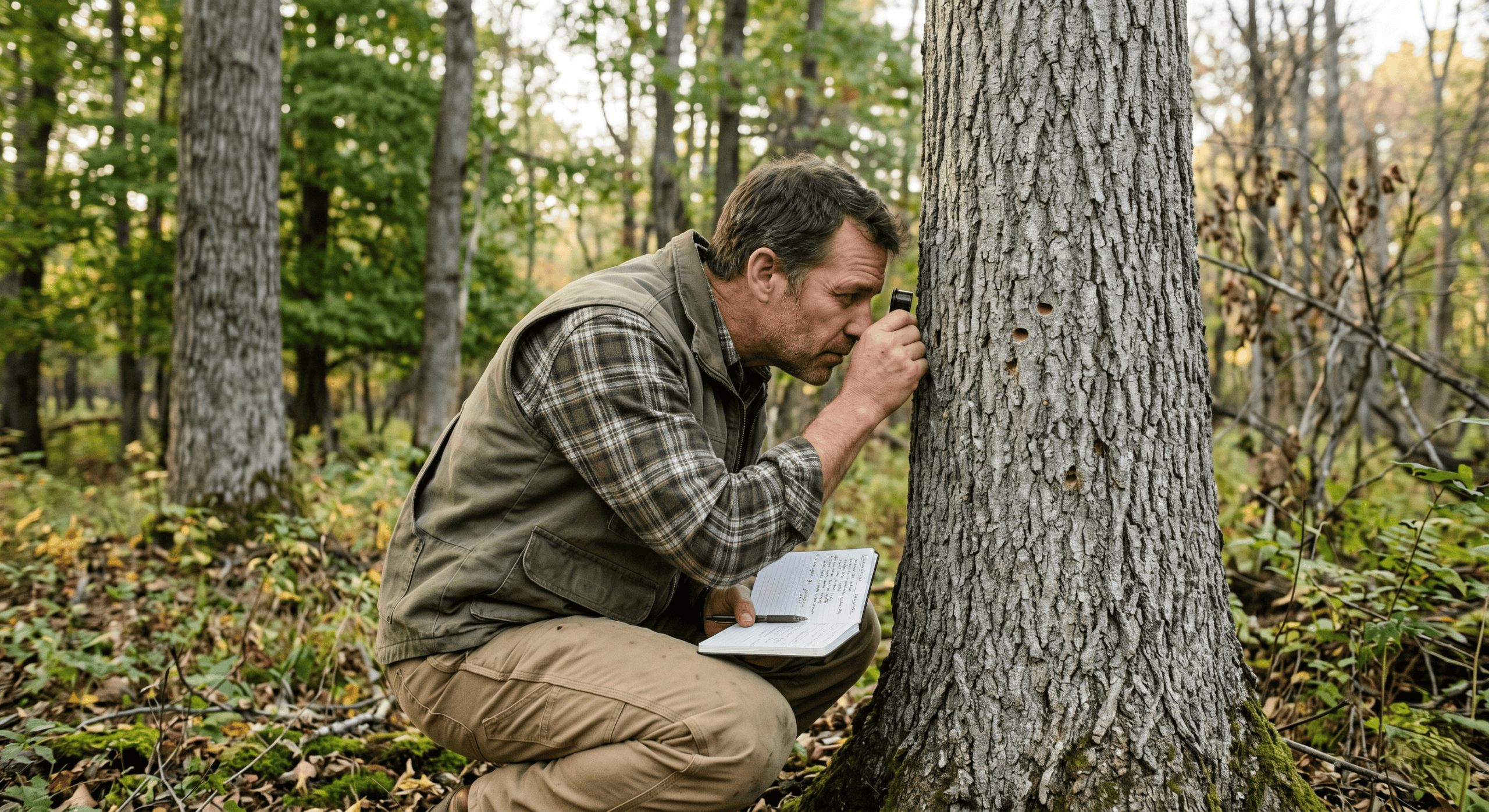
The bark and stem carry external evidence of what’s happening inside the tree. Walk close to your most important trees and look for:
- D-shaped exit holes — approximately 1/8 inch wide, flat-sided; diagnostic sign of EAB adult emergence on ash bark
- Fungal conks — shelf-like growths on the bark or at the base; indicate active internal decay, usually sapwood or heartwood rot
- Vertical bark splits or cracks — can indicate internal decay, freeze-thaw damage, or in ash, the callus tissue response to EAB larval galleries beneath
- Woodpecker excavation — extensive flecking or scaling of bark by woodpeckers searching for larvae; a reliable early indicator of EAB or other wood-boring insect activity
- Resin streaming or wetwood — on oaks, can indicate bacterial wetwood or early decline; on conifers, may indicate bark beetle activity
- Scale insects or woolly masses on hemlock twigs — the white woolly coating at the base of hemlock needles is the diagnostic sign of hemlock woolly adelgid
Understory Composition
What’s growing below the canopy tells you about the future forest. A healthy understory has a mix of native species — seedlings and saplings of desirable canopy trees, native ferns, native shrubs — establishing at various heights beneath the canopy.
Problem signs: a dense, unbroken layer of Japanese barberry or multiflora rose that shades out native seedlings; beech root sprout colonies that exclude everything around them; a completely bare forest floor under closed canopy with no regeneration of any species. Each of these signals a different management problem with a different solution.
Mast and Regeneration
Mast production — acorns, beechnuts, and other hard mast — is the wildlife foundation of a hardwood stand. Walk your oaks and beeches in late summer and fall and observe the mast crop. A good mast year on a well-structured oak means abundant acorns on the ground. A compromised crown — suppressed, damaged, or declining — produces fraction of the mast a released open-grown tree produces.
Regeneration assessment answers the question: what species are establishing under the current canopy? If desirable species — oak, cherry, maple — are present as seedlings and small saplings, the stand has a viable next generation. If invasives dominate and no desirable species are establishing, the next generation is already in trouble. For the habitat implications of mast production and regeneration, see my article on managing woods for deer.
Invasive Species Pressure
Walk the understory specifically looking for the invasive species most active in your area. In Sullivan, Ulster, and Orange Counties, the priority species to monitor are:
- Japanese barberry — thorny, low-growing shrub with small oval leaves; often first-noticeable as a dense spiny groundcover in disturbed areas
- Multiflora rose — arching canes with clusters of small white flowers in late spring; can form impenetrable thickets in gap areas
- Autumn olive — silvery-green leaves with nitrogen-fixing root nodules; common along forest edges and in canopy gaps
- Oriental bittersweet — vine that girdles and kills trees; identified by round orange-red berries in fall and distinctive girdling bark damage on host trees
- Wild grape — heavy vine load that breaks branches and suppresses crown development; common throughout the region
Note where each species is present, how dense the coverage is, and whether coverage has expanded since your last walk. Early-stage establishment is manageable. Late-stage monoculture coverage requires intensive multi-year treatment. For the management tools available for each, see my article on timber stand improvement.
Stand Structure and Stocking
Step back and look at the stand as a whole. Is the canopy dense and closed, or does it have gaps and openings? Are trees of different ages and sizes present — structural diversity — or is the stand uniform and even-aged? Is the stocking heavy with many competing stems, or are trees well-spaced with room to develop?
Dense uniform stocking with heavy competition signals a stand that needs thinning or TSI work. Abundant gaps may mean recent mortality or prior disturbance — worth tracking. A stand with no vertical structure — just a closed canopy and a bare floor — has poor habitat value and limited regeneration potential. For the management implications of overgrown, structurally compromised stands, see my article on how to improve a neglected or overgrown woodlot.
The Three Most Active Threats in Sullivan, Ulster, and Orange Counties
Regional context matters for a health assessment. Here are the three threats I currently see most actively on private woodland in this region.
Emerald ash borer is confirmed throughout New York State and is actively moving through ash populations across the region. Any ash with crown dieback, D-shaped exit holes, woodpecker scaling, or epicormic sprouting on the trunk needs evaluation immediately. The timber salvage window for declining ash is measured in seasons, not years.
Hemlock woolly adelgid is an expanding threat to eastern hemlock in the Hudson Valley. HWA-affected hemlocks show progressive needle loss from the inner crown outward, white woolly masses at needle bases, and eventually complete crown loss and mortality. Early-stage infestations respond well to systemic insecticide treatment. Late-stage infestations do not. Annual hemlock monitoring is worth the effort given what hemlocks provide — winter deer cover, cold-water stream shading, and year-round canopy. Check current HWA distribution at dec.ny.gov.
Beech bark disease has compromised the majority of mature American beech across the region. BBD-affected beech decline over years and eventually die — but before dying, they produce dense root sprout colonies that crowd out desirable regeneration. Monitor beech for active BBD signs (small bumps on bark from the beech scale insect followed by fungal canker) and for expanding sprout colonies in the understory that are suppressing oak and cherry regeneration.
What You Can Assess Yourself — and What Requires a Forester
A self-assessment is genuinely valuable. You can identify crown dieback, document bark signs, note invasive species presence and coverage, observe mast production, and track changes from year to year — all without professional training. That baseline information is useful to you and to any forester you eventually bring in.
Where a forester’s assessment adds value that self-observation can’t replace:
- Confirming pest or disease identification — distinguishing EAB signs from other bark damage, confirming HWA vs. other scale insects, assessing BBD severity on individual trees
- Evaluating timber implications of health conditions — which declining trees should be harvested immediately, which have time, which have no remaining value
- Prescribing treatment — what herbicide, what application method, what timing for invasive control; what TSI prescription addresses the specific stand conditions observed
- Updating the management plan if health conditions have changed significantly since the last assessment
For new woodland owners learning to read their land, see my article on forest land management for beginners for a broader introduction to what a management walk involves.
How Often Should You Assess Your Woodlot?
An annual walk is the right baseline for most private woodland owners. Pick the same season each year — late summer is useful because EAB crown dieback is most visible, mast crops are assessable, and invasive species are at peak growth and easy to identify.
Walk more frequently if: you have ash or hemlock on the property given current active pest pressure in the region; you’ve recently completed a harvest or TSI treatment and want to track regeneration and invasive response; or you’ve identified a developing problem — expanding barberry coverage, declining crowns — that you’re monitoring for treatment timing.
A professional assessment every five years — or at each plan renewal cycle — gives the baseline a level of technical accuracy that self-observation alone can’t provide. Between those professional visits, your annual walk is what catches problems before they’re emergencies.
Frequently Asked Questions
What are the most common signs of an unhealthy woodlot?
The most consistent signs I see across unmanaged private woodland in this region are: crown dieback on ash from EAB, white woolly masses on hemlock indicating HWA, heavy Japanese barberry or multiflora rose coverage suppressing native regeneration, dense beech root sprout colonies crowding out desirable species, and vine-loaded crop trees with suppressed or damaged crowns. Any one of these warrants attention. More than one in the same stand is a clear signal that active management is overdue.
Can I do a woodlot health assessment without forestry training?
Yes — a useful one. You can observe crown condition, document bark signs, note invasive species presence and density, and track changes year to year without professional credentials. What you can’t reliably do without training is confirm specific pest or disease identification, assess timber value implications of declining trees, or prescribe appropriate treatments. A self-assessment gives you a baseline and early warning. A forester confirms the interpretation and prescribes the response.
How is a professional woodlot health assessment different from a self-assessment?
A professional assessment adds three things a self-assessment can’t produce: accurate identification of pest and disease conditions, evaluation of the timber value and management implications of what’s observed, and a written prescription for treatment. A forester also brings regional knowledge — which threats are currently active in your county, what the current treatment windows are, and what NYSDEC programs may apply to your situation. Both types of assessment are useful. The professional assessment is what turns observations into a management action plan.
How Environmental Forest Products Can Help
I conduct woodlot health assessments on private woodland across Sullivan, Ulster, and Orange Counties regularly. A health assessment is often the starting point for a broader management engagement — it tells us both what the stand currently needs and what the realistic management options are going forward.
Here’s what I can do for a woodland health assessment:
- Walk the entire property systematically — evaluating crown condition, bark and stem signs, understory health, invasive pressure, mast and regeneration, and stand structure
- Identify and confirm pest and disease conditions — EAB, HWA, BBD, and any other active threats — and assess their current severity and management implications
- Evaluate the timber value implications of any declining trees and advise on timing for any salvage harvest decisions
- Write a written assessment summary with priority management recommendations
- Integrate findings into a management plan update or a 480-a compliance amendment if conditions have changed significantly
If you haven’t walked your woodlot with fresh eyes in the last two or three years — or if you’ve noticed something that concerns you and want an expert opinion — call me. A health assessment takes half a day on most properties and gives you the baseline you need for every management decision that follows.
Request a Free Woodlot Health Assessment
Call me directly: (845) 754-8242
Email: henry@eforestproducts.com
Serving Sullivan County NY, Ulster County NY, Orange County NY, Pike County PA, Wayne County PA, and Sussex County NJ.
Henry Kowalec is a licensed consulting forester and member of the Society of American Foresters with over 30 years serving private landowners in the Hudson Valley and Catskills. Environmental Forest Products | Westbrookville, NY 12785 | Licensed in NY, PA, NJ.