Every year, private woodland owners in New York sell timber and walk away thinking they got a fair deal. Most of them have no way to know whether they did. They don’t know what the timber cruised out at, didn’t solicit competing bids, and accepted the first number a buyer put in front of them. That number was set by someone who knew exactly what the timber was worth while they were guessing.
I’ve managed timber sales on private land across Sullivan, Ulster, and Orange Counties for over 30 years. The gap between what an unmanaged sale returns and what a properly managed sale returns is not marginal. On a $30,000 sale, the difference can easily reach $6,000 to $12,000 — for identical timber, on identical ground, sold in the same market.
The steps that close that gap are not complicated. Here they are, in order.
The Most Common Way Landowners Get Taken Advantage Of
It almost always starts the same way. A timber buyer contacts the landowner — by letter, by phone, by door — and makes an offer. He seems knowledgeable. His confidence about what the timber is worth anchors the entire conversation. He may walk the property and point out trees. Because the landowner doesn’t know the timber’s independent value, that first number sets the frame for everything that follows.
That anchor is the problem. A buyer’s first offer reflects what the timber is worth to his operation at a price that preserves his margins. It does not reflect market stumpage price, and it does not reflect what competitive bidding would produce. The buyer knows this. The landowner typically does not.
This information asymmetry is the core mechanism. A timber buyer who has cruised and priced hundreds of stands knows your timber better than you do after a twenty-minute walk. Closing that gap requires independent information — a timber appraisal — before any price conversation begins. For the full explanation of why a buyer’s offer is not a valuation, see my article on timber buyers vs. consulting foresters.
Step One — Get an Independent Timber Appraisal First
The most protective thing a landowner can do before selling timber is to know what the timber is worth before anyone else names a price. An independent timber appraisal by a licensed consulting forester produces that knowledge.
A timber appraisal includes a field cruise — systematic sampling plots across the stand, measuring species, diameter, and log grade for every merchantable tree. Those measurements produce volume estimates by species and grade class. Current stumpage prices from NYSDEC regional data and local market knowledge then convert that volume into a written stumpage value estimate.
That report becomes your negotiating baseline. It tells you what you have, what it’s worth, and the minimum you should accept. It also gives you the information to recognize when a buyer’s offer is reasonable versus when it falls well below market. Without that document, you’re negotiating blind.
NYSDEC publishes regional stumpage price data that provides a public benchmark for what timber is selling for in your area. That data is available at dec.ny.gov. For a complete explanation of the timber appraisal process and what the report contains, see my article on how to get a timber appraisal on your property.
Step Two — Mark the Timber Before Anyone Makes an Offer
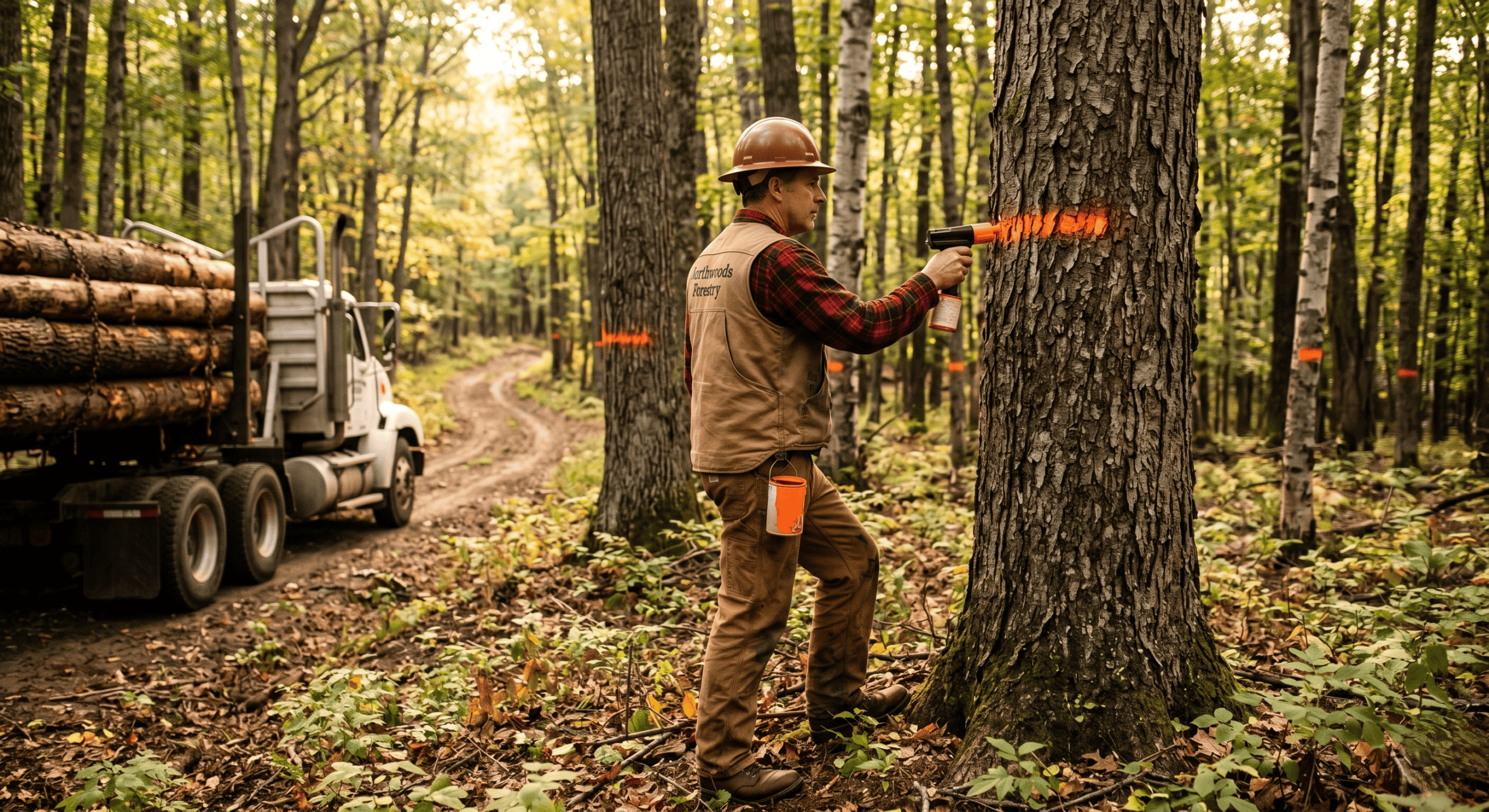
Timber marking — identifying which trees will be cut and which will remain — is one of the most consequential steps in any timber sale. Marking determines what income the sale generates today and what forest value remains after the logger leaves.
A consulting forester marks timber based on silvicultural objectives — which trees should come out given the stand’s age, composition, and long-term management goals. A buyer who offers to mark his own timber is identifying what he wants to take. Those two prescriptions produce very different outcomes.
When a buyer marks timber, he takes the best trees — the highest-grade, largest-diameter stems that maximize his return. Your residual stand becomes whatever he left behind. An unmanaged buyer-marked sale consistently leaves a poorer-quality residual stand than a forester-marked sale — and you’ll be managing and harvesting from that residual for the next twenty years.
Marked timber also defines the sale precisely. A timber sale contract can reference specific marked trees. Payment bases on the marked volume. Any trees cut outside the marked boundaries become a contract violation. Without forester-marked timber, you have no defined product to sell, no audit trail, and no contractual basis for protecting the trees you want to keep. For the silvicultural side of what a properly marked harvest involves, see my article on selective timber harvesting.
Step Three — Competitive Bids, Not a Single Offer
This is the step that produces the largest single financial impact in a timber sale. The difference between a single-buyer offer and competitive bidding is the difference between what one buyer is willing to pay and what the market will actually bear.
A competitive bid process works like this. The consulting forester prepares a timber sale prospectus — the cruise data, the marked timber volume by species and grade, the sale boundary, the access conditions, and the contract terms. That prospectus goes simultaneously to multiple qualified buyers in your region. Each buyer has the same information and submits a sealed bid by a set deadline. The highest qualified bid wins.
When buyers know they’re competing, they bid at or near what the timber is worth to them — not at the lowest number they think a landowner will accept. On properties across Sullivan and Ulster Counties, I’ve run this process where the high competitive bid ran 25% to 40% above the initial single-buyer offer the landowner had already received. On a $30,000 sale, that spread translates to $7,500 to $12,000 in additional income for the same trees.
The prospectus also ensures every bidder prices the same defined product. Without marked timber and a cruise report, different buyers estimate different things. Competitive bids on undefined timber produce incomparable numbers. Bids on marked, cruised timber produce directly comparable market prices.
Step Four — Write a Proper Timber Sale Contract
A handshake deal and a check are not a timber sale contract. By the time the logger has left the property, any verbal agreement is unenforceable. A written contract — signed before any equipment enters — is the only legal protection a landowner has.
What the Contract Must Include
A timber sale contract protects the landowner before, during, and after the harvest. Every contract I write for a client includes these components:
- Defined sale area — the exact boundaries of the harvest area, with map attached; trees outside the boundary are explicitly excluded
- Marked timber identification — reference to the forester-marked trees by species and grade class; unmarked trees are not part of the sale
- Price terms — stumpage price per MBF by species and grade, total estimated payment, deposit requirements, and payment schedule
- Logging specifications — maximum stump height, slash disposal requirements, stream buffer protection zones, and any area restrictions
- Skid trail and landing specifications — where skid trails may be located, what surface treatment is required, and how the logger seeds and stabilizes disturbed areas after the harvest
- Damage provisions — what constitutes damage to residual trees, the penalty for cutting outside the marked area, and who bears responsibility for remediation
- Insurance requirements — proof of logger’s liability insurance and workers’ compensation coverage before any equipment enters
- Completion and bond-back terms — what the logger must complete before the performance bond releases
A contract missing any of these provisions protects the logger more than the landowner. Get it in writing, get it complete, and get it signed before the first truck arrives.
Step Five — Forester Oversight During the Harvest
A well-written contract means nothing if no one verifies compliance. Timber harvests move fast. A logging crew can work through a stand in days, and problems that go unchecked during the harvest become permanent — residual tree damage, unauthorized cutting, improperly placed skid trails, slash piled in stream buffers.
Forester oversight means regular on-site visits — not occasional drive-bys. On each visit, I check which trees were cut against which trees were marked. I verify skid trail routing against the contract specifications and confirm that stream buffers are being respected. When problems arise — and they occasionally do, even with reputable loggers — I address them in real time, before they cause irreversible damage to the residual stand.
On-site oversight also creates the landowner’s evidentiary record of contract compliance. If a dispute arises after the harvest, documented oversight visits establish what was happening on the ground throughout the operation. Without that documentation, a dispute over contract violations becomes a credibility contest rather than a factual one.
What Happens If You Skip These Steps
I’ve walked properties after unmanaged timber sales many times. The pattern is predictable. The best trees are gone. Left behind are the species and stems that nobody wanted — lower quality, lower value, positioned to compete with each other for the next twenty years. Skid trails run wherever logging was easiest, not wherever site damage was least. Slash sits in the wrong places. Meanwhile, the landowner holds a check — often a fraction of what a managed sale would have returned — with no way to know what they left behind.
The residual stand damage is the most lasting consequence. It doesn’t surface immediately — it shows up at the next harvest, fifteen years later, when a forester walks the stand and finds that timber value should have built in the interim but hasn’t. The wrong trees were left, competing with each other in a compromised structure. The unmanaged sale cost the landowner twice: once in uncaptured stumpage income, and again in long-term stand value that poor residual composition may never fully recover.
How Much Can You Make Selling Timber in New York?
The honest answer: it depends on what you have. A well-stocked 50-acre woodlot of mature black cherry and oak in Sullivan or Ulster County — sold through a competitive bid process under forester management — can realistically return $20,000 to $50,000 or more in stumpage income. A red maple-dominated stand on difficult terrain returns significantly less.
What you have is answered by a timber cruise. What it’s worth is answered by current stumpage prices. What you’ll actually receive depends on whether you use a competitive bid process or accept the first offer someone makes you. For the complete framework on what drives timber value, see my guide on how much timber is worth. For how to read your own stand’s value potential before calling anyone, see my article on how to know if your timber is valuable.
Frequently Asked Questions
Can I sell my timber directly to a logging company without a forester?
You can — but you’ll be negotiating without knowing what you’re selling or whether the price is fair. A logging company’s offer reflects their margin requirements, not your timber’s market value. Without an independent appraisal and a competitive bid process, there is no market price — only what that one company is willing to pay. For many landowners, the forester’s fee is the best investment in the timber sale because it consistently returns more in additional stumpage income than it costs in fees.
What is a stumpage price and how do I know if mine is fair?
Stumpage price is what a buyer pays for standing timber — trees still in the ground, before cutting or hauling begins. It is expressed in dollars per thousand board feet, written as MBF. NYSDEC publishes regional stumpage price reports showing what timber has sold for in your region by species and grade. That data gives you a benchmark before any buyer names a price. Compare any offer against current NYSDEC data and the independent appraisal your forester produces — both together tell you whether the offer is fair.
How long does a properly managed timber sale take?
From initial forester engagement to final payment, a well-managed timber sale on a 50-acre woodlot typically takes three to six months. The timber cruise and appraisal run four to six weeks. Preparing the sale prospectus and soliciting bids takes another two to four weeks. The harvest itself runs one to four weeks depending on volume and site conditions. Final payment, slash cleanup, and site restoration follow the harvest. The timeline is longer than accepting a buyer’s offer on the spot — but the financial and silvicultural outcome is substantially better in every case I’ve managed over 30 years.
How Environmental Forest Products Can Help
I manage timber sales for private landowners across Sullivan, Ulster, and Orange Counties. Every sale follows the same five-step sequence — appraisal, marking, competitive bids, contract, oversight. My fee comes from the landowner. My job is to maximize what you receive from the sale and to protect the forest that remains after the logger leaves.
Here’s what I provide for every timber sale I manage:
- Timber cruise and written appraisal — species, volume, grade, and current stumpage value before any buyer conversation
- Tree marking — forester-marked timber that defines the sale, protects the residual stand, and serves as the contract reference
- Competitive bid process — sale prospectus, qualified buyer outreach, sealed bid solicitation, and bid evaluation
- Timber sale contract — complete written agreement covering all the protective provisions listed above
- Harvest oversight — regular on-site visits during the operation to confirm contract compliance
- Integration with any active 480-a management plan — confirming the harvest satisfies plan activity requirements and maintaining enrollment compliance
If a timber buyer has contacted you — or if you’re ready to sell timber and want to do it the right way — call me before you respond to any offer or sign any agreement.
Request a Free Timber Sale Consultation
Call me directly: (845) 754-8242
Email: henry@eforestproducts.com
Serving Sullivan County NY, Ulster County NY, Orange County NY, Pike County PA, Wayne County PA, and Sussex County NJ.
Henry Kowalec is a licensed consulting forester and member of the Society of American Foresters with over 30 years serving private landowners in the Hudson Valley and Catskills. Environmental Forest Products | Westbrookville, NY 12785 | Licensed in NY, PA, NJ.