Landowners ask me to recommend “the best tree for deer” like there’s one right answer. There isn’t. The right mix depends on your soil, how much sun the site gets, and what’s already growing on your property.
I’ve planted and managed mast trees across Sullivan, Orange, and Ulster Counties for over 30 years. What works reliably here in the Hudson Valley and Catskills isn’t always what a Southern hunting-land nursery catalog recommends. Here’s what I actually plant, and why.
Why Tree Choice Matters More Than People Think
Deer need different food at different times of year. A single tree species can’t cover that. Oaks provide fall and winter mast. Soft mast trees like apple feed deer earlier in the season. A mixed planting spreads that food out across more of the calendar.
I plan every wildlife planting around that calendar gap before I recommend a single species. Our tree planting services start with that assessment, not with a species list.
Which Oak Trees Are Best for Deer?
White oak is the tree I recommend most for deer on Hudson Valley properties. According to Ohio State University Extension’s guide to mast production for woodland wildlife, acorns from the white oak group are less bitter than acorns from the red oak group, and most wildlife species prefer them.
Red oak still earns a place in the planting plan. The Connecticut Department of Energy and Environmental Protection’s mast fact sheet notes that white oaks produce a sweet, palatable mast crop nearly every year, while red oaks produce a more bitter crop every other year that lasts longer on the ground through the winter. Planting both gives deer food earlier in the fall and later into winter, from the same planting.
One thing to set expectations on: oaks are slow. Ohio State Extension notes that oaks can take more than 25 years to start producing acorns. If you want mast sooner, oaks need to be paired with faster-producing species, not planted alone.
Is Persimmon a Good Choice for Deer in This Region?
Persimmon shows up on almost every national list of deer trees, and deer do eat the fruit readily where it grows. But I want to be straight with Hudson Valley landowners on this one: American persimmon isn’t native to Sullivan, Orange, or Ulster Counties. The New York Natural Heritage Program’s own records show the tree’s native New York range is limited to Long Island and the New York City area, not the Hudson Valley or Catskills.
That doesn’t rule it out entirely. Cold-hardy persimmon genotypes exist that survive well into colder zones, and our region generally falls in USDA zones 5b to 6b. [Zone claim TK — sourced from a general gardening reference, not yet confirmed against the USDA Plant Hardiness Zone Map directly; Henry to verify before publish.] But this isn’t a “plant it and forget it” tree here the way it is farther south. If you want to try persimmon, it needs a cold-hardy selection and a protected site, not a standard nursery seedling. [Specific cultivar recommendations TK — Henry to confirm which genotypes he’s had success with on local sites.]
For most properties in our service area, I’d rather put that planting effort into oak and apple, which I know perform here without qualification.
What Soft Mast Trees Should You Plant?
Apple is the soft mast tree I plant most often for deer in this region. It fruits earlier than oak, it’s well suited to Hudson Valley soils and climate, and old apple trees on abandoned homestead sites already show how well deer respond to it here.
Crabapple and native serviceberry are two more options worth considering, particularly on smaller plantings where a full-size apple tree isn’t practical. [Specific variety recommendations TK — Henry to confirm preferred cultivars for disease resistance in this climate.]
What Should You Avoid Planting Near Your Deer Trees?
Invasive shrubs are the biggest threat to a new mast planting, not the deer themselves. Ohio State Extension specifically flags autumn olive, multiflora rose, tree-of-heaven, and honeysuckle as species that outcompete native mast producers when left unchecked.
I see this constantly on properties across Sullivan County. A landowner plants oak and apple seedlings, and within two seasons, autumn olive and multiflora rose have shaded them out. Clearing that competition before and after planting matters as much as the species you choose.
How Many Trees Should You Actually Plant?
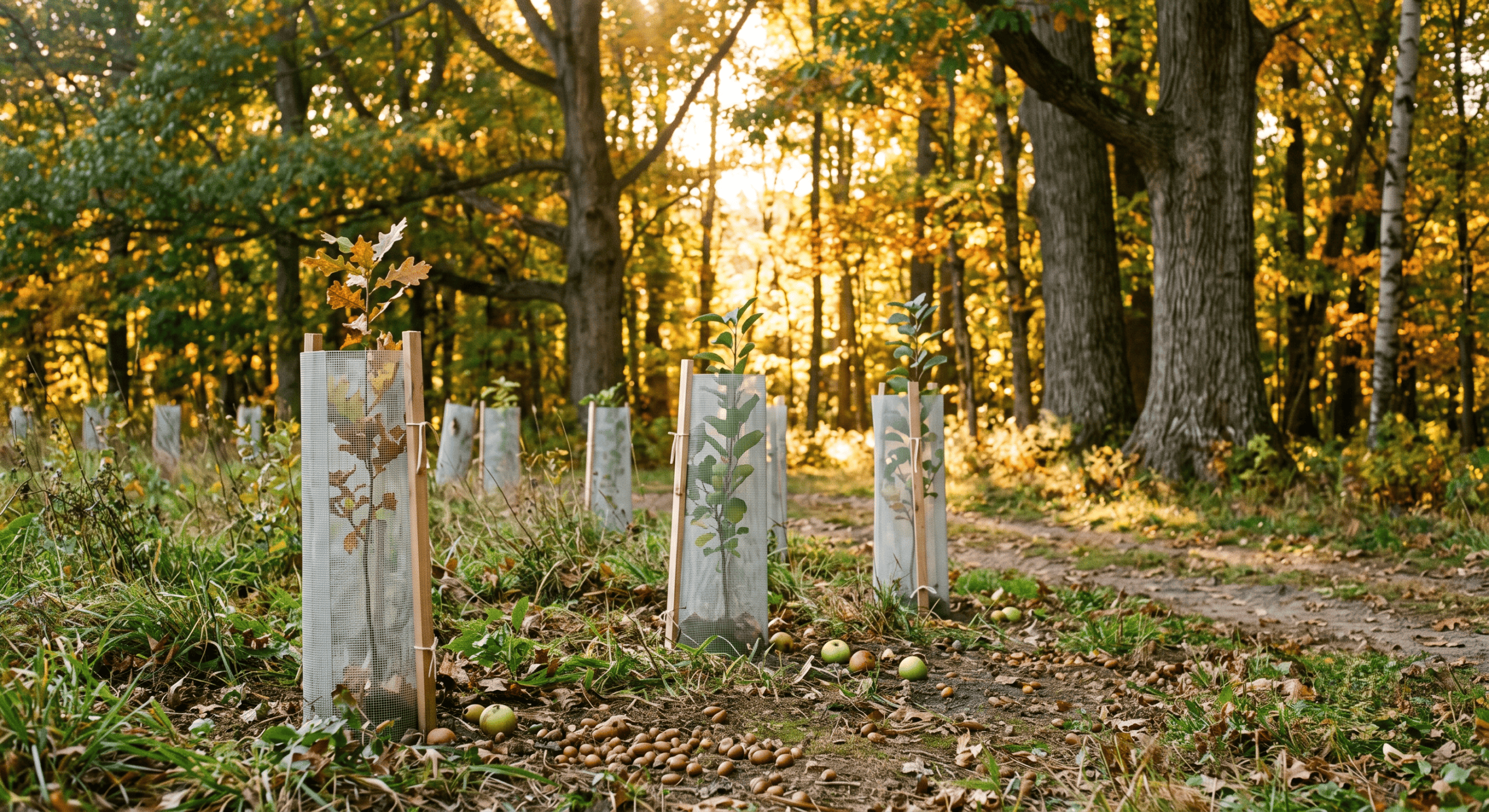
More than people expect, and expect losses. Deer browse pressure on young seedlings is heavy in this region, and tree shelters are often necessary to get a planting established. Ohio State Extension recommends tree shelters or other protection specifically in areas with high deer populations, which describes most of the properties I work on.
[Specific planting density and spacing recommendations TK — Henry to confirm based on typical order size and site conditions.] I plan for that loss rate up front rather than replanting a failed planting a second time. Our tree planting team accounts for browse pressure in every wildlife planting plan.
Frequently Asked Questions
What is the best tree to plant for deer in New York?
White oak is generally the strongest single choice for Hudson Valley properties, since deer prefer its acorns and it’s well suited to the region. A mix of white oak, red oak, and apple covers more of the feeding calendar than any single species.
Do deer prefer white oak or red oak acorns?
Deer generally prefer white oak acorns, which are less bitter than red oak acorns. Red oak acorns still matter because they last longer on the ground, providing food later into winter when white oak acorns are gone.
Should I plant persimmon trees for deer in the Hudson Valley?
Persimmon isn’t native to this region and sits at the edge of what grows reliably here. If you want to try it, use a cold-hardy genotype in a protected site rather than a standard nursery seedling.
How long does it take an oak tree to produce acorns for deer?
Oaks can take more than 25 years to start producing acorns. If you want food production sooner, pair oak plantings with faster-producing species like apple.
How Environmental Forest Products Can Help
I’ve planned wildlife plantings across Sullivan, Orange, and Ulster Counties for over 30 years, and I plant for what actually performs here, not what a national catalog recommends.
Before you order seedlings, I can walk your property and tell you which mix of oak, apple, and other mast species fits your soil, your sun exposure, and your deer pressure.
Learn more about our tree planting services, or request an estimate to get started.
Call (845) 754-8242 or email henry@eforestproducts.com. I serve landowners throughout Sullivan, Orange, and Ulster Counties, NY, plus Pike and Wayne Counties, PA, and Sussex County, NJ.
Henry Kowalec is a licensed consulting forester and member of the Society of American Foresters with over 30 years serving private landowners in the Hudson Valley and Catskills. Environmental Forest Products | Westbrookville, NY 12785 | Licensed in NY, PA, NJ.