Eastern hemlock is not replaceable on any reasonable human timeframe. A hemlock grove that took 150 years to develop cannot be replanted and recovered in a landowner’s lifetime. When hemlock woolly adelgid kills a stand, it takes the thermal cover, stream shading, and forest interior habitat that stand provided — permanently, from a practical standpoint.
Hemlock woolly adelgid is present in the Hudson Valley and Catskills region and has been advancing through hemlock populations in Sullivan, Ulster, and Orange Counties. The insect is small and the early damage is subtle. By the time most landowners notice something is wrong, the infestation has been progressing for one to three years. Treatment works — but it works best early. After significant crown loss, the window for effective intervention is much narrower.
Here’s how to identify HWA on your property, what treatment options exist, and how to decide whether treatment makes sense for your hemlocks.
Why Hemlocks Matter — What You Lose When They Die
Eastern hemlock (Tsuga canadensis) provides ecological services no other northeastern tree species replicates. Understanding what’s at stake makes the treatment decision easier to frame.
Winter deer cover. Hemlock groves provide the only reliable year-round thermal cover in the northeastern forest. Deer concentrate in hemlock stands during winter — the dense evergreen canopy intercepts snow, moderates temperature, and creates bedding conditions no hardwood stand can match in January or February. Landowners who manage for deer habitat and have hemlocks on their property are sitting on irreplaceable habitat infrastructure.
Cold-water stream shading. Hemlocks growing along stream banks shade the water, keeping temperatures low enough for brook trout and other cold-water species. When hemlock die along a stream, water temperatures rise, canopy gaps accelerate bank erosion, and the stream ecology shifts in ways that take decades to partially recover.
Forest interior habitat. Hemlock groves support a specific community of forest interior birds — Blackburnian warbler, Black-throated green warbler, and others — that depend on the dense year-round canopy. Those bird communities don’t reassemble after hemlock loss. The habitat simply doesn’t exist in former hemlock stands.
Visual and aesthetic value. Mature hemlock groves are among the most visually distinctive features of the Catskills and Hudson Valley landscape. Their loss changes the character of the landscape in ways that most landowners feel acutely when they happen.
For how hemlock stands function within a broader woodland health and habitat management framework, see my article on managing woods for deer.
How to Identify Hemlock Woolly Adelgid on Your Property
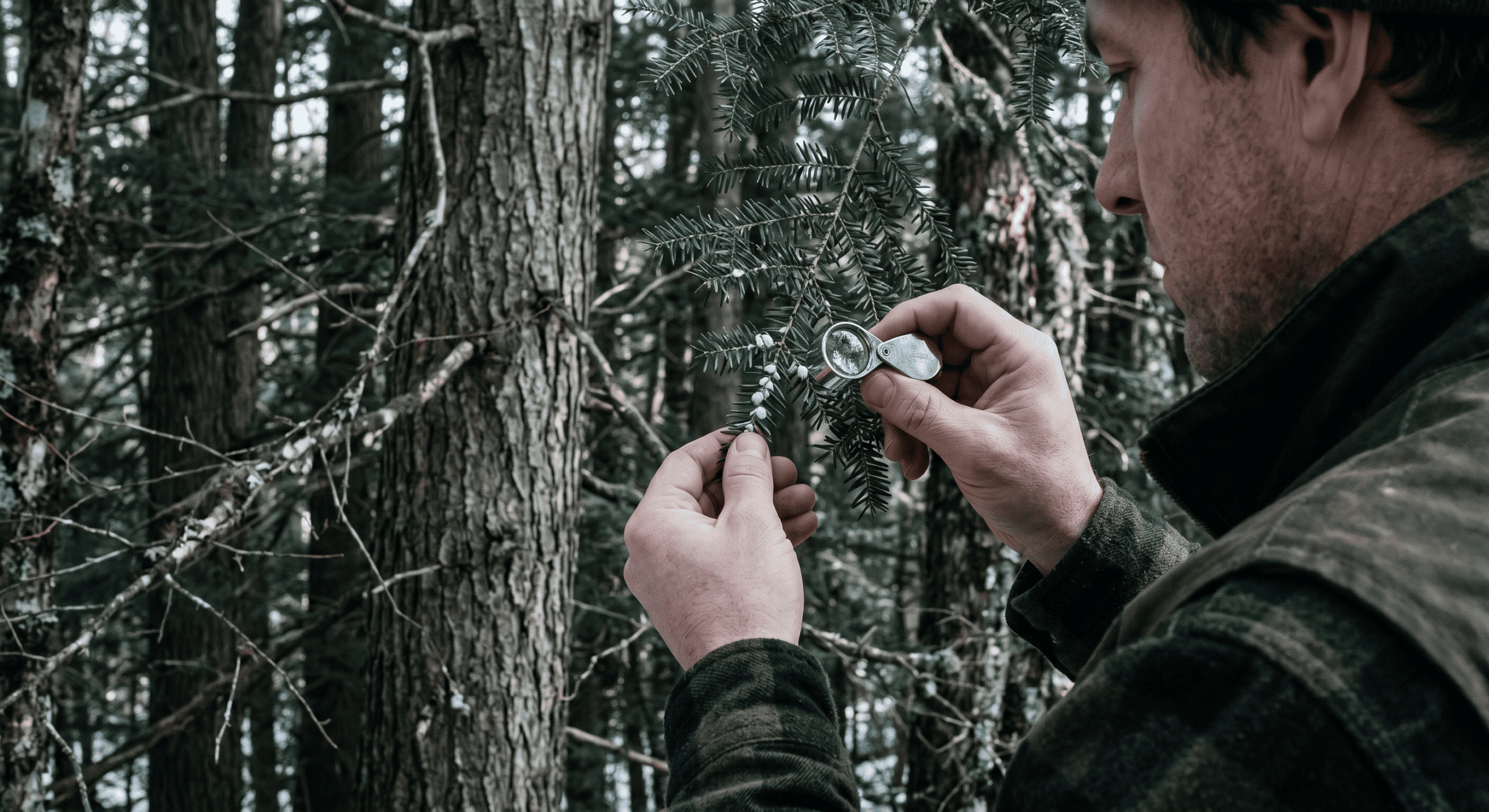
Hemlock woolly adelgid (Adelges tsugae) is tiny — about 0.8mm long — and not visible to the naked eye as an individual insect. What you see are the egg masses it produces: distinctive white woolly tufts at the base of hemlock needles on the underside of branches.
To check your hemlocks, pull a branch down to eye level and look at the underside of the twigs. If HWA is present, you’ll see small white woolly masses — like tiny cotton balls — attached to the base of individual needles. These masses are visible year-round, though they’re most conspicuous from fall through early spring when the adelgid is most actively producing eggs.
Beyond the woolly masses, watch for these progressive signs of HWA infestation:
- Needle graying or silvering — healthy hemlock needles are dark green on top with two white stomatal bands on the underside; HWA-infested needles gray from the base, losing their dark green color
- Needle drop from inner crown — HWA causes needles to drop from the inner portions of the crown first, working outward; thinning starts from inside out
- Branch dieback from crown tips inward — as infestation advances, branch tips die back and the crown thins progressively
- Crown transparency — a hemlock crown that lets you see through it has significant HWA damage; healthy hemlocks have dense opaque crowns
Early detection is everything. A hemlock with white woolly masses but still-green needles and a full crown responds well to treatment. A hemlock with 50% or more needle loss has a much lower chance of full recovery even with treatment. Current HWA distribution in New York is documented at dec.ny.gov.
How Fast Does HWA Kill Hemlock Trees?
HWA moves faster than most landowners expect. In warm regions with no winter mortality of the insect — the climate buffer that naturally limits HWA in colder climates — hemlocks can die within four to ten years of initial infestation. In the Hudson Valley and Catskills, colder winters kill a portion of the adelgid population each year, slowing the progression somewhat. But warming winters have reduced that natural suppression over time.
The practical timeline in our region: hemlocks typically show progressive decline over five to fifteen years from initial infestation, with mortality rate increasing as crown loss exceeds 50%. Trees that have lost more than 70% of their crown are rarely recoverable even with aggressive treatment.
The implication for treatment timing is straightforward. Treat while the tree still has most of its crown. Don’t wait to confirm the infestation is “serious enough.” If white woolly masses appear on a hemlock with value — ecological, aesthetic, or habitat — treatment is warranted.
Hemlock Woolly Adelgid Treatment Options
Three categories of treatment exist for HWA. Each has different delivery mechanisms, different protection durations, and different situations where it works best. Treatment requires a licensed pesticide applicator for some applications — confirm requirements with NYSDEC before beginning any program.
Soil Injection and Drench — Imidacloprid
Imidacloprid is a systemic neonicotinoid insecticide that hemlocks absorb through their root systems and translocate into the foliage where the adelgid feeds. Applied as a soil injection or soil drench around the tree’s drip line, imidacloprid moves through the vascular system to the needles. The adelgid feeds on the needle tissue, ingests the insecticide, and dies.
Soil application is cost-effective for treating multiple trees simultaneously in accessible locations. It requires adequate soil moisture for uptake — applications in dry conditions or on compacted soils reduce effectiveness. Protection duration for soil-applied imidacloprid typically runs three to seven years depending on tree size, soil conditions, and application rate.
One important caveat: imidacloprid has documented effects on pollinators and aquatic invertebrates. Applications near streams, wetlands, or flowering vegetation require careful timing and method selection. Do not apply within a recommended buffer distance of water features. Current label requirements and buffer distances govern application near water.
Trunk Injection — Emamectin Benzoate and Imidacloprid
Emamectin benzoate (trade name TREE-äge) delivered by trunk injection is the highest-efficacy treatment currently available for HWA. A licensed applicator injects the insecticide directly into the tree’s vascular system through ports drilled into the base of the trunk. The tree translocates the insecticide upward into foliage, where it kills feeding adelgids.
Trunk injection produces faster knockdown than soil application and avoids the soil-to-root uptake variable. Protection duration for emamectin benzoate trunk injection typically runs five to seven years per application — longer than most soil-applied imidacloprid treatments. The trade-off is higher per-tree application cost.
Imidacloprid trunk injection — a different delivery of the same active ingredient as the soil application — is also available. It produces faster uptake than soil application with similar protection duration. Both trunk injection products require licensed applicators in most situations.
Horticultural Oil and Insecticidal Soap
Horticultural oil and insecticidal soap kill adelgid by direct contact — physically smothering the insect. They require thorough coverage of all infested foliage, making them practical only for small, accessible trees where complete spray coverage is achievable. Both products provide no residual protection and require reapplication as populations rebuild.
For mature forest hemlocks with crowns too large for complete spray coverage, horticultural oil and soap are not practical control options. They work well for landscape hemlocks within reach of conventional spraying equipment.
When Treatment Is Worth It — and When It Isn’t
Not every hemlock warrants treatment. The decision depends on the tree’s current condition, its ecological or aesthetic value, and the realistic cost-benefit over the treatment period.
Treatment is clearly worth pursuing when:
- The hemlock has significant ecological value — stream bank shading, winter deer cover, forest interior bird habitat
- The tree still retains 70% or more of its crown with predominantly green needles
- The hemlock is a significant specimen — large diameter, prominent visual position, or irreplaceable landscape feature
- The stand has multiple mature hemlocks that collectively justify the treatment investment
Treatment is a harder case when:
- Crown loss has already exceeded 50% to 60%
- The hemlock is a small, suppressed stem with no particular ecological significance
- Access for repeat treatments is genuinely difficult
- The cost of multi-cycle treatment exceeds the realistic value of preserving that individual tree
For most mature stream-bank hemlocks, large-specimen hemlocks, or hemlocks in deer wintering areas, treatment is economically and ecologically justified when caught before significant crown loss. The math changes after 50% crown loss — efficacy drops and the investment becomes harder to justify on trees that may not recover even with treatment.
What Happens to the Forest When Hemlocks Die
The secondary effects of hemlock mortality extend well beyond the lost trees themselves. Understanding what follows hemlock loss informs decisions about both treatment and post-mortality management.
When hemlocks die along stream corridors, canopy gaps open over the water. Water temperatures rise — sometimes significantly — and bank erosion accelerates as root systems die and root mass no longer holds streambanks. The ecology of cold-water streams can shift permanently within a decade of hemlock loss along their banks.
In woodland interiors, dead hemlock stands create large canopy gaps that — without active management — often fill with invasive shrubs rather than desirable native species. The same gap dynamics that make harvest openings productive for native regeneration also benefit invasive plants when hemlock gaps open without management attention. Oriental bittersweet, multiflora rose, and autumn olive establish aggressively in hemlock mortality gaps. For controlling the invasive plants that colonize those gaps, see my article on invasive species in your forest.
Post-hemlock stand management — deciding what to do with dead and dying timber, how to manage the gap for native regeneration, and how to control invasive colonization — is a distinct planning challenge that a consulting forester can help navigate.
Monitoring Your Hemlock Stands — What to Watch For
Annual monitoring is the most important practice for any landowner with hemlocks. Check each stand once per year — late winter or early spring is the best window, when woolly egg masses are most visible and before new spring growth obscures them.
On each monitoring walk, pull branches at various heights and look at needle undersides for white woolly masses. Note which trees show masses and estimate coverage — sparse (a few branches), moderate (half the crown), or heavy (most of the crown). Note needle color and crown density. Photograph the same trees each year so you have a visual record of progression.
Early detection on even a few trees in a stand warrants beginning a treatment program for the whole stand. HWA spreads by wind and animal dispersal — hemlocks near infested trees will typically show infestation within one to two seasons of adjacent trees becoming heavily infested.
For a comprehensive approach to monitoring your woodland for multiple health threats simultaneously, see my article on how to do a woodlot health assessment. And for the full woodland management framework where hemlock protection fits, see my complete guide for private forest landowners.
Frequently Asked Questions
Can hemlock trees recover from HWA after treatment?
Yes — when treatment begins before significant crown loss, hemlock trees recover effectively. A tree retaining 70% or more of its crown at the time of treatment commonly shows new growth and crown restoration within two to three growing seasons after effective treatment. Trees with 50% to 70% crown loss can recover but more slowly and with less certainty. Trees with more than 70% crown loss are unlikely to recover even with treatment, though some survive at reduced vigor. This is why treatment timing matters more than almost any other variable in HWA management.
How long does hemlock woolly adelgid treatment last?
Protection duration depends on the product and application method. Soil-applied imidacloprid typically provides three to seven years of protection depending on soil conditions, tree size, and application rate. Emamectin benzoate trunk injection typically provides five to seven years per application. No treatment is permanent — all require re-treatment on a cycle to maintain protection. Build the re-treatment schedule into any hemlock management plan from the beginning rather than waiting for efficacy to lapse before scheduling the next application.
Does NYSDEC provide any assistance for hemlock woolly adelgid on private land?
NYSDEC has active HWA programs, primarily focused on biological control research and deployment of predatory beetles (Laricobius nigrinus and Sasajiscymnus tsugae) that naturally suppress adelgid populations. Biological control programs operate primarily through NYSDEC and partner organizations at landscape scale — they are not a substitute for chemical treatment on individual trees where protection matters. For private landowners, chemical treatment remains the primary reliable option. Check current NYSDEC HWA programs and any cost assistance available through state or federal programs at dec.ny.gov.
How Environmental Forest Products Can Help
I assess hemlock stands for HWA presence and severity on private land across Sullivan, Ulster, and Orange Counties. Hemlock monitoring is part of every forest health assessment I conduct on properties where hemlocks are present. Early detection and timely treatment are the difference between saving your hemlock stands and watching them die.
Here’s what I can do for a landowner managing hemlocks:
- Walk your hemlock stands and assess HWA presence, infestation severity, and current crown condition for each tree
- Evaluate which hemlocks warrant treatment based on crown condition, ecological value, and realistic recovery potential
- Advise on the appropriate treatment product and application method for your trees, site conditions, and proximity to water features
- Coordinate with licensed pesticide applicators for treatment — I don’t apply pesticides myself, but I identify which trees need treatment and what method fits the situation
- Integrate hemlock monitoring and treatment into a forest management plan and 480-a compliance schedule
- Advise on post-mortality management for stands where hemlocks have already died — invasive control, native species establishment, and gap management
If you have hemlocks on your property and haven’t had them evaluated for HWA recently, call me. A half-day assessment across your hemlock stands tells you exactly where you stand and what the treatment priorities are.
Request a Free Hemlock Stand Assessment
Call me directly: (845) 754-8242
Email: henry@eforestproducts.com
Serving Sullivan County NY, Ulster County NY, Orange County NY, Pike County PA, Wayne County PA, and Sussex County NJ.
Henry Kowalec is a licensed consulting forester and member of the Society of American Foresters with over 30 years serving private landowners in the Hudson Valley and Catskills. Environmental Forest Products | Westbrookville, NY 12785 | Licensed in NY, PA, NJ.