The most common misunderstanding I encounter from landowners who want better wildlife habitat is this: more trees equals more habitat. Walk into an unmanaged, wall-to-wall mature forest and it looks wild, dense, and alive. For most wildlife, it’s a food desert with a roof on it.
A closed-canopy forest with no light reaching the forest floor produces almost no browse, minimal mast from suppressed crowns, and no bedding cover at ground level. Deer move through it. They don’t live in it. Grouse can’t find the regenerating stems they need. Turkey have no structural variety to work. The songbird community skews heavily toward species that tolerate dense interior forest and away from the edge and early successional species that diverse habitat supports.
Forest thinning — done deliberately with wildlife objectives in mind — changes all of that. Here’s how, and what the results actually look like.
What Forest Thinning Actually Does to Habitat
Forest thinning creates light. That sounds simple, but the ecological cascade from canopy light reaching the forest floor is profound and fast.
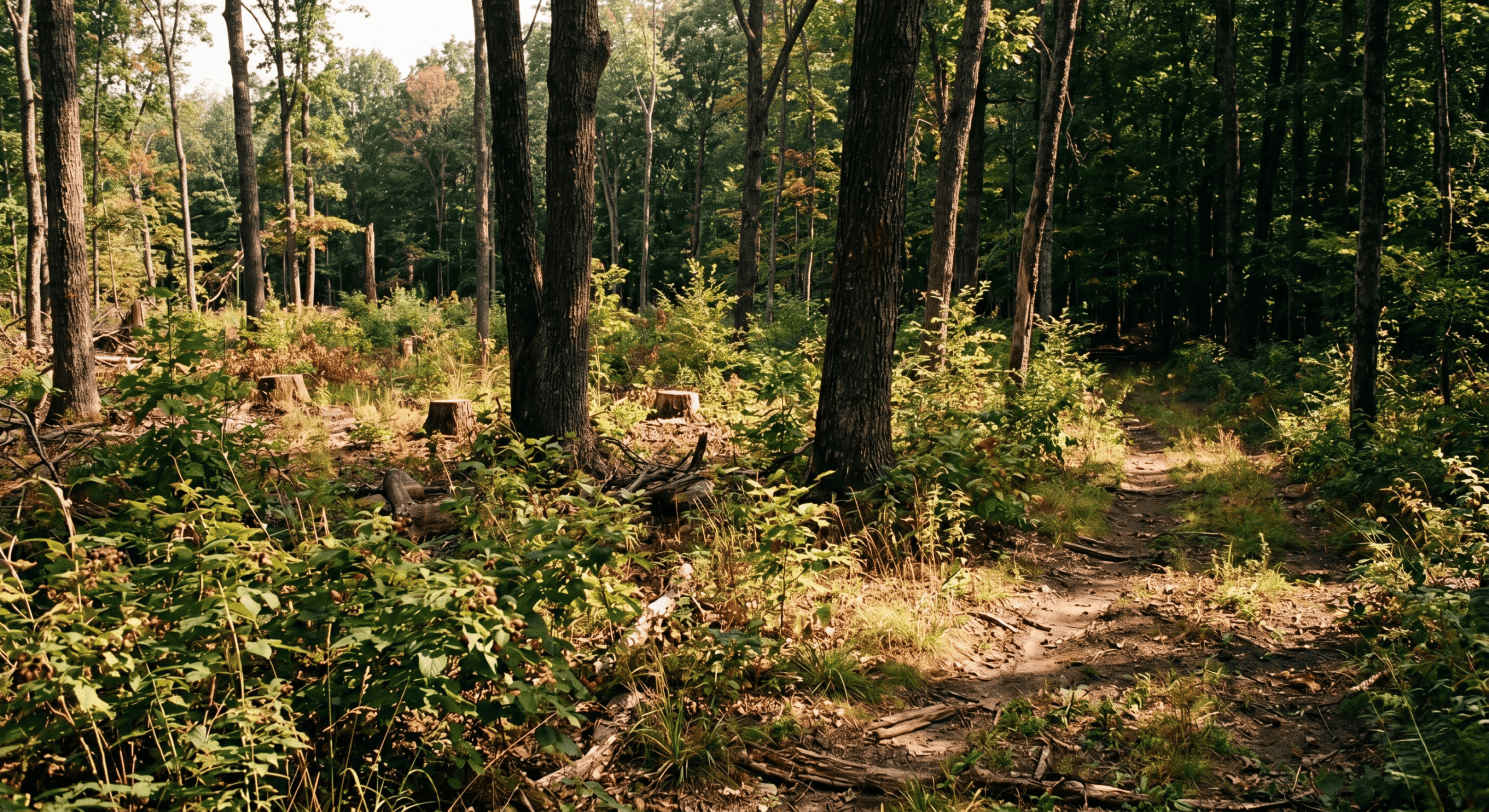
When light hits the forest floor for the first time in decades, seeds in the soil seed bank germinate. Raspberry, blackberry, goldenrod, young aspen, young cherry, young oak — all respond within one to two growing seasons. The formerly bare forest floor becomes a dense thicket of regenerating vegetation. From a wildlife perspective, that transition happens almost overnight relative to any other habitat management timeline.
Simultaneously, the trees that remain after thinning receive more light, water, and soil nutrients. Their crowns expand. Mast producers — oaks especially — respond with significantly higher acorn production within three to five years of competitive release. The structure of the stand shifts from uniform and dense to varied — different heights, different canopy densities, different age classes developing across the thinned area.
That structural diversity is the foundation of productive wildlife habitat. It is what thinning creates and what a closed-canopy forest cannot provide.
The Structural Diversity That Wildlife Needs
Wildlife habitat is not about any single feature — dense forest, open meadow, or thick brush. It’s about the right combination of features occurring at the right scale and in the right spatial relationship to each other.
Most wildlife species require three things within their daily home range: food, cover, and movement connectivity between the two. A well-thinned woodland provides all three simultaneously — browse and mast for food, regenerating thickets and retained conifers for cover, and a varied canopy structure that creates the edge and transition zones that most species exploit for movement.
An unmanaged closed-canopy forest fails on all three. No browse grows on a shaded floor. No bedding cover exists at ground level. Movement through a uniform mature stand offers no edge, no variety, no transitions to exploit. Thinning doesn’t create new habitat from nothing — it unlocks the biological potential that was already present in the soil and in the suppressed trees waiting for light.
How Thinning Creates Each Habitat Component
Browse — The Immediate Benefit
Browse — the buds, twigs, leaves, and stems that deer, rabbit, and other herbivores feed on — requires light. It grows in the regenerating vegetation that establishes after canopy thinning. Raspberry and blackberry canes appear within the first growing season after thinning. Young aspen, young cherry, and young maple sprout from stumps and root systems. Goldenrod and other forbs establish in lighter gaps.
Deer find thinned areas fast. Often within the first season after a thinning operation, deer trails concentrate toward the new growth. Ruffed grouse use regenerating aspen for drumming cover and budding in winter. The browse response to thinning is the fastest visible wildlife benefit — and for landowners who hunt their property, one of the most motivating.
Mast Production — The Long-Term Benefit
Mast — acorns, beechnuts, and other hard mast — is the nutritional foundation of fall and winter wildlife diets across the eastern forest. Deer, wild turkey, black bear, and dozens of smaller species depend on mast crops for the fat reserves they carry into winter.
Mast production depends on crown size. A suppressed oak in a dense forest produces a fraction of the acorns that a released oak with a full open crown produces. Thinning around your best mast producers — releasing them from direct crown competition — produces measurably higher mast yields within three to five growing seasons. That increase compounds over years as the released crowns continue to expand.
This is the same crop tree release practice that improves timber quality — the goals are identical, and the treatment is the same. One thinning operation advances both objectives simultaneously. For how crop tree release works within a broader management approach, see my article on managing woods for deer.
Bedding Cover — The Often-Overlooked Benefit
Deer bed where they feel secure — dense enough to conceal them, with good sightlines and scent detection capacity for approaching predators. Mature closed-canopy forest rarely provides this. The ground is visible for long distances, there is no concealment at deer height, and the uniformity of structure eliminates the micro-topographic variety deer prefer for beds.
Thinning creates bedding habitat through two mechanisms. First, the regenerating thickets that grow in thinned areas provide ground-level concealment within two to three growing seasons. Dense raspberry, young aspen regeneration, and cut-over slash all create the low structure deer use for beds. Second, thinning operations produce slash — the tops and branches of removed trees — that provide immediate cover within weeks of the operation.
Locating thinning operations on south-facing slopes where possible maximizes the thermal benefit. Deer preferentially bed on south-facing terrain that collects solar heat in winter. A thinned south slope with regenerating cover is prime bedding habitat.
Travel Corridors — The Connecting Tissue
Wildlife habitat is not just what each patch provides — it’s how patches connect. A thinned area that creates browse and bedding must connect to the rest of the property’s food and cover resources through corridors that allow safe movement.
Thoughtful thinning design retains woody travel corridors — strips of denser cover linking thinned areas to adjacent food sources, water, and larger habitat blocks. Deer follow these corridors predictably. Maintaining them during thinning operations is a deliberate design choice, not an afterthought. Before any thinning prescription, I walk the property with movement patterns in mind — where do deer currently move, and how does the thinning design support or interrupt those patterns?
Which Wildlife Species Benefit Most from Forest Thinning
Virtually every wildlife species that uses northeastern woodland benefits from some degree of structural diversity in the habitat — but several respond most directly and most visibly to forest thinning.
White-tailed deer respond quickly to thinning through browse availability, bedding cover, and mast production. Deer home ranges in good habitat shift to incorporate thinned areas within one to two seasons of the operation. Hunter observations typically show increased deer use of thinned areas almost immediately.
Ruffed grouse are perhaps the most directly tied to early successional habitat of any game species in the Northeast. They require young aspen stands for drumming, budding, and brooding. Thinning that creates aspen regeneration — particularly on properties with existing aspen — produces measurable grouse habitat improvement. Without aspen regeneration, grouse habitat improvement is harder to achieve through thinning alone.
Wild turkey use structural diversity in the landscape — open areas for displaying and feeding, forest edge for travel, mature areas for roosting. Thinning that creates edge between mature forest and regenerating areas benefits turkey movement and foraging patterns.
Songbirds — particularly early successional species like chestnut-sided warbler, yellow warbler, and common yellowthroat — respond strongly to thinning that creates shrubby regenerating habitat. Forest interior species lose habitat when thinning is too aggressive, so balance matters for the full songbird community.
The Difference Between Thinning for Wildlife and Thinning for Timber
Thinning for wildlife and thinning for timber use many of the same tools — both involve removing selected stems and releasing the trees that remain. The difference is in what the prescription optimizes for.
Timber-focused thinning concentrates on crop trees with the best timber potential — high-quality stems in dominant or co-dominant crown positions, straight-boled, defect-free, in commercially valuable species. The goal is diameter growth on future sawlogs.
Wildlife-focused thinning concentrates on mast producers, stand structure diversity, and gap creation. It may retain some low-quality or irregular trees that a timber prescription would remove — because cavity trees, snags, and irregular stems provide wildlife habitat value that uniform high-quality timber stands don’t. It may create larger or more dispersed openings than a timber prescription would specify.
In practice, the two approaches overlap significantly. Most well-designed thinning prescriptions advance both timber quality and wildlife habitat simultaneously. The trade-offs are real but manageable — a forester who understands both goals designs a prescription that advances both without fully sacrificing either. For the full integration of timber and wildlife goals in a management plan, see my article on how to balance timber value, wildlife habitat, and long-term land goals.
How Much to Thin — and What to Leave
The most common thinning mistake for wildlife purposes is not thinning enough. Landowners who are hesitant to cut trees often create openings too small and too sparse to produce meaningful habitat response. A quarter-acre to half-acre opening produces a genuine browse and bedding response. A scattering of individual tree removals across a dense stand does not.
The prescription needs to match the objective. For browse production, openings large enough to let sunlight reach the ground for most of the day are necessary. Mast production, individual crop tree release with crown competition removed on all sides is necessary. For bedding cover, creating thicket density within two to three growing seasons requires enough canopy removal to support dense regeneration.
What to leave matters as much as what to remove. Retain your best mast producers — oaks and beeches with the largest crowns — even if they’re not high-value timber trees. Retain any cavity trees, snags, and large-diameter legacy trees. Or retain conifer cover, particularly hemlock, for winter thermal protection. And retain the woody corridor strips that maintain movement connectivity across the thinned area.
For the invasive species management that must accompany effective habitat thinning, see my article on invasive species in your forest. Canopy openings from thinning benefit native regeneration and invasive plants equally — managing invasives in thinned areas is essential to getting the habitat response you’re working for. For the full TSI framework within which thinning for wildlife fits, see my article on timber stand improvement.
Frequently Asked Questions
How long after thinning do wildlife start using the area?
Deer typically find thinned areas within the first growing season — sometimes within weeks of the operation if slash provides immediate ground cover. Browse vegetation establishes in the first growing season after thinning, and deer follow it fast. Grouse use of regenerating aspen begins as soon as stems reach suitable height — typically two to three years for meaningful cover and five to ten years for full grouse habitat value. Mast production increase from released oaks takes three to five years to become measurable but compounds strongly after that. The wildlife response to thinning is front-loaded on deer and browse, with grouse and mast benefits following over a longer arc.
Can thinning for wildlife also generate timber income?
Often yes — particularly when the thinning removes commercially valuable stems. A thinning that takes mature oaks and cherry from a dense stand simultaneously creates habitat openings and generates stumpage income. The key is designing the prescription to advance both goals rather than optimizing for one at the expense of the other. Not every wildlife thinning has commercial value — some of the stems that need to come out for habitat purposes are low-grade or non-commercial. But on mixed hardwood properties with merchantable timber, a well-designed prescription commonly produces both income and habitat improvement in the same operation.
How is forest thinning for wildlife different from a clearcut?
A clearcut removes all or nearly all trees from a given area. Thinning removes a portion — typically 30% to 50% of the canopy — while retaining the best trees for mast production, future timber growth, thermal cover, and structural diversity. Clearcutting does create valuable early successional habitat, but it eliminates all the above-ground structure that thinning retains. For most private woodland situations in the Hudson Valley and Catskills, a well-designed thinning produces better overall habitat because it creates openings while retaining the mature structure — mast trees, den trees, thermal cover — that complete habitat requires. Clearcutting makes more sense in specific silvicultural situations, like aspen regeneration, than as a general wildlife habitat tool.
How Environmental Forest Products Can Help
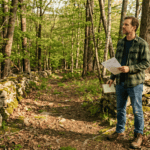
I’ve designed and supervised wildlife habitat thinning operations on private woodland across Sullivan, Ulster, and Orange Counties for over 30 years. Every prescription starts with a property walk that looks at wildlife use patterns, existing stand structure, mast producer locations, movement corridors, and the specific habitat components the property currently lacks.
Here’s what I can do for a landowner focused on habitat improvement through thinning:
- Walk the property and map existing habitat features — mast producers, cover types, movement corridors, bedding areas — before designing any prescription
- Design a thinning prescription that targets the specific habitat components most limiting wildlife use on your property
- Identify which thinning operations have commercial timber value and manage those as revenue-generating harvests
- Integrate invasive species control with thinning operations so habitat openings favor native regeneration
- Develop a wildlife habitat plan that qualifies for 480-a compliance and sequences thinning activities over the ten-year plan period
- Supervise thinning operations to confirm the prescription is executed correctly — corridor retention, mast tree protection, slash distribution
If you want more wildlife on your property and you’re not sure why you’re not seeing it, a property walk is the starting point. In most cases, the answer is structural — not a lack of animals, but a lack of the habitat features they need. Thinning is how you build those features into a mature stand.
Request a Free Wildlife Habitat Assessment
Call me directly: (845) 754-8242
Email: henry@eforestproducts.com
Serving Sullivan County NY, Ulster County NY, Orange County NY, Pike County PA, Wayne County PA, and Sussex County NJ.
Henry Kowalec is a licensed consulting forester and member of the Society of American Foresters with over 30 years serving private landowners in the Hudson Valley and Catskills. Environmental Forest Products | Westbrookville, NY 12785 | Licensed in NY, PA, NJ.