A woodlot management plan is not a bureaucratic document. It’s the difference between making decisions about your land and guessing about it — and the difference between a woodlot that builds value and one that quietly loses it.
Most of the landowners I work with in Sullivan, Ulster, and Orange Counties didn’t grow up thinking of themselves as forest managers. They own a woodlot — maybe 20 acres behind the house, maybe 80 acres they inherited from a parent — and they want to do right by it without necessarily knowing what “doing right by it” means in practice.
A woodlot management plan answers that question. It tells you what you have, what it needs, and what to do in what order. It’s the document that turns a piece of woods from something you own into something you manage — and the gap between those two things is where most of the value gets lost.
What a Woodlot Management Plan Actually Is
A licensed consulting forester prepares a woodlot management plan as a written, site-specific document. It describes the current condition of your woodland and maps out management actions over a defined time horizon — typically 10 years.
It is not a generic template, it is not a form you fill out. And it is not something you can get from a timber buyer. Instead, a woodlot management plan reflects what a forester found when they walked your property, measured your stands, and identified your invasive plants and pest problems. It also reflects what you told them your goals were.
The distinction between a plan and a report matters. A report describes what’s there. A plan describes what to do about it. A good woodlot management plan does both — and then prioritizes the work in an order that makes sense given your goals, your land, and your resources.
What a Woodlot Management Plan Includes
Every plan I prepare for a private landowner contains the same core elements, scaled to the size and complexity of the property.
Property Description and History
The plan begins with a factual record of the property — legal description, acreage, municipality, land use history, any prior timber harvests, existing roads and access, streams, wetlands, and boundary information. The history matters more than most landowners expect. For example, a woodlot that sat in farm fields until 1965 before growing back carries a completely different stand character than one that has been forest for generations. That history shapes what I find — and what I recommend.
Forest Inventory and Stand Maps
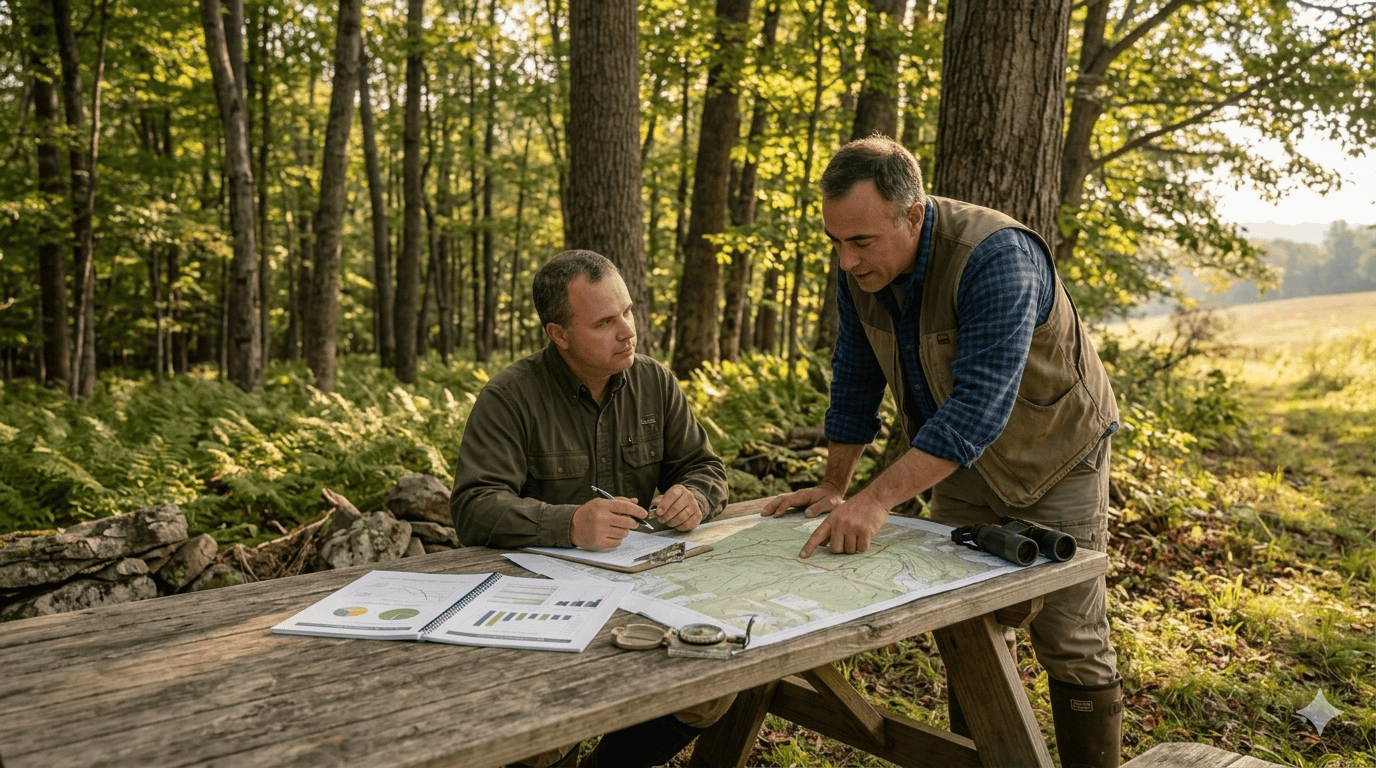
The core of the plan is the inventory. I divide the property into stands — distinct units of forest with similar species composition, age, and structure — and measure each one. For every stand, I record dominant and co-dominant species, average diameter, estimated timber volume, and stand age. I also document basal area, site quality, regeneration condition, and any significant health or habitat features. Stand maps show where each unit sits on the property, where streams and wetlands fall, and where the roads and boundaries run.
This inventory is the factual foundation that every recommendation builds on. Without it, any suggestion about what to cut, what to leave, or what to treat is a guess.
Goals and Objectives
Before I write a single recommendation, I spend time on this conversation. What do you want this land to do? Produce timber income? Qualify for New York’s 480-a Forest Tax Law? Improve deer and turkey habitat? Protect a stream? Leave something worth inheriting? Most landowners carry two or three goals at once. As a result, the plan has to reflect all of them — and the recommendations have to make sense against those goals, not just against generic forestry principles.
Stand-by-Stand Management Prescriptions
For each stand on the property, I write specific management prescriptions — what to do, what method to use, and why. Not “consider possible timber work when conditions allow.” Specific prescriptions: the harvest method, the target species and diameter classes, the TSI work needed, the invasive species treatment required, and the timeframe. Vague recommendations don’t help anyone. Specific ones give you something to act on and something to hold a contractor accountable to.
10-Year Activity Schedule
The prescriptions tell you what. The schedule tells you when. A 10-year activity schedule sequences the recommended work in a logical order — what’s urgent, what can wait, what needs to happen first to enable later work. For landowners in New York’s 480-a program, the schedule carries additional weight. The NYSDEC expects to see every listed activity completed and documented over the enrollment period. That makes the schedule a binding commitment, not just a suggestion.
Forest Health and Habitat Documentation
Beyond timber, the plan documents what else is on the property: invasive species present and the extent of each infestation, pest and disease indicators, snags and downed logs, mast-producing trees, vernal pools, riparian corridors, and wildlife habitat features. For landowners whose goals include wildlife or conservation, this section is as important as the timber inventory. For everyone else, it still documents what needs monitoring and attention over the plan period.
Monitoring Protocol
A woodlot management plan isn’t a document you read once. Instead, the monitoring section describes how and when to review the plan — typically at the five-year mark — and what conditions trigger a revision. For example, a major storm, a new pest outbreak, a change in ownership, or a significant shift in goals can all warrant revisiting the prescriptions before the full plan period ends.
Why You Need a Woodlot Management Plan — Even If You’re Not Planning a Timber Sale
This is the question I hear most often from woodlot owners who aren’t actively thinking about timber: “Do I really need a plan if I’m not trying to sell anything right now?”
Yes. Here’s why.
A plan protects you when a timber buyer comes calling.
Timber buyers approach landowners with unsolicited offers regularly — particularly in Sullivan and Ulster Counties, where logging demand is active. Without a plan, a landowner has no independent basis for evaluating the offer. They don’t know what their timber is worth, what the stand needs, or what they’re giving up. By contrast, a landowner with a current management plan knows all three. That knowledge is the difference between a transaction that serves both parties and one that serves only the buyer.
A plan is required for 480-a enrollment.
If you own 50 or more contiguous acres of productive forest land in New York, you need a written management plan from a licensed forester to enroll in the 480-a Forest Tax Law. That program reduces your forest land’s assessed value by 80%. In many cases, the first year of tax savings exceeds the plan’s cost. Without the plan, there’s no enrollment. Without enrollment, that benefit disappears every year the plan stays delayed.
A plan is the record of your land’s history.
A woodlot with a current management plan and documented management activity commands more value from future buyers — a family member, a conservation organization, a timber investment fund — than one without. The plan shows that someone actively managed the land. That evidence carries real dollar value in any future transaction.
A plan changes how you see your land.
This is the benefit most landowners don’t anticipate. Walking a property with a forester — seeing what’s actually there, understanding what the stand is doing and where it’s headed — changes how you think about every acre. Most landowners who get a management plan wish they had done it sooner.
What a Woodlot Management Plan Costs — and What It Returns
Plan cost depends on property size, stand complexity, and whether 480-a enrollment processing is included. For a typical small woodlot — 20 to 50 acres — plan preparation runs in the low-to-mid hundreds of dollars. Larger properties with multiple complex stands cost more. I provide a clear estimate before any work begins.
The return is harder to reduce to a single number — it varies by situation. For a landowner enrolling in 480-a, the first year of tax savings typically covers the plan cost and more. A landowner who avoids a bad timber sale because they knew what their timber was worth, the return runs into the thousands. For a landowner who makes better decisions over the next decade with a professional road map instead of guesswork, the return compounds across the full stand rotation.
I’ve never had a landowner come back to me and say a management plan wasn’t worth the investment. I have had landowners come back after selling timber without one, wishing they’d done it first.
Frequently Asked Questions
Is a woodlot management plan the same as a forest management plan?
Yes, functionally. The terms are used interchangeably in professional forestry practice. “Forest management plan” is the language used in New York’s 480-a program and most regulatory contexts. “Woodlot management plan” is the language many private landowners use when they think of their land as a woodlot rather than a forest. The document — a written, site-specific, forester-prepared plan covering inventory, goals, prescriptions, and a 10-year activity schedule — is the same regardless of what you call it.
How long does it take to get a woodlot management plan prepared?
From the initial property walk to the completed written plan, most small to mid-size woodlot properties take four to six weeks. For 480-a enrollment in New York, add the NYSDEC review period — typically several additional weeks after submission. If you have a pending timber sale or a property tax filing deadline that affects timing, let me know at the first call. I work around landowner timelines when I can, and I’ll tell you directly if the schedule isn’t achievable.
Can I use an existing plan from a previous owner?
Only if it’s current and was prepared by a licensed NYS forester. A plan more than 10 years old, or one that no longer reflects current stand conditions, isn’t a useful management guide — and it won’t satisfy 480-a enrollment requirements. If you’ve inherited or purchased a property with an existing plan on file, I can review it and determine whether it needs a full revision or a targeted update. Bring whatever documentation came with the property to that first conversation.
Do I need a plan if my woodlot is less than 50 acres?
You don’t need one for 480-a enrollment — properties under 50 contiguous acres don’t qualify for the program. But a plan is still valuable for any size woodlot. It tells you what you have, identifies the management priorities, and gives you a professional basis for any timber sale decision. On a small property, every management decision carries more weight because there’s less margin for error. A plan on a 15-acre woodlot can prevent a mistake that sets the property back by 20 years.
How Environmental Forest Products Can Help
Preparing woodlot management plans for private landowners is one of the core services I’ve built my practice around over 30 years. Every plan I write starts with a full property walk. Every prescription is specific to that land and those goals. And before I consider the work done, every landowner gets a direct conversation about what the plan says and what it asks of them.
I serve landowners across Sullivan, Orange, and Ulster Counties in New York and into Pike and Wayne Counties in Pennsylvania and Sussex County in New Jersey.
What I offer for woodlot management planning:
- Complete woodlot management plan preparation — written 10-year plans covering inventory, goals, prescriptions, and activity schedule
- 480-a Forest Tax Law enrollment — plan preparation, NYSDEC submission, assessor application, and compliance support
- Timber appraisal — independent valuation of standing timber before any sale decision
- Timber harvest planning and supervision — when a harvest is part of the management plan
- Plan review and update — for landowners with an existing plan that needs refreshing or amendment
If you want to understand what a plan for your woodlot would look like and what it would cost, the first step is a conversation. Request an estimate — tell me your acreage and county. I’ll give you a straight answer.
This article is part of the Woodlot Management for Private Landowners guide on the EFP blog.
📞 (845) 754-8242
✉️ henry@eforestproducts.com
📍 Westbrookville, NY 12785
Serving Sullivan, Orange, and Ulster Counties NY | Pike and Wayne Counties PA | Sussex County NJ
Henry Kowalec is a licensed consulting forester and member of the Society of American Foresters with over 30 years serving private landowners in the Hudson Valley and Catskills. Environmental Forest Products | Westbrookville, NY 12785 | Licensed in NY, PA, NJ.