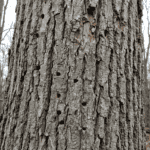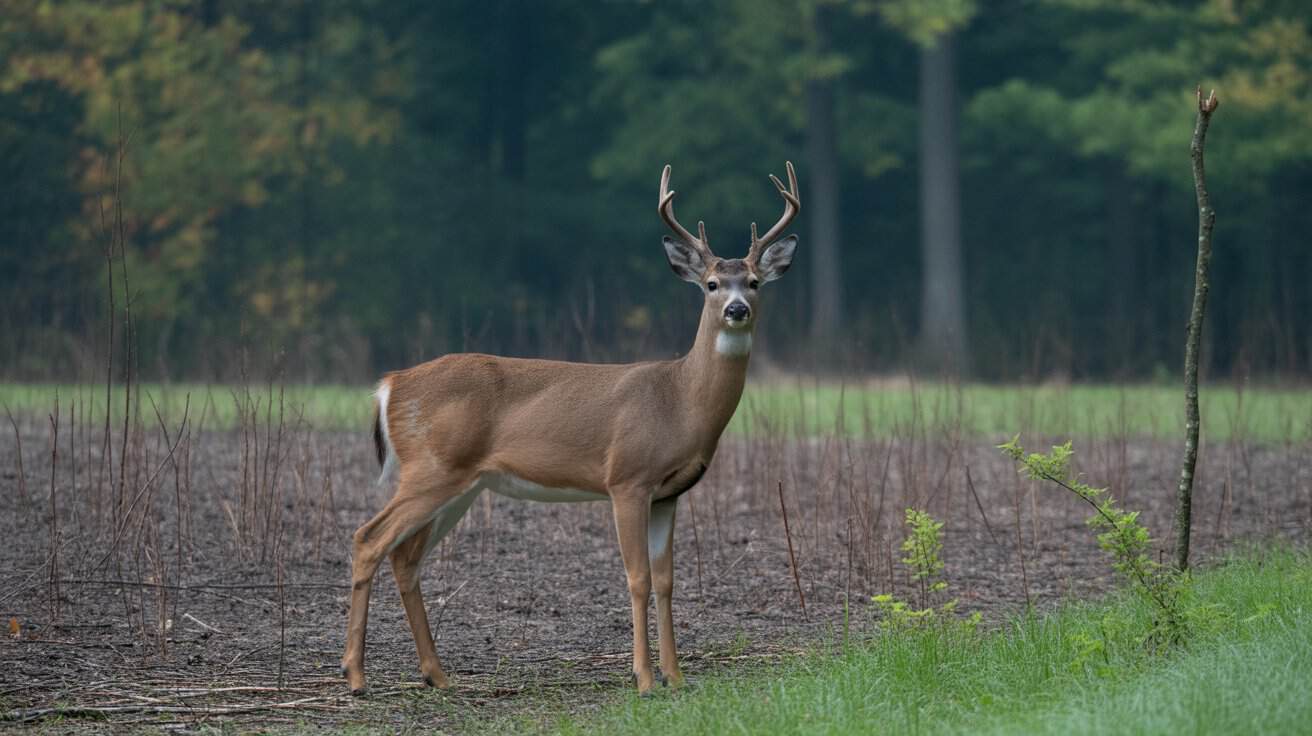
A lot of landowners in Sullivan and Ulster Counties tell me they have great deer habitat. Big mature woods, dense cover, oak trees everywhere. Then they ask me why they’re not seeing many deer.
The answer is usually the same. A closed-canopy mature forest looks like deer habitat. For the most part, it isn’t. Deer need food, bedding cover, and travel corridors — and a wall-to-wall mature tree canopy produces very little of any of those three things.
Good deer habitat requires active management. The landowners who consistently hold deer on their property aren’t the ones with the biggest unbroken forest. They’re the ones who understand what deer actually need — and who manage their woods deliberately to provide it.
What Deer Actually Need from Your Woods
White-tailed deer are edge animals. They evolved at the intersection of forest and open land — not deep inside either one. Their core habitat requirements map directly onto that biology.
Deer need three things from a woodland property:
- Food — high-energy mast (acorns, beechnuts) in fall; browse (buds, twigs, forbs) in winter and spring; forbs and soft mast through summer
- Bedding cover — dense, low vegetation that provides thermal protection and concealment from predators; typically found in young regenerating forest, thickets, or areas with down woody debris
- Travel corridors — connective cover that allows deer to move between food and bedding areas without crossing exposed ground
A mature closed-canopy forest fails on all three counts. The canopy shades out the understory vegetation deer browse. Mast production is present but concentrated in a small percentage of trees. Bedding cover is minimal because nothing grows on the shaded forest floor. Deer move through mature forest — they don’t live in it.
Managing for deer means actively creating the conditions that address those three needs simultaneously. It’s not complicated. But it requires doing something, not just leaving the woods alone.
Mast Production — The Foundation of Deer Habitat
Mast — the acorns, beechnuts, and other hard mast that deer rely on through fall and early winter — is the foundation of deer nutrition in a hardwood forest. Nothing else a woodland can offer matches the caloric density of a good acorn crop. Deer put on the fat reserves they need to survive winter and reproduce in spring largely on mast.
The problem on most private woodlots is that mast production is concentrated in a handful of trees while dozens of other oaks and beeches are suppressed, crowded, or structurally compromised. A suppressed oak with a thin, struggling crown produces a fraction of the acorns a well-crowned, open-grown oak can produce.
The management tool here is crop tree release — the same silvicultural practice I use for timber value improvement, applied specifically to your best mast producers. I walk the stand, identify the oaks and other mast trees with the best crown potential, and remove the competing stems that are limiting their growth. A released mast tree responds with expanded crown growth and significantly higher annual acorn production within three to five years.
White oak acorns are the preferred mast food for deer in our region — lower tannin content makes them more palatable than red oak acorns. Identifying and releasing your best white oaks is one of the highest-impact single actions you can take for deer habitat on a mixed hardwood property.
Browse — Why Deer Need More Than Just Trees
Browse is the buds, twigs, and young stems that deer feed on through winter and spring when mast is gone and forbs haven’t emerged yet. In a well-managed woodland, browse comes from the regenerating understory — the young stems that grow when canopy gaps let light reach the forest floor.
In a mature closed-canopy forest, browse production is nearly zero. Nothing grows on a shaded forest floor that a deer can eat. The understory is either bare, covered in shade-tolerant invasives, or stocked with species deer don’t prefer.
Creating browse requires opening the canopy. Even small gaps — quarter-acre to half-acre openings in a dense canopy — produce an explosion of regenerating stems within one to two growing seasons. That flush of growth is browse. Raspberry canes, blackberry, goldenrod, young aspen, young cherry — all high-preference deer foods that appear naturally when light hits the forest floor.
This is one of the most direct ways that a properly designed timber harvest benefits deer. A selective timber harvest that creates dispersed canopy openings simultaneously generates income from merchantable timber and produces browse habitat that will hold deer for years afterward.
Bedding Cover — The Element Most Landowners Overlook
Deer spend the majority of their daylight hours bedded down. They choose bedding sites for two things: thermal protection and security. A good bedding area is dense enough that a bedded deer can smell and hear approaching predators before they get close — and has enough cover to make the deer feel hidden.
Mature forest almost never provides this. Bedding cover comes from:
- Young regenerating stands — five- to fifteen-year-old growth after a harvest or natural disturbance; dense enough to provide concealment at ground level
- Conifer thickets — hemlock, white pine, and spruce stands provide year-round thermal cover and are heavily used by deer in winter
- Brushy areas and slash — the tops and branches left after a harvest create immediate ground-level cover that deer use within weeks of a cutting operation
- South-facing slopes — deer preferentially bed on south-facing terrain that collects solar heat; these areas warm up first in winter and provide thermal advantage
If your property has hemlock stands, those are priority habitat features. Hemlock provides dense winter cover that no other northeastern species matches for thermal protection. With hemlock woolly adelgid pressure increasing in our region, those stands need monitoring. A forester can assess their current health and help you plan for their long-term role in your habitat structure.
How Timber Harvesting Creates Deer Habitat
This is the point most landowners don’t expect: a well-planned timber harvest is one of the best single investments you can make for deer habitat on a mature woodlot.
Here’s the mechanism. A closed-canopy mature forest has most of its biological productivity locked in the upper canopy. Deer can’t reach it. A selective harvest that removes mature timber and creates canopy openings releases that productivity to ground level — where deer actually live.
Within one to three years after a harvest that creates meaningful canopy openings, those areas become the most productive deer habitat on the property. Browse production explodes. Bedding cover establishes. Deer shift their core use areas toward the cutover.
The key is how the harvest is designed. A harvest that removes timber uniformly across the property creates different habitat than one designed to create discrete openings, maintain travel corridors, and retain mast trees. I design harvests with both timber value and habitat outcomes in mind when that’s what the landowner wants. The two goals are compatible far more often than most people expect.
Even the ash mortality from emerald ash borer creates habitat opportunity — managed correctly, those canopy gaps can be directed toward browse production and early successional cover rather than invasive shrub colonization.
Managing Timber and Deer on the Same Property
The question I hear most often from landowners who hunt their own land: can I manage for deer habitat and still generate timber income? The answer is yes — with some trade-offs worth understanding.
Timber management and deer habitat management share more tools than they conflict on. Crop tree release improves both mast production and timber quality. Canopy openings from selective harvests produce both income and browse. Timber stand improvement that removes low-value competing stems improves both stand structure and habitat diversity.
The trade-offs are real but manageable. Maximum timber production favors a more uniform, even-aged approach that doesn’t always produce the diversity of structure that deer need. Maximum deer habitat favors more canopy openings and structural diversity than a timber-only operation would create. A forester who understands both goals can find the prescription that advances both without fully sacrificing either.
The properties I’ve managed for both timber and deer in Sullivan and Orange Counties consistently hold more deer than comparable unmanaged properties nearby. Active management creates the structural diversity — young regenerating areas, mast tree crowns, travel corridors, bedding cover — that a static mature forest simply doesn’t have.
What a Habitat Improvement Plan Actually Looks Like
A wildlife habitat improvement plan for a woodland property is not a theoretical document. It’s a field-based prescription tied to your specific acreage, your existing stand conditions, and your goals.
When I develop a habitat plan for a landowner, the process starts with a property walk. I’m looking at current stand structure, mast tree distribution and crown condition, existing cover types, topography, and existing travel corridors. I note where deer are already using the property and where habitat gaps are limiting their use.
From that assessment, a habitat plan typically identifies:
- Mast trees for crop tree release treatment — locations, species, priority ranking
- Harvest areas designed to create browse and bedding cover — size, location, and timing relative to stand maturity
- Invasive species management priorities — particularly in areas where habitat improvement work would otherwise be colonized by barberry or multiflora rose
- Travel corridor maintenance — leaving woody cover connections between habitat patches
- Conifer cover assessment — hemlock stand health, white pine potential, any planting needs
For the full framework on forest health and habitat management on private land in this region, see my forest health and habitat improvement guide. And for current NYSDEC guidance on wildlife habitat management, dec.ny.gov maintains landowner resources on habitat improvement programs available in New York.
Frequently Asked Questions
How many acres do I need to meaningfully manage for deer habitat?
Meaningful habitat improvements can be made on properties as small as 25 to 30 acres, though larger properties give you more flexibility in creating habitat diversity. Deer home ranges in the Northeast typically run 300 to 600 acres for does and larger for bucks — so your property is one piece of a larger landscape. That said, habitat improvements on even small woodlots make your land a preferred destination within that home range. The goal is to make your acres the best acres in the neighborhood, not to contain deer entirely within your property line.
Does a timber harvest hurt deer habitat or help it?
A well-designed timber harvest almost always helps deer habitat, particularly on mature closed-canopy properties. Harvests that create canopy openings produce browse and bedding cover that mature forest cannot. The design of the harvest determines the habitat outcome — a forester who understands your wildlife goals can integrate them into the harvest prescription. A poorly designed harvest with no habitat intent can miss those opportunities, but it rarely makes deer habitat worse than a fully closed mature canopy.
Can I manage for deer habitat and still qualify for 480-a Forest Tax Law?
Yes. New York’s 480-a program requires active forest management under an approved plan — and wildlife habitat improvement is a recognized and encouraged component of qualifying management plans. A management plan that includes crop tree release for mast production, timber stand improvement, and harvest prescriptions designed with habitat goals can fully satisfy 480-a requirements. I write 480-a plans that integrate timber and wildlife objectives routinely on properties across Sullivan, Ulster, and Orange Counties.
How Environmental Forest Products Can Help
I’ve been working with private landowners on timber and wildlife habitat management across Sullivan, Ulster, and Orange Counties for over 30 years. Managing woods for deer — and doing it in a way that also produces timber income and qualifies for the 480-a tax program — is work I do on properties throughout this region.
Here’s what I can do for your property:
- Walk your woodlot and assess current habitat conditions, mast tree quality, and cover type distribution
- Develop a field-based habitat improvement plan with specific prescriptions for your acreage and goals
- Identify and mark mast trees for crop tree release treatment
- Design timber harvests that generate income and create browse and bedding habitat simultaneously
- Integrate habitat objectives into a 480-a Forest Management Plan for property tax reduction
- Advise on invasive species management in areas targeted for habitat improvement
If you’re hunting your own land and not seeing the deer activity you expect — or if you want to build the kind of habitat that holds deer year-round — a property walk is the right first step.
Request a Free Habitat Assessment
Call me directly: (845) 754-8242
Email: henry@eforestproducts.com
Serving Sullivan County NY, Ulster County NY, Orange County NY, Pike County PA, Wayne County PA, and Sussex County NJ.
Henry Kowalec is a licensed consulting forester and member of the Society of American Foresters with over 30 years serving private landowners in the Hudson Valley and Catskills. Environmental Forest Products | Westbrookville, NY 12785 | Licensed in NY, PA, NJ.