If you have ash trees on your property in New York, the question is no longer whether emerald ash borer will reach them. In most of Sullivan, Ulster, and Orange Counties, it already has. The question now is what you do about it — and how much time you have left to act.
I’ve watched emerald ash borer move through woodlots across the Catskills and Hudson Valley for years. The pattern is consistent. Landowners who wait too long lose both the tree and the timber value it carried. Landowners who act with a clear plan — treat what’s worth treating, salvage what’s worth cutting — come out ahead on both counts.
Here’s what you need to know about EAB, what your real options are, and how to make a decision that makes sense for your specific property.
What Emerald Ash Borer Does to Your Trees
Emerald ash borer (Agrilus planipennis) is an invasive wood-boring beetle native to Asia. It was first confirmed in the United States in Michigan in 2002 and has since spread throughout the Northeast, killing hundreds of millions of ash trees.
The damage is done by the larvae, not the adult beetles. Female beetles lay eggs in bark crevices on ash trees. The larvae hatch and bore into the cambium layer — the living tissue just beneath the bark — where they feed in distinctive S-shaped galleries. Those feeding galleries disrupt the tree’s ability to move water and nutrients from roots to crown. The tree starves from the top down.
Every species of ash is susceptible — white ash, green ash, black ash, and blue ash all fall to EAB. There is no native ash species with documented resistance. In heavily infested areas, ash mortality runs close to 100% in untreated trees within five to ten years of initial infestation.
How to Identify EAB on Your Property
EAB is not always visible until significant damage has already occurred. The adult beetle is small — about half an inch long, metallic green — and most active in late spring and early summer. Seeing the beetle itself is uncommon. What you’re more likely to see are the damage signs.
Look for these indicators on your ash trees:
- Crown dieback — thinning and die-back starting at the top of the crown and progressing downward; a common early sign
- Epicormic sprouting — stressed ash trees push out water sprouts along the trunk and major branches; a stress response to the vascular disruption EAB causes
- Serpentine galleries — S-shaped feeding channels visible under the bark when a section is peeled back; the definitive sign of EAB larvae
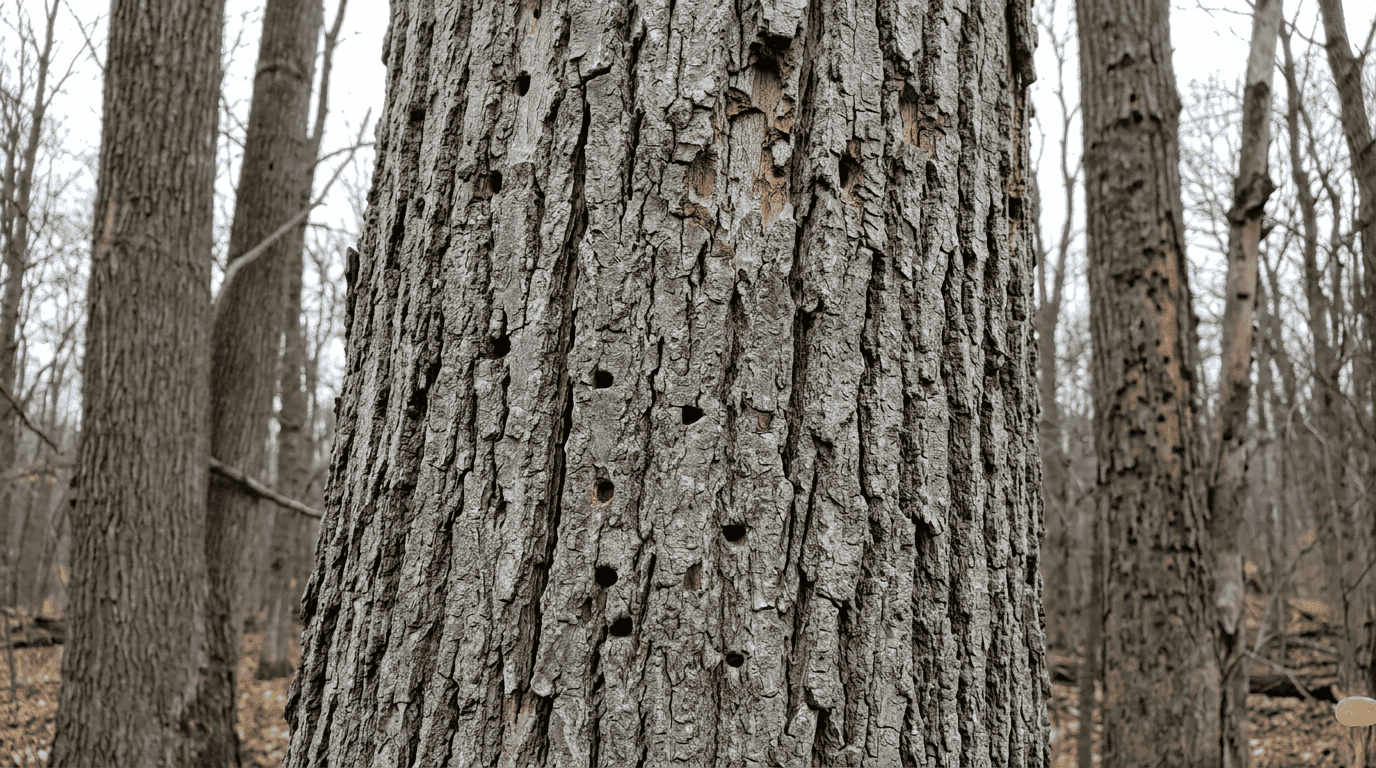
- D-shaped exit holes — flat-sided, D-shaped holes approximately 1/8 inch wide where adult beetles have emerged; distinctive and diagnostic
- Bark splits — vertical bark cracks caused by callus tissue forming over larval galleries beneath
- Woodpecker activity — heavy woodpecker flecking on the upper trunk is a reliable early indicator; woodpeckers excavate bark to reach EAB larvae
If you see crown dieback combined with D-shaped exit holes on your ash trees, EAB is confirmed. The NYSDEC maintains current EAB distribution maps and identification resources at dec.ny.gov.
How Fast Does EAB Kill Ash Trees?
This is the question that determines your decision timeline — and the answer is faster than most landowners expect.
From the time EAB establishes in a tree, mortality typically follows within three to five years in heavily infested areas. The beetle’s population builds exponentially once it gains a foothold in a stand. A woodlot that shows early crown dieback on a few trees in year one can be 50% to 70% dead by year three.
Critically, the timber value window closes before the tree is dead. Once an ash tree has lost 50% or more of its crown, the wood quality has already begun to deteriorate. Staining, cracking, and structural weakening progress quickly in declining ash. A tree that’s worth $200 to $400 in stumpage today may be worth nothing as sawtimber in two years.
The practical implication: if you have merchantable ash on your property and you haven’t had it evaluated, the time to act is now — not after the next growing season.
Emerald Ash Borer Treatment — When It Makes Sense
Emerald ash borer treatment is available and genuinely effective — but it makes economic sense only in specific situations. Understanding when treatment is worth it is as important as understanding how it works.
The primary treatment method is trunk injection or soil injection of systemic insecticides — most commonly emamectin benzoate (trunk injection) or imidacloprid (soil drench or injection). These products move through the tree’s vascular system and kill EAB larvae as they feed. Emamectin benzoate trunk injection, applied by a licensed pesticide applicator, provides protection for two to three years per treatment cycle and has the strongest efficacy data of the available options.
Treatment makes economic sense when:
- The ash tree has significant landscape, shade, or ornamental value that justifies ongoing treatment cost
- The tree is a specimen ash in a yard, along a road, or near a structure where removal would be costly or disruptive
- A woodlot contains genetically superior or unusually large ash that a landowner wants to preserve for seed source or ecological reasons
- The tree is less than 30% to 40% crown decline — treatment on trees beyond that threshold is unlikely to be cost-effective
Treatment must be repeated on a two- to three-year cycle as long as EAB pressure continues in the area. In a woodlot context with dozens or hundreds of ash trees, treatment across the entire stand is rarely economically justified. It’s a tool for individual high-value trees — not a woodlot management strategy.
When Treatment Is Not Worth It
For most forest ash — trees in a woodlot context valued primarily for timber rather than landscape function — treatment is not the right answer. The math doesn’t work.
A woodlot ash tree worth $150 to $300 in stumpage does not justify repeated treatment applications costing more than that per tree per cycle. In a stand with 20 or 30 ash trees, treatment across the board would cost many times the timber value those trees carry.
Once a tree shows more than 30% to 40% crown dieback, treatment efficacy drops sharply. Trees at that stage are past the window where investment returns value. The right call for those trees is to evaluate them for salvage timber value — not to spend money on treatment that won’t save the wood.
The Timber Salvage Window — What It’s Worth and How Long You Have
This is where I spend most of my time advising landowners with ash on their property. The timber salvage window is real, it has value, and it closes faster than people expect.
White ash has historically been a premium hardwood in this region — valued for furniture, flooring, tool handles, and sports equipment. EAB has disrupted that market, but merchantable ash with sound wood still has stumpage value in most regional markets. The key word is sound.
A salvage harvest on ash timber should happen when:
- Trees show early to moderate crown decline — less than 50% crown loss
- No visible fungal conks or major bark splits indicating advanced internal decay
- The stand has enough volume to attract competitive bids from buyers
- A forester has confirmed current market demand from mills accepting EAB-affected ash
I’ve helped landowners in Sullivan and Ulster Counties capture meaningful stumpage income from ash salvage harvests that would have been worthless two years later. The trees were declining — some had obvious early EAB signs — but the wood was still sound and the mill accepted it. Waiting another season would have eliminated the option.
Before making any decision on ash timber, get a professional assessment of what you have and what it’s currently worth. My article on how to get a timber appraisal covers what that process looks like. And for the broader framework on ash timber value in the current market, see my guide on how much timber is worth.
What EAB Means for Your Forest Beyond the Ash
The loss of ash from a woodlot is not just about the timber value of the ash trees themselves. Ash often represents a significant portion of the canopy in mixed hardwood stands in our region. When ash dies, it opens the canopy — sometimes dramatically — and that opening creates both a problem and an opportunity.
The problem: canopy gaps in ash-heavy stands are quickly colonized by invasive shrubs — Japanese barberry, multiflora rose, and autumn olive — that out-compete desirable native regeneration. Without active management, those gaps fill with invasives rather than the oak, cherry, and maple seedlings you want in the next forest generation.
The opportunity: managed correctly, ash mortality can be used to release high-value crop trees that were competing with ash for light and growing space. A forester working in a post-ash stand can direct the succession toward better species composition through targeted timber stand improvement and planting where needed.
The stands that come out of the EAB era in the best shape are the ones with an active management plan. For the full context on forest health management in this region, see my forest health and habitat improvement guide.
Frequently Asked Questions
Is emerald ash borer present throughout New York State?
Yes. EAB is confirmed in all 62 counties in New York State. Sullivan, Ulster, and Orange Counties have had confirmed EAB presence for years. The question for any individual property is not whether EAB is in the region — it is — but what stage of infestation your specific ash trees are showing and what options remain. Current county-level distribution data is maintained by NYSDEC at dec.ny.gov.
What is the most effective emerald ash borer treatment?
Emamectin benzoate trunk injection, applied by a licensed pesticide applicator, has the strongest efficacy data of the available treatment options. It provides two to three years of protection per application and is most effective when applied to trees with less than 30% to 40% crown decline. Imidacloprid soil injection is a lower-cost alternative with somewhat less efficacy for heavily infested trees. Neither treatment is appropriate as a woodlot-wide strategy — both are economically justified primarily for high-value individual landscape or specimen trees.
Can I salvage my ash timber if the trees are already declining?
Often yes — but the window is time-sensitive. Ash trees with early to moderate crown decline and no visible internal decay indicators can still carry meaningful stumpage value in regional markets. Once crown loss exceeds 50% or visible decay signs appear, sawlog value drops sharply. If your ash trees are showing early EAB signs, get a forester assessment immediately. A season of delay can be the difference between a salvage harvest that generates income and a removal cost with no return.
How Environmental Forest Products Can Help
EAB is one of the most time-sensitive issues I deal with on private land in Sullivan, Ulster, and Orange Counties. The decisions you make in the next one to two years on ash timber will determine whether you capture any value from those trees — or watch it deteriorate standing in your woods.
Here’s what I can do for your property:
- Walk your woodlot and assess EAB infestation stage on your ash trees
- Evaluate which ash trees — if any — are candidates for individual treatment vs. salvage harvest
- Conduct a timber cruise to determine current stumpage value of salvageable ash
- Manage a salvage harvest with competitive bidding, contract, and on-site oversight
- Advise on post-ash stand management — invasive control, crop tree release, and species composition going forward
- Integrate ash management into a full forest management plan for 480-a Forest Tax Law enrollment
If you have ash on your property and you haven’t had it looked at, don’t wait another season. Call me.
Request a Free EAB Property Assessment
Call me directly: (845) 754-8242
Email: henry@eforestproducts.com
Serving Sullivan County NY, Ulster County NY, Orange County NY, Pike County PA, Wayne County PA, and Sussex County NJ.
Henry Kowalec is a licensed consulting forester and member of the Society of American Foresters with over 30 years serving private landowners in the Hudson Valley and Catskills. Environmental Forest Products | Westbrookville, NY 12785 | Licensed in NY, PA, NJ.