The most common thing I hear from landowners who call me about invasive species is: “I noticed it a few years ago but figured it would sort itself out.” It never does. Invasive plants don’t self-correct — they expand. What covers a quarter acre today covers two acres in three years and ten acres in seven.
The damage happens in two directions simultaneously. Invasive shrubs and vines crowd out native regeneration — the oak, cherry, and maple seedlings that represent the next generation of your forest. They also degrade wildlife habitat, reduce timber value accumulation, and make every future management activity more difficult and more expensive.
The good news: most invasive species in the Hudson Valley and Catskills are controllable with the right method, the right timing, and a realistic multi-year commitment. Here’s what to look for, what actually works, and where to start first.
Why Invasive Species Matter More Than Most Landowners Think
Invasive plants don’t just occupy space. They restructure the forest’s regeneration dynamics — the biological processes that determine what species grow in the understory and eventually replace the canopy above.
A dense Japanese barberry understory prevents oak seedlings from establishing. Without oak seedlings establishing now, the next generation of your forest won’t include oaks — regardless of how many mature oaks stand in the canopy today. The canopy trees die eventually. What replaces them depends entirely on what the understory allows to grow.
Invasive species also affect timber value in ways that don’t show up immediately. Heavy invasive pressure reduces diameter growth on crop trees by competing for soil moisture and nutrients. It suppresses the native regeneration that will be the next harvest. It creates habitat conditions that favor deer over-browsing of desirable seedlings while leaving unpalatable invasives untouched. Each of these effects compounds over years and decades into a measurably poorer-quality forest and a lower-value timber asset.
For the full context on how invasive species fit into a broader woodlot health assessment, see my article on how to do a woodlot health assessment.
The Six Most Damaging Invasive Species in Hudson Valley and Catskills Woodlands
These are the species I encounter most consistently on private woodland in Sullivan, Ulster, and Orange Counties. Knowing how to identify each one tells you what you’re dealing with and what control approach is appropriate.
Japanese Barberry
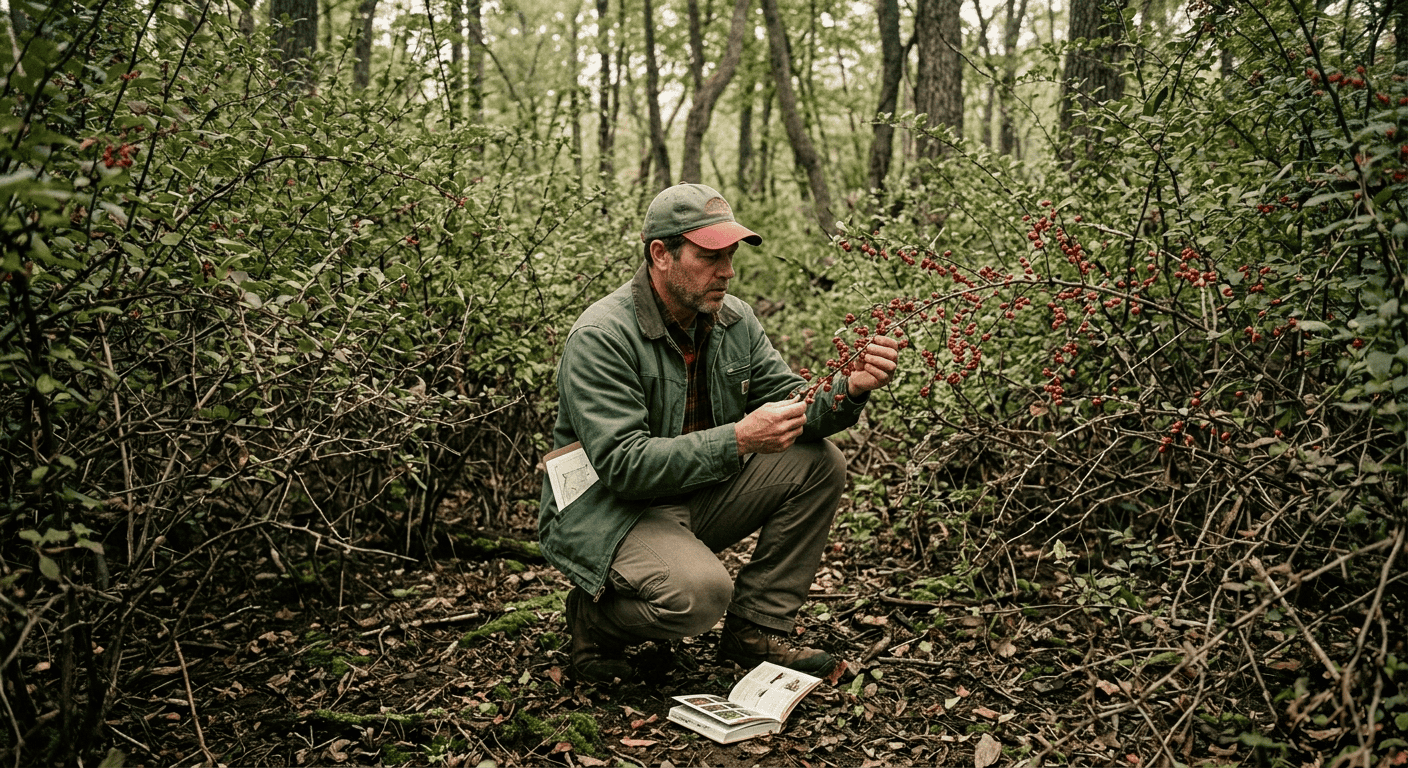
Japanese barberry (Berberis thunbergii) is the most widespread invasive shrub in the region’s woodlands. It forms dense, thorny thickets one to three feet tall that carpet the forest floor under partial shade. Identification: small oval leaves, single sharp thorns at nodes on arching stems, small yellow flowers in spring, and bright red berries through fall and winter. The red berries persist through winter and make winter identification easier than most species.
Barberry is particularly problematic because research links its presence to higher tick densities — the humid microclimate beneath barberry thickets supports blacklegged tick (Ixodes scapularis) populations at higher rates than open woodland floor. NYSDEC lists Japanese barberry as a prohibited invasive species in New York. Confirmed distribution and current regulatory status are at dec.ny.gov.
Multiflora Rose
Multiflora rose (Rosa multiflora) forms impenetrable arching cane thickets that reach six to twelve feet in canopy gaps, forest edges, and disturbed areas. Identification: compound leaves with five to nine leaflets, distinctive fringed stipules at the leaf base, clusters of small white five-petaled flowers in late spring, and small red rose hips persisting through winter. The fringed stipule is the most reliable identification feature.
Multiflora rose establishes aggressively in canopy gaps created by harvesting, windthrow, or road clearing. Harvesting without invasive control planning often accelerates multiflora rose spread rather than creating the native browse habitat the harvest intended.
Oriental Bittersweet
Oriental bittersweet (Celastrus orbiculatus) is a woody vine that climbs and girdles trees, breaking branches under its weight and eventually killing host trees. Identification: round orange-red berries in clusters along the entire stem length in fall — distinguishing it from native American bittersweet, which bears berries only at stem tips. The girdling vine habit and full-stem berry distribution make Oriental bittersweet one of the most destructive species to individual crop trees.
Autumn Olive
Autumn olive (Elaeagnus umbellata) is a nitrogen-fixing shrub that establishes rapidly on disturbed sites and forest edges. Identification: silvery-green undersides to the leaves, small fragrant tubular flowers in spring, and clusters of small red speckled berries in fall. The silvery leaf underside is the easiest field identification feature.
Autumn olive’s nitrogen-fixing root system alters soil chemistry in ways that favor its own continued establishment and disadvantage native species. Once established on a forest edge, it spreads aggressively into gaps and open areas.
Japanese Knotweed
Japanese knotweed (Fallopia japonica) forms dense monoculture stands six to ten feet tall along stream banks, road edges, and disturbed sites. Identification: hollow bamboo-like stems with distinct nodes, large heart-shaped leaves with a flat or slightly indented base, and small white flowers in late summer. The hollow jointed stem is distinctive.
Japanese knotweed is among the most difficult invasive species to control. Its root system extends deep and wide, producing new shoots from root fragments. Any soil disturbance near an established knotweed stand risks spreading root fragments and expanding the infestation.
Garlic Mustard
Garlic mustard (Alliaria petiolata) is a shade-tolerant biennial herb that invades forest understories and out-competes native spring wildflowers. Identification: triangular to heart-shaped toothed leaves with a garlic smell when crushed, small white four-petaled flowers in spring, and long slender seed pods. The garlic odor when leaves are crushed is the fastest identification method.
Garlic mustard produces allelopathic compounds that suppress native plant growth and disrupt the mycorrhizal fungi that hardwood seedlings depend on for establishment. Heavy garlic mustard infestations effectively poison the soil environment for oak and maple seedling growth.
How Invasive Species Damage Your Forest — Beyond the Visual
The visible crowding of invasive plants is only the surface of the damage. Three less-visible mechanisms cause compounding harm over time.
Regeneration failure. When invasive shrubs dominate the understory, desirable native seedlings cannot establish. A forest with a healthy mature canopy and a barberry-dominated understory has no future forest growing beneath it. When the canopy trees eventually die or come down, the next successional layer is invasives — not the oaks and cherry the landowner assumed were regenerating below.
Soil chemistry alteration. Garlic mustard and autumn olive both alter soil chemistry in ways that favor continued invasive establishment. Garlic mustard suppresses mycorrhizal fungi. Autumn olive adds nitrogen that changes competitive dynamics in ways that benefit invasives over native species adapted to lower-nitrogen soils. These chemical changes persist after the plants are removed, slowing native recovery.
Deer browse interaction. Deer avoid most invasive species and heavily browse native seedlings that compete with invasives. In heavily infested stands, deer pressure removes native regeneration while leaving invasive plants untouched — accelerating the invasive takeover and creating a self-reinforcing cycle that’s harder to break with each passing year. For the full picture on how invasive pressure interacts with deer habitat management, see my article on managing woods for deer.
Control Methods — What Works and What Doesn’t
Mechanical Control
Mechanical control — cutting, pulling, or mowing — works for some species in some situations, but it rarely eliminates established infestations on its own. Pulling small barberry plants by the roots in early spring, before the soil dries out, removes individual plants without herbicide. Hand-pulling works for small garlic mustard infestations before seed set in spring.
Cutting multiflora rose or barberry without herbicide treatment stimulates vigorous resprouting. A single cut stem produces multiple new shoots from the root crown within one growing season. Mechanical control without follow-up herbicide treatment is maintenance, not eradication — it buys time but doesn’t reduce the infestation.
Herbicide Treatment
For established infestations of shrubby invasive species — barberry, multiflora rose, autumn olive — cut-stump herbicide treatment is the most reliable control method. Cut the stem near the ground and immediately apply a concentrated herbicide — typically triclopyr or glyphosate — to the freshly cut surface. The plant draws the herbicide into the root system through the cut, killing the root crown and preventing resprouting.
Timing matters critically. Apply herbicide to cut stumps immediately after cutting — within two to three minutes for best results. Delayed application allows the cut surface to dry and seal, reducing herbicide uptake into the root system. Late summer and fall applications are particularly effective because plants are actively translocating nutrients downward into root systems — pulling herbicide into the root zone more efficiently than spring applications.
For Oriental bittersweet, cut-stump treatment handles individual vines on crop trees. Basal bark treatment — applying a triclopyr-oil mixture to the lower six to twelve inches of the vine stem — controls bittersweet without requiring cutting first. Foliar herbicide application works for large infestations of knotweed and autumn olive when applied in late summer when plants are actively translocating.
All herbicide applications on private woodland require following label directions exactly. In New York, certain herbicides require a pesticide applicator license for commercial use. Landowners applying herbicide on their own property for their own use operate under different regulations than commercial applicators — confirm current requirements with NYSDEC or Cornell Cooperative Extension before beginning any treatment program.
The Timing Problem
The single most common reason invasive control programs fail is treating once and then stopping. A single treatment — even a well-executed cut-stump application — rarely kills 100% of the root systems in a dense infestation. Surviving root crowns resprout. Seeds in the soil germinate. Nearby untreated plants continue spreading.
Effective invasive control requires a minimum two- to three-year commitment with annual monitoring and retreatment of surviving stems and new seedlings. In heavily infested areas, meaningful control — not eradication, but genuine reduction to levels where native plants can compete — takes three to five years of consistent effort.
Priority Areas — Where to Start First
Most woodland properties have more invasive species than any realistic single-season treatment can address. Priority sequencing is essential.
Start with areas immediately around your best crop trees. The competition those invasives impose on high-value timber trees is the most direct financial cost of the infestation. Removing invasive pressure from your best cherry, oak, and maple trees produces immediate benefit to diameter growth and to the regeneration potential of the most valuable part of your stand.
Next, prioritize areas you recently harvested or plan to harvest soon. Canopy gaps from harvesting accelerate invasive establishment — light reaching the forest floor benefits invasive seedlings as much as native ones. Treating invasives in and around harvest areas before logging, and following up afterward, gives native regeneration a competitive advantage in the post-harvest environment.
Then address areas where invasive coverage is still light. Early-stage infestations are far easier and cheaper to control than established monocultures. Containing a light infestation before it densifies is the highest-leverage invasive control investment in any woodlot. For the full context on how invasive control fits into a neglected stand restoration approach, see my article on how to improve a neglected or overgrown woodlot.
Can You Control Invasives Yourself?
Some of it, yes. Hand-pulling garlic mustard before seed set is effective and requires no equipment beyond a pair of gloves. Cutting vines on individual crop trees with loppers or a handsaw is straightforward. Small barberry infestations in accessible areas can be pulled or cut-stump treated with basic equipment and a herbicide concentrate available at agricultural supply stores.
Where DIY control falls short: large-scale infestations covering multiple acres, knotweed stands requiring specialized treatment protocols, and any situation where herbicide application requires professional judgment on rate, carrier, and timing. On those situations, a consulting forester or licensed pesticide applicator adds real value — both in treatment effectiveness and in avoiding application errors that can damage non-target plants or create regulatory problems.
For a complete picture of what invasive control involves within a broader timber stand improvement program, see my article on timber stand improvement.
How Invasive Control Fits Into a Management Plan
Invasive species control is a standard component of forest management plans throughout this region. A 480-a management plan written for a property with significant invasive pressure will include invasive control as a prescribed management activity in the ten-year activity schedule — with priority areas, methods, and target years identified.
For landowners enrolled in New York’s 480-a Forest Tax Law, completing invasive control activities prescribed in the management plan is a compliance requirement. Falling behind on prescribed invasive control puts the 480-a enrollment at risk in the same way falling behind on harvest activities does.
USDA NRCS EQIP provides cost-share funding for qualifying invasive species control practices on private land. Availability varies by year and county. Check current program availability at nrcs.usda.gov or ask a consulting forester whether your property qualifies. For the full picture on what a forest management plan covers and how invasive control fits within it, see my guide on the forest health and habitat improvement guide.
Frequently Asked Questions
How long does invasive species control take to show results?
Results vary by species and infestation density. Garlic mustard shows clear results within one to two growing seasons after treatment — native plants begin reestablishing where garlic mustard is controlled. Barberry and multiflora rose show measurable reduction after two to three seasons of consistent cut-stump treatment. Japanese knotweed is the slowest to respond — meaningful control typically takes five or more years of persistent treatment. In all cases, native regeneration recovery lags behind invasive die-off by one to three years — the soil seed bank and seedling establishment process takes time after the competition is removed.
Will invasive plants come back after treatment?
Yes — in most cases, some regrowth and new seedling establishment occurs even after effective treatment. This is why multi-year monitoring and retreatment are essential. The goal of invasive control is not eradication — it’s reduction to levels where native plants can compete and establish successfully. Annual monitoring walks identify surviving stems and new seedlings before they reestablish to density. Retreating those stems in the same season prevents reinfestation from outpacing the native recovery.
Does invasive species control qualify for USDA cost-share funding?
In many cases, yes. USDA NRCS EQIP funds invasive species control as a qualifying conservation practice on private land in New York. Eligibility depends on practice codes active in your county in the current funding cycle, acreage requirements, and whether your property has a qualifying forest management plan. Funding availability changes annually. Contact your local NRCS office or ask a consulting forester to check current EQIP practice availability for invasive control in your county before assuming funding is or isn’t available.
How Environmental Forest Products Can Help
Invasive species assessment and control prescription is a regular part of my work on private woodland across Sullivan, Ulster, and Orange Counties. Every management plan I write for a property with significant invasive pressure includes a specific invasive control prescription — priority areas, methods, timing, and treatment sequencing — not just a general note that invasives should be addressed.
Here’s what I can do for a landowner dealing with invasive species:
- Walk the property and map the extent and density of invasive species by type and location
- Identify priority control areas — crop tree zones, harvest areas, and early-stage infestations — and sequence them by impact and feasibility
- Write a specific invasive control prescription as part of a management plan or as a standalone advisory
- Advise on appropriate treatment methods and timing for each species and site condition
- Evaluate EQIP cost-share eligibility for qualifying invasive control practices on your property
- Integrate invasive control with timber stand improvement and habitat improvement prescriptions so all three advance simultaneously
If invasive species are spreading on your property and you’re not sure where to start, a property walk is the right first step. Call me.
Request a Free Invasive Species Assessment
Call me directly: (845) 754-8242
Email: henry@eforestproducts.com
Serving Sullivan County NY, Ulster County NY, Orange County NY, Pike County PA, Wayne County PA, and Sussex County NJ.
Henry Kowalec is a licensed consulting forester and member of the Society of American Foresters with over 30 years serving private landowners in the Hudson Valley and Catskills. Environmental Forest Products | Westbrookville, NY 12785 | Licensed in NY, PA, NJ.