Most landowners who call me about a timber sale are thinking about the transaction — who they sell to and how much they get. That’s understandable. But a timber sale is not a single transaction. It’s a sequence of seven connected steps, and what happens at each step directly affects what happens at every step that follows.
Getting step three right — the competitive bid process — depends entirely on getting steps one and two right first. A harvest that goes smoothly depends on a contract written carefully in step five. The payment you receive at the end depends on the appraisal you commissioned at the beginning.
Here’s the full sequence, explained in plain terms, so you know what to expect and where the decisions that matter most actually occur.
What “Selling Standing Timber” Actually Means
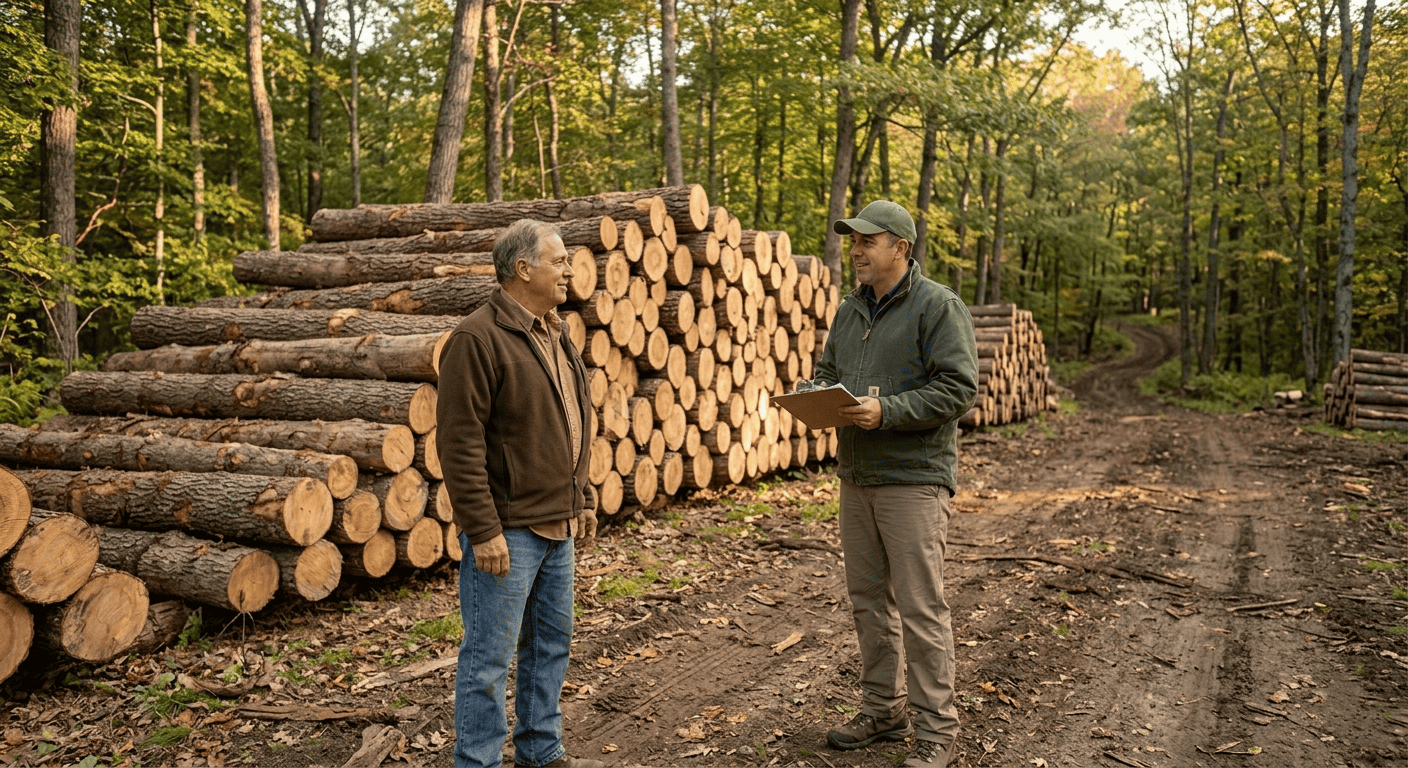
Selling standing timber means selling trees that are still rooted in the ground — on the stump, before harvesting. The buyer pays for the right to enter the property, cut the designated timber, and remove it. The landowner receives a stumpage payment in exchange for that right.
This differs from selling delivered logs. In a delivered log sale, the landowner or their agent harvests and hauls the timber before selling the product to a mill. Standing timber sales are far more common for private landowners in New York. They require no logging equipment, no harvesting operations, and no direct involvement in the physical harvest.
In a standing timber sale, the logger absorbs the costs of equipment, labor, fuel, skidding, loading, and hauling. Those costs come out of the gap between what the mill pays for delivered logs and what the logger pays the landowner in stumpage. That gap is why stumpage prices are always lower than delivered log prices — the logger’s margin lives in between. Understanding this helps you evaluate whether any stumpage offer reflects fair market value. For the per-acre value context that informs that evaluation, see my article on timber value per acre in New York.
The Two Types of Timber Sale — Lump Sum vs. Per-Unit
Before getting into the process sequence, understand that standing timber sales come in two forms. The type you use affects how payment calculates, when you receive it, and what risk each party carries.
Lump Sum Sales
In a lump sum sale, the buyer pays a fixed total amount for all the marked timber in the defined sale area — regardless of what the actual cut volume turns out to be. The landowner receives a single payment, usually in full or in part before harvest begins. The buyer assumes the volume risk.
Lump sum sales are simpler to administer. They give the landowner certainty about total payment upfront. The trade-off: if the actual volume exceeds the sale estimate, the buyer captures the upside. If volume falls short, the buyer absorbs the loss. For landowners with a good cruise report and accurate volume estimates, lump sum sales are common and work well.
Per-Unit Sales
In a per-unit sale — also called a scale sale or cruise sale — payment ties to the actual volume cut and removed. A scaler measures it at the landing or mill after harvest. The price per thousand board feet (MBF) is agreed to in advance by species and grade. Payment then calculates from actual scaled volume.
Per-unit sales give the landowner upside if volume exceeds estimates. They also provide protection if volume falls short. The trade-off here is administration — scaling documentation, payment reconciliation, and a longer payment timeline. Per-unit sales work best when the cruise estimate carries significant uncertainty or when very large volumes are involved.
Which Type Is Right for You
For most private landowners in Sullivan, Ulster, and Orange Counties selling timber from a woodlot with a reliable cruise report, a lump sum sale is the more common and practical choice. Payment certainty and administrative simplicity outweigh the volume risk for most stand sizes. A consulting forester advises on which structure fits your specific stand and volume.
Step One — Timber Appraisal and Stand Assessment
Every well-managed timber sale starts with an independent appraisal — before any conversation with a buyer, before any marketing of the timber, before any decisions about timing or sale type.
A timber appraisal by a licensed consulting forester produces a written report. That report covers the species, volume, and log grade of your merchantable timber. It applies current stumpage prices to produce a total estimated sale value. That report becomes the factual foundation for every subsequent step. Without it, you negotiate from assumptions rather than documented knowledge.
The appraisal also tells you whether the stand is silviculturally ready for harvest. It confirms whether the volume and grade justify logging mobilization cost. It shows whether a harvest now serves the stand’s long-term health. It also identifies any forest health issues — EAB, hemlock woolly adelgid, beech bark disease — that should influence the harvest prescription or timing.
For what the appraisal process involves and what the resulting report contains, see my article on how to get a timber appraisal on your property. For the full value framework that makes the appraisal meaningful, see my guide on how much timber is worth.
Step Two — Tree Marking and Sale Boundaries
Once the appraisal confirms the stand is ready and the value justifies a sale, a consulting forester marks the trees for harvest. Tree marking is one of the most consequential steps in the entire process. It determines both the immediate income from the sale and the long-term quality of the residual stand.
Forester-marked timber uses paint to identify individual stems for cutting. The forester applies a blaze mark at eye height and a separate mark at the base near the ground. After harvest, the base mark remains on the stump. That stump mark provides a post-harvest audit — confirming whether the logger cut only marked trees. Any unmarked tree the logger cuts becomes a documented contract violation.
Tree marking follows silvicultural objectives, not just economic ones. A forester marks for the right trees to come out — based on species, grade, crown position, and the stand’s long-term management direction. A buyer marking his own timber identifies what he wants to take. Those two prescriptions produce very different outcomes for the residual stand. For the silvicultural logic behind a properly marked harvest, see my article on selective timber harvesting.
The forester establishes sale boundaries at the same time. Physical flagging or paint marks on the ground define the outer limits of the harvest area. No logging equipment or cutting activity belongs outside those boundaries under any circumstances.
Step Three — Finding Buyers and Soliciting Bids
With marked timber and a cruise report in hand, the consulting forester prepares a timber sale prospectus. This package gives qualified buyers the information they need to submit competitive bids. The prospectus includes cruise data by species and grade, sale boundaries, access conditions, required contract terms, and the bid submission deadline.
The forester sends the prospectus simultaneously to multiple qualified buyers — sawmills, logging operations, and timber buyers who operate in your region and handle your species mix. Each buyer receives identical information. Each submits a sealed bid by the deadline. The highest qualified bid wins the sale.
This competitive bid structure is the most important financial protection in the entire process. When buyers compete on equal information, they bid at or near true market value. When one buyer sets the price in a private negotiation, the landowner has no reference point for whether that price reflects the market. For the full explanation of why competitive bids consistently outperform single-buyer negotiations, see my article on how to sell timber from your land.
Step Four — Reviewing and Accepting a Bid
After the bid deadline, the consulting forester reviews all submitted bids and presents them to the landowner. Review covers two things: price and buyer qualifications.
On price — does the high bid reach or approach the appraised stumpage value? On qualifications — does the buyer carry appropriate insurance? Do they have a track record of contract compliance in your region? Does their equipment match your stand’s terrain and species mix?
Price is the primary criterion, but not the only one. A high bid from a buyer with a poor compliance history carries more risk than a slightly lower bid from a proven local operator. The forester’s regional knowledge of buyers matters here. Familiarity with how different operations actually perform in the field is information a landowner simply cannot access independently.
Once the landowner accepts a bid, the buyer receives notification and contract preparation begins. No timber is cut, and no equipment enters the property, until both parties sign the contract.
Step Five — The Timber Sale Contract
The timber sale contract is the legal foundation of the entire operation. Everything both parties agreed to verbally before this point becomes enforceable only when it appears in the signed written contract. The contract governs what timber the sale covers, what price the buyer pays, how the harvest proceeds, what site restoration the logger must complete, and what consequences violations carry.
A complete timber sale contract covers: the defined sale boundaries, the marked timber by species and grade, price terms and payment schedule, logging specifications (stump height, slash disposal, stream buffer protection), skid trail and landing locations, damage provisions and violation penalties, insurance requirements, and completion bond terms. Every one of these provisions protects the landowner from a different category of potential problem.
The contract also specifies that no equipment enters the property until the landowner receives any required deposit. For lump sum sales, the buyer often pays a substantial deposit — protecting the landowner if the buyer defaults or abandons the sale after harvest begins.
Step Six — The Harvest Operation
Once both parties sign the contract and the buyer delivers any required deposit, the harvest begins. The logger mobilizes equipment, establishes skid trails and a log landing, and starts felling and skidding marked timber.
Forester oversight during the harvest means regular on-site visits — not just a check at the beginning and end. On each visit, I check which trees were cut against which trees were marked. I verify skid trail routing against the contract specifications. I confirm stream buffer compliance. When problems arise — and they occasionally do, even with reputable loggers — I address them immediately, before they cause irreversible damage to the residual stand.
Most harvest problems are correctable during the harvest but not after it. That’s the practical purpose of regular oversight visits. Harvest duration varies by volume and site conditions. A modest timber sale on a 50-acre woodlot typically runs two to four weeks of active logging. Larger sales or challenging terrain extend that timeline. Weather — particularly spring thaw and wet periods — can interrupt harvest schedules.
Step Seven — Site Restoration and Final Payment
After the last load of logs leaves the property, the logger’s obligations under the contract continue. Site restoration requirements — skid trail seeding, landing stabilization, slash scattering in appropriate areas — must be complete before the performance bond releases and before any remaining payment comes due.
For lump sum sales, final payment typically occurs after harvest completion and site restoration. For per-unit sales, final payment reconciles the total scaled volume against the agreed per-unit price. The buyer pays any remaining balance after scaling is complete.
The forester conducts a post-harvest walk to confirm restoration requirements are met and the residual stand matches the condition the contract specified. The forester documents any deficiencies in site restoration or contract compliance before the bond releases — giving the landowner leverage to require remediation if needed.
Frequently Asked Questions
Do I need a forester present during the actual logging?
A forester does not need to be on-site for every hour of the harvest. Regular oversight visits are what matter. For most operations, that means two to three visits per week during active logging. The frequency increases for complex operations, difficult terrain, or situations where the logger’s contract compliance history warrants closer monitoring. Regular visits catch problems before they become permanent — which is the practical purpose of oversight.
When does the landowner receive payment for standing timber?
Payment timing depends on the sale type and contract terms. For lump sum sales, the buyer commonly pays a substantial deposit before harvest begins, with the balance due at completion. For per-unit sales, payment typically follows scaling, which occurs during or after the harvest. Requiring a meaningful deposit before any equipment enters the property is standard practice. It protects the landowner if the buyer defaults mid-harvest.
What happens if a logger cuts trees outside the marked area?
Trees cut outside the marked area or sale boundaries are a contract violation — sometimes called timber trespass. The contract’s damage provision specifies the penalty, typically a multiple of the stumpage value of the improperly cut timber. The forester’s base-mark system and post-harvest stump audit provide the documentation to establish what was cut versus what was authorized. This is one of the most important reasons to have forester-marked timber and a complete written contract before any logging begins.
How Environmental Forest Products Can Help
I’ve managed standing timber sales on private land across Sullivan, Ulster, and Orange Counties for over 30 years. Every sale I manage follows the full seven-step sequence — appraisal, marking, competitive bids, bid review, contract, harvest oversight, and site restoration confirmation. No shortcuts. No steps skipped.
Here’s what I provide for a standing timber sale:
- Timber appraisal — written report with species, volume, grade, and stumpage value before any buyer conversation
- Tree marking — forester-marked timber with base marks for post-harvest audit
- Sale prospectus and competitive bid solicitation — identical information to multiple qualified buyers simultaneously
- Bid review and buyer qualification assessment — price plus compliance history and equipment capability
- Timber sale contract — complete written agreement covering all protective provisions
- Harvest oversight — regular on-site visits throughout the logging operation
- Post-harvest walk — site restoration confirmation before the performance bond releases
If you have standing timber and want to understand how a well-managed sale works for your specific property, call me before you respond to any offer or sign any agreement.
Request a Free Standing Timber Sale Consultation
Call me directly: (845) 754-8242
Email: henry@eforestproducts.com
Serving Sullivan County NY, Ulster County NY, Orange County NY, Pike County PA, Wayne County PA, and Sussex County NJ.
Henry Kowalec is a licensed consulting forester and member of the Society of American Foresters with over 30 years serving private landowners in the Hudson Valley and Catskills. Environmental Forest Products | Westbrookville, NY 12785 | Licensed in NY, PA, NJ.