The first question most landowners ask when they call me about a forest management plan is: what does it cost? That’s a fair question. But it’s almost always the wrong first question. The right first question is: what does it return?
A forest management plan that costs $1,500 and qualifies a 75-acre Sullivan County property for 480-a enrollment — saving $2,500 per year in property taxes — pays for itself in seven months. Every year after that, the savings continue at no additional cost until the ten-year renewal. Over a decade, that’s $25,000 in cumulative tax savings from a $1,500 investment.
I’m not suggesting cost doesn’t matter. It does. But understanding what drives plan cost, what the realistic price range is for New York woodland properties, and what the plan returns helps you evaluate the investment rather than just the price tag. Here’s the honest breakdown.
What Drives Forest Management Plan Cost
Three variables determine what a forest management plan costs in New York. Understanding each one helps you anticipate what you’ll pay before the first forester conversation.
Property Size
Size is the primary cost driver. A larger property requires more field time — more ground to walk, more sample plots to establish, more stands to describe and map. Field time is the largest component of any management plan fee. A 50-acre property and a 200-acre property are not four times different in complexity — but they are substantially different in the forester’s time on the ground.
Most foresters charge either a flat fee based on acreage or an hourly rate for field and office time. Both approaches arrive at roughly the same place for a given property size and complexity. What matters is that you understand what the fee covers — and that you ask before work begins.
Stand Complexity
A 75-acre property with two distinct stands — a uniform mature hardwood section and a young regenerating area — costs less to plan than a 75-acre property with six stands of different species, ages, structures, and management needs. Stand complexity drives the inventory time in the field and the writing time in the office.
Properties with active forest health issues — EAB-affected ash, hemlock woolly adelgid pressure, heavy invasive shrub coverage — add complexity. Documenting and prescribing for those conditions takes more time than a clean, healthy stand with a straightforward management trajectory.
Plan Purpose and Required Detail Level
A plan written for 480-a enrollment must meet NYSDEC’s content requirements. A plan written to also satisfy USDA NRCS technical standards for EQIP cost-share programs requires additional documentation components. A plan used for estate valuation documentation needs a signed professional certification statement that adds time and professional liability considerations.
The more purposes a plan must serve simultaneously, the more detail the forester must build into it — and the more the plan costs. A forester familiar with all three sets of requirements builds a single plan that satisfies all of them. That’s more efficient than going back and amending a plan after the fact — but it’s not free.
For a complete explanation of what each plan component involves, see my guide on what a forest stewardship plan contains.
Typical Cost Range for New York Woodland Properties
Forest management plan fees in New York typically fall within a range that reflects property size and complexity. Here’s an honest general framework based on my 30 years of practice in Sullivan, Ulster, and Orange Counties.
For a 50- to 75-acre property with two to four stands of moderate complexity, a complete 480-a-qualifying management plan typically runs in the range of $1,000 to $2,500. Simpler properties — uniform stands, few health issues, straightforward management objectives — land at the lower end. More complex properties — diverse stand types, active health threats, multiple program requirements — land at the higher end.
For a 100- to 200-acre property, plan cost typically runs $2,000 to $5,000 depending on stand diversity, health conditions, and required documentation level. Larger properties with eight or more distinct stands, significant invasive pressure, or multi-program compliance requirements can run higher.
These ranges reflect what a licensed consulting forester charges in the Hudson Valley and Catskills region. Plan costs in other parts of New York vary by market. Urban-adjacent forestry markets in the lower Hudson Valley or Long Island may run higher. Rural markets in the northern tier may run lower. Always ask for a fee estimate specific to your property before committing to any engagement.
Does the Plan Cost Include the Forester’s Field Time?
It should — and you should confirm this explicitly before signing any engagement agreement. A complete management plan fee typically covers:
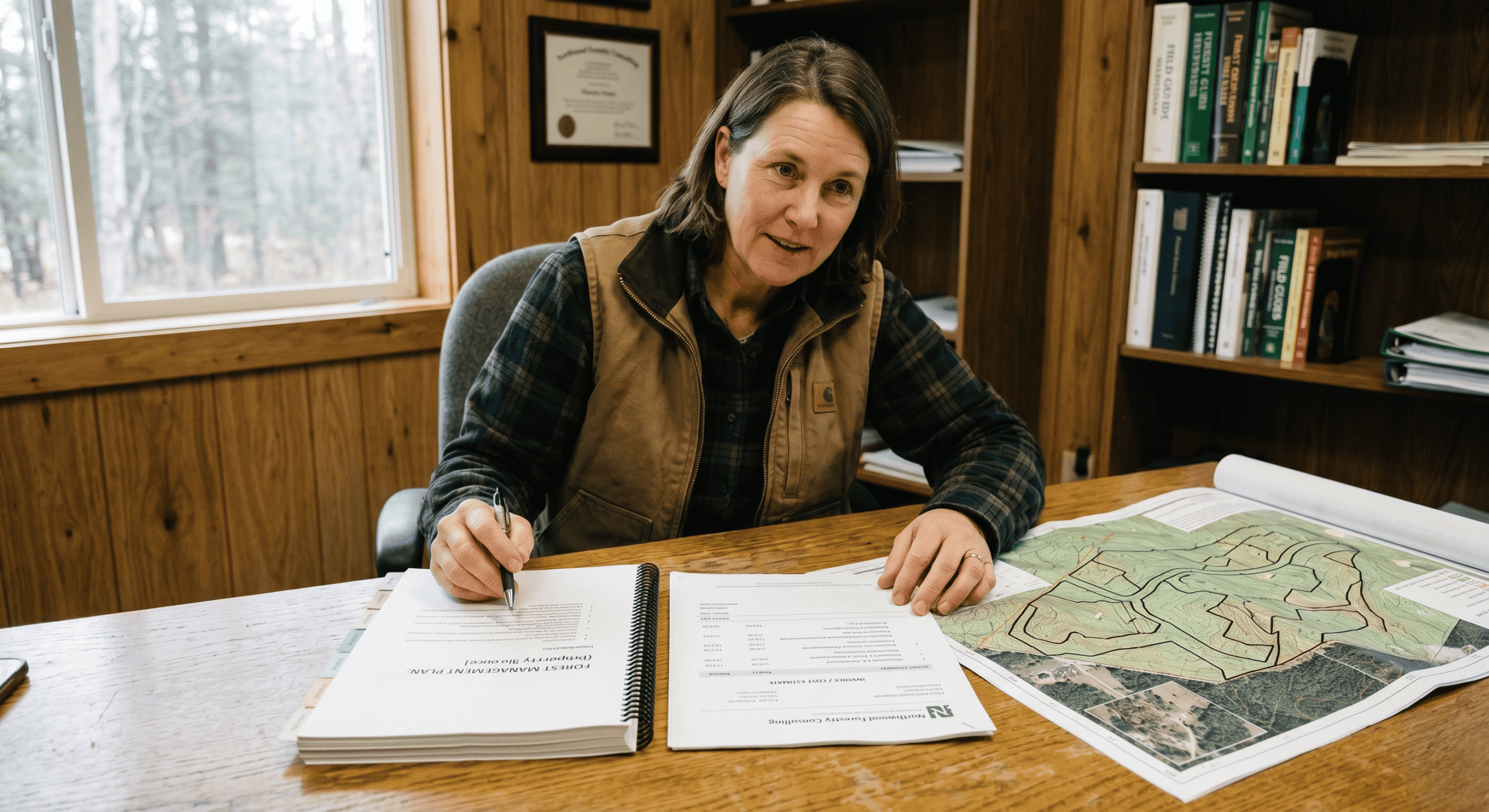
- Field inventory — the forester’s time walking the property, establishing sample plots, measuring trees, and recording stand conditions
- Property map production — stand boundary mapping, access road notation, water feature identification
- Plan writing — stand descriptions, management objectives, ten-year activity schedule, and silvicultural rationale for each prescription
- NYSDEC submission — preparation of the submission package and communication with the regional office through approval
- Review response — if NYSDEC requests clarifications or minor revisions, a complete fee should cover reasonable revision responses
Some foresters charge field time and plan writing as separate line items. That’s not inherently problematic — but understand what you’re agreeing to before work begins. A fee quoted for “plan writing only” that doesn’t include field inventory is not a complete management plan fee. You’ll pay for field time separately, and the total will be higher than the initial quote suggested.
Are There Cost-Share Programs That Reduce the Price?
Yes — in some cases, and it’s worth asking. Two programs are worth knowing about.
USDA NRCS EQIP (Environmental Quality Incentives Program) provides cost-share payments for qualifying conservation practices on private land. In some years and counties, EQIP covers a portion of forest management plan costs as part of a broader conservation practice package. Availability varies by year, county, and funding allocation. Ask a consulting forester or your local NRCS office whether plan cost assistance is currently available in your area. Current program information is at nrcs.usda.gov.
USDA Forest Service cooperative forestry assistance has historically provided some cost assistance for private forest management plans through state forestry programs. Funding availability has varied significantly with federal budget cycles. Ask NYSDEC’s Division of Lands and Forests whether any current cooperative forestry assistance is available in your county before assuming you’ll pay full cost.
One honest caveat on cost-share plans: a plan written to minimum program standards may not serve your property as well as one written to your specific management needs. Cost-share programs fund a plan. They don’t always fund a good one. If cost-share is available, take it — but work with a forester who will write a useful plan, not just a qualifying one.
The Return Calculation — What the Plan Actually Pays Back
A management plan generates return in three ways. Understanding all three gives you the complete picture of what you’re actually paying for.
480-a tax savings are the most straightforward and most significant return for most landowners. The program reduces assessed value by up to 80%. On a qualifying 75-acre Sullivan County property, annual savings of $2,000 to $3,000 or more are realistic. The plan cost — whatever it is — recovers in one to two years. After that, every year of enrollment is pure return on the plan investment. For the full 480-a income picture, see my article on forest stewardship and 480-a tax savings.
Better timber sale outcomes are the second return channel. A management plan establishes the silvicultural framework for any timber sale — which stands, what type of harvest, what the residual stand should look like. That framework protects both the sale’s immediate return and the forest’s long-term value. Landowners who sell timber without a management plan often accept the first offer they receive. Landowners with a plan know what they have and negotiate from information.
Avoided costly mistakes are the third return — harder to quantify but real. A management plan identifies forest health threats before they become expensive emergencies. It sequences management activities so investments build on each other rather than working at cross purposes. It documents what was done and when, which matters for 480-a compliance and for any future sale or estate transaction involving the property.
For the full framework on how these income streams stack on a single property, see my article on how to make money from wooded land.
When Plan Cost Is Not the Right Question
There’s one situation where focusing on plan cost leads landowners in the wrong direction. It’s when they’re comparing plan cost to doing nothing.
A landowner who owns 100 acres of productive Sullivan County woodland and isn’t enrolled in 480-a isn’t “saving” the plan cost by not getting a plan written. He’s forfeiting $2,000 to $4,000 or more in annual tax savings — every year — because he hasn’t made a one-time investment of $1,500 to $3,000. The math runs heavily against inaction over any meaningful time horizon.
The same logic applies to timber sales. A landowner who sells timber without a management plan may save the plan cost — and lose $5,000 to $15,000 in stumpage value by negotiating without independent information about what the timber is worth. That’s not a savings. It’s a trade of a small known cost for a large unknown loss.
Plan cost is a real consideration. It shouldn’t be the only one. The question worth asking is not “what does the plan cost?” but “what does not having a plan cost over the next ten years?” For most woodland owners with 50 or more acres, that answer is uncomfortable. For the situations that most call for a forester, see my article on when to call a consulting forester.
For the complete guide to what a forest management plan is and what the process involves, see my pillar post on forest management plans for private landowners.
Frequently Asked Questions
Can I get a forest management plan for free in New York?
Partially, in some cases. USDA NRCS EQIP and USDA Forest Service cooperative forestry assistance programs have historically provided cost assistance for private forest management plans when funding is available. Availability changes year to year and county to county. Ask a consulting forester or your local NRCS office whether any cost assistance is currently available before assuming you’ll pay full cost. Even when cost-share is available, work with a forester who will write a plan that actually serves your property — not just a plan that clears program minimums.
Do I pay separately for the forester’s field visit and the written plan?
It depends on how the forester structures their fees. Some charge a single all-in flat fee covering field inventory, plan writing, and NYSDEC submission. Others itemize field time and office time as separate line items. Neither approach is inherently better — but you need to know which one you’re agreeing to. Always ask what the quoted fee covers before work begins. A fee that covers “plan writing” but not field inventory is not a complete management plan fee. The total cost will be higher than the initial quote suggests.
How does the plan cost compare to what it saves on 480-a taxes?
For most qualifying properties, the plan cost recovers within the first year or two of 480-a enrollment — sometimes within the first year alone. A plan that costs $2,000 and produces $2,500 in annual tax savings recovers its cost in ten months. After that, the tax savings continue for the full ten-year plan period with no additional plan cost. At renewal, the updated plan cost repeats — but so do the next ten years of savings. Over a 20-year enrollment period, most landowners recover ten to twenty times the plan cost in cumulative 480-a tax savings.
How Environmental Forest Products Can Help
I write forest management plans for private woodland owners across Sullivan, Ulster, and Orange Counties. Every plan I write covers field inventory, stand descriptions, property map, management objectives, ten-year activity schedule, and NYSDEC submission for 480-a approval — all in one fee.
Before I quote any fee, I walk the property or review available aerial and stand information to give you a realistic estimate for your specific acreage and complexity. I don’t quote a number before I know what the property involves. And I tell you upfront whether any cost-share funding appears available for your county and situation.
Here’s what the fee covers for every management plan I write:
- Field inventory — property walk, sample plot establishment, species and stand condition assessment
- Property map with stand boundaries, access roads, and water features
- Written plan — stand descriptions, management objectives, and ten-year activity schedule
- NYSDEC submission and communication through 480-a approval
- Reasonable revision responses if NYSDEC requests clarification
If you own 50 or more acres of productive forest land in Sullivan, Ulster, or Orange County and you’re not enrolled in 480-a, the plan cost is the smallest number in the return calculation. Call me and we’ll work out what your property involves and what a realistic fee looks like before you commit to anything.
Request a Free Management Plan Fee Estimate
Call me directly: (845) 754-8242
Email: henry@eforestproducts.com
Serving Sullivan County NY, Ulster County NY, Orange County NY, Pike County PA, Wayne County PA, and Sussex County NJ.
Henry Kowalec is a licensed consulting forester and member of the Society of American Foresters with over 30 years serving private landowners in the Hudson Valley and Catskills. Environmental Forest Products | Westbrookville, NY 12785 | Licensed in NY, PA, NJ.