Thinning a woodlot at the right time and in the right way is one of the highest-return investments a private landowner can make in their forest. Done wrong, it’s expensive and slow to recover from.
I mark thinning projects on private woodlots across Sullivan, Ulster, and Orange Counties every year. The most common situation I walk into is a stand that needed thinning five years ago. The canopy has closed tight, the best trees are losing ground to low-value competition, and the landowner has been waiting for a sign that it’s time to do something. The sign they missed was the growth rate — when the good trees slow down, the forest is telling you the competition has gotten ahead of them.
This article covers what woodlot thinning actually is, how it differs from other forestry work, when to do it, and what distinguishes a well-executed thinning job from one that leaves a mess and a setback. If you’re thinking about your woodlot’s future, this is the place to start.
What Woodlot Thinning Is — and What It Isn’t
Woodlot thinning is the deliberate removal of selected trees from a stand to improve the growth rate, quality, and structure of the trees that remain. It is a silvicultural practice — meaning it has a defined purpose and a method, not just a result.
What thinning is not: it’s not simply cutting out the dead or ugly trees. It’s not a timber sale, though thinning work can sometimes generate revenue as a byproduct. And it’s not the same as a clearcut — thinning always leaves a substantial portion of the canopy intact. The trees that come out serve the trees that stay. That’s the operating principle.
Thinning is closely related to — and often used interchangeably with — timber stand improvement (TSI), the broader category of non-commercial cutting and tending work. Within TSI, thinning specifically refers to stand density reduction: removing enough stems to give the remaining trees the growing space and canopy access they need. Crop tree release is the most common form of thinning on private woodlots — identifying the best individual trees and freeing them from immediate competition.
Why Thinning Matters: What Overstocked Stands Cost You
When a stand gets overstocked — too many stems competing for the same light, water, and nutrients — every tree in it suffers. Growth rates slow across the board. The best trees slow down just like the worst ones. Diameter growth, which is the primary driver of timber value, stalls. A stand that could be producing merchantable timber in 15 years starts looking like a 25-year proposition instead.
The other cost is structural. In an overstocked stand, the canopy closes tight and stays closed. Sunlight doesn’t reach the forest floor. Regeneration stops. The existing trees grow slowly upward with narrow crowns and small diameters. If a disease hits one species or a storm takes down a section of canopy, there’s nothing in the understory ready to fill the gap.
I’ve walked overstocked stands in Ulster County that were so dense you couldn’t see 30 feet in any direction. The trees were tall, straight, and nearly worthless — small diameters, thin crowns, no mast production, no understory. Those stands had been growing for 30 years and producing almost nothing in the way of timber value or habitat value. A thinning done at year 15 would have changed that outcome entirely.
When Is the Right Time to Thin a Woodlot?
Timing a thinning correctly is one of the most valuable judgments a forester makes on a property. Thin too early and you sacrifice trees that haven’t reached their potential. Thin too late and the competition has already suppressed the best stems for years.
The indicators I look for when evaluating whether a stand needs thinning:
- Crown competition: Are the best trees’ crowns touching or overlapping adjacent trees’ crowns? When crown competition is active, diameter growth slows — and this is the most direct indicator that a thinning is overdue.
- Stand density: Is the stand significantly denser than the target basal area for the site and species mix? A stocked stand at 120 square feet of basal area per acre where 80 is optimal is telling you something.
- Understory condition: A completely closed canopy with no regeneration and no understory shrub layer is a structural warning sign. The stand has nowhere to go when individual trees die.
- Stem quality: If the best-quality trees — the straightest, most vigorous individuals — are clearly losing ground to low-quality neighbors, the competition is doing damage you can measure in future timber value.
- Stand age: Young regeneration stands in their first 20 to 30 years of growth are typically the highest-priority candidates for pre-commercial thinning. The growth response from thinning at this stage, compounded over the stand’s full rotation, is the largest return available from any single management action.
There is no universal answer to “when should I thin.” The right timing depends on species, site quality, stand history, and goals. What’s universal is that the earlier you thin a stand that needs it, the greater the return — because the growth response compounds over time.
Types of Thinning and When Each Applies
Not all thinning work is the same. Different situations call for different approaches, and understanding the distinctions helps a landowner have a better conversation with their forester about what they’re actually getting.
Pre-Commercial Thinning
Pre-commercial thinning (PCT) applies to young stands where the stems being removed have no commercial timber value — they’re too small to sell. The work is done entirely for the benefit of the residual stand. PCT in a young aspen, birch, or hardwood regeneration stand — where stems are crowding each other at 3 to 5 inches in diameter — can dramatically change the quality of the next timber crop over a 20-to-30-year horizon. It’s also one of the highest-value habitat interventions available, because the dense young stands created by PCT are prime grouse and woodcock cover.
Crop Tree Release
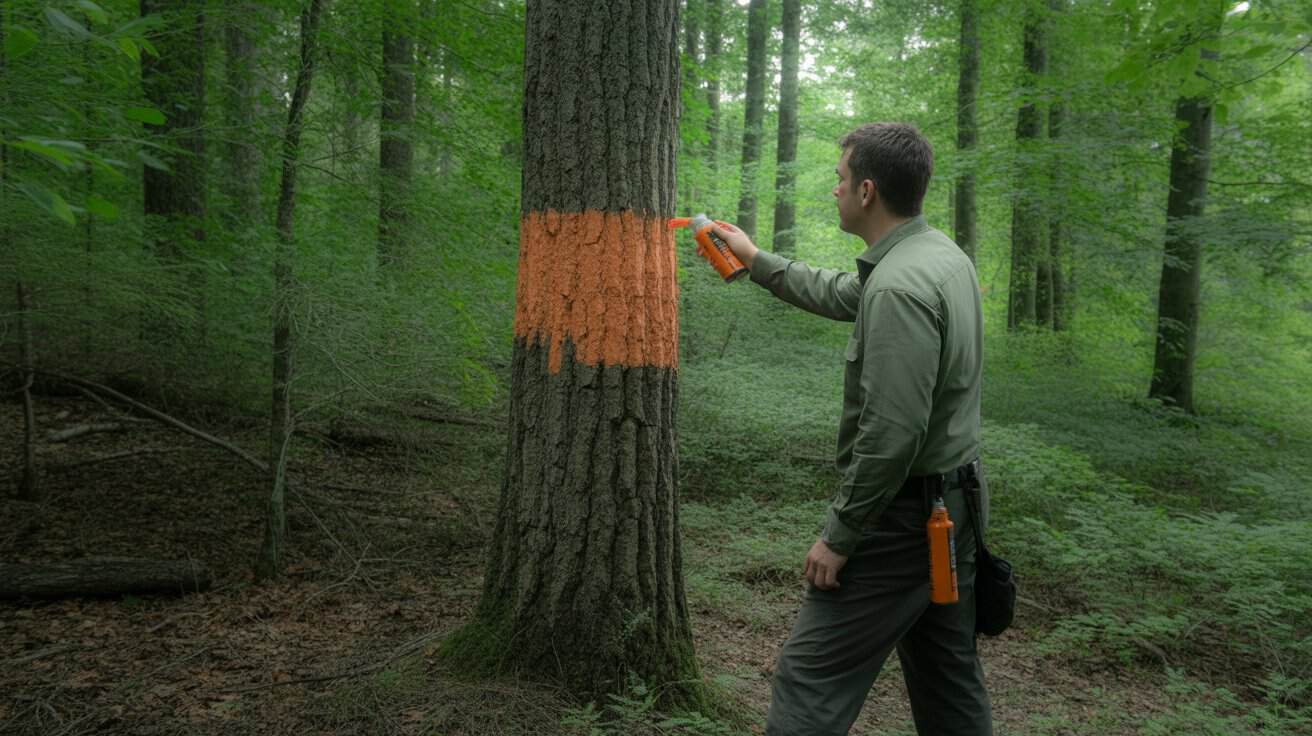
Crop tree release is the most common form of thinning I mark on private woodlots. I identify the 50 to 80 best trees per acre — the straightest, most vigorous, highest-value individuals — and remove the trees that are directly crowding their crowns. The crop trees get immediate access to light, water, and nutrients. Their diameter growth accelerates. Over the next decade, those trees add significant value while the low-quality stems that were removed would have added almost nothing.
Commercial Thinning
Commercial thinning removes trees that are large enough to have timber value, generating revenue for the landowner while simultaneously improving the residual stand. It’s the best of both outcomes — income and forest improvement — but it requires the same professional oversight as any commercial harvest: a timber appraisal, a forester-marked cut, a written contract, and on-site supervision. Without that oversight, a commercial thinning becomes a high-grading operation in practice, regardless of what it’s called on paper.
Salvage Thinning
When storm damage, pest activity, or disease has killed or damaged a portion of a stand, salvage thinning removes the affected trees before they lose commercial value and before the material becomes a safety or fire hazard. Salvage work is time-sensitive — the window between a tree dying and its timber becoming unmarketable is shorter than most landowners expect. I’ve seen landowners wait six months to call after a major storm and find that the value was already compromised.
What a Good Thinning Job Looks Like
After a well-executed thinning, the residual stand should feel more open without feeling empty. The best trees — the crop trees — should have clear crown space around them. There should be light reaching the forest floor in patches. The slash from the removed trees should be on the ground, lopped and scattered rather than piled in ways that create fire hazard or block access.
What a good thinning doesn’t look like: it doesn’t look like a clearcut. It doesn’t look like the logger took whatever was easiest to reach. And it doesn’t leave the best trees damaged by logging equipment or skidding operations. Those are signs of a job done without proper marking and supervision.
The trees that come down in a thinning should be selected by a forester, not by the operator. The difference in outcome is significant. A forester-marked thinning removes the competition to the crop trees. An operator-selected thinning removes whatever is easiest to cut and skid, which often means the straightest, most accessible trees — the opposite of what the forest needs.
Frequently Asked Questions
Can I do woodlot thinning myself?
You can do some of the cutting work yourself — particularly pre-commercial thinning in young stands where the stems are small enough to handle safely with a chainsaw. What you can’t do yourself is the marking. Deciding which trees come out and which stay requires a trained eye, knowledge of the stand’s development trajectory, and an understanding of timber quality that comes from professional training and field experience. Have a forester mark the work first. Then do the cutting yourself if you’re able to do it safely — it’s a perfectly reasonable division of labor.
How much does woodlot thinning cost?
Pre-commercial thinning costs money — the stems removed have no sale value, so the work is pure investment. Costs vary by stand density, topography, and access, but forester marking plus contractor labor on a typical pre-commercial thinning project runs in the few-hundred-dollar range per acre for a small property. Commercial thinning, by contrast, can generate net revenue — the sale value of the removed timber offsets and often exceeds the cost of the operation. A timber appraisal before a commercial thinning tells you what to expect on your specific property.
Will thinning damage the trees that stay?
Done right, no. Done wrong, yes. A well-executed thinning — with proper felling direction, controlled skidding, and operator care around the crop trees — leaves the residual stand undamaged. Scarred root flares, damaged cambium from skidder contact, and broken tops on residual trees are signs of a thinning done without supervision or marking. Those injuries affect timber value and long-term tree health for decades. This is one of the primary reasons professional oversight during any cutting operation matters.
How often should I thin my woodlot?
That depends on the stand’s growth rate and your goals, but a general answer for northeastern hardwood stands is every 10 to 15 years for stands that are being actively managed for timber quality. Young regeneration stands in their first rotation may need a pre-commercial thinning at 15 to 20 years and a crop tree release at 25 to 35 years before they’re ready for a first commercial harvest. The management plan for the property determines the right schedule — which is one reason having a current plan matters for any landowner who wants to manage deliberately rather than reactively.
How Environmental Forest Products Can Help
I mark thinning projects on private woodland properties across Sullivan, Orange, and Ulster Counties in New York and into Pike and Wayne Counties in Pennsylvania and Sussex County in New Jersey. Every marking job starts with a property walk and ends with a clear plan for which trees come out, which stay, and why.
What I offer for woodlot thinning and stand improvement:
- Stand assessment and thinning prescription — evaluate whether and how your stand needs thinning, and mark the work before any cutting begins
- Pre-commercial thinning marking — young stand thinning for maximum long-term growth response
- Crop tree release marking — identify and free the best timber and mast-producing trees in your stand
- Commercial thinning supervision — appraisal, contract, and on-site supervision when the thinning generates marketable timber
- Forest management plan preparation — a written 10-year plan that puts thinning in context with your full management goals, including 480-a enrollment
If your woodlot has been growing unmanaged for more than 10 years, it almost certainly needs a thinning assessment. Request an estimate and tell me your acreage and county. I’ll give you a straight answer about where your stand is and what it needs.
This article is part of the Woodlot Management for Private Landowners guide on the EFP blog.
📞 (845) 754-8242
✉️ henry@eforestproducts.com
📍 Westbrookville, NY 12785
Serving Sullivan, Orange, and Ulster Counties NY | Pike and Wayne Counties PA | Sussex County NJ
Henry Kowalec is a licensed consulting forester and member of the Society of American Foresters with over 30 years serving private landowners in the Hudson Valley and Catskills. Environmental Forest Products | Westbrookville, NY 12785 | Licensed in NY, PA, NJ.