The short answer is yes. New York’s 480-a Forest Tax Law requires a licensed forester to write the management plan that qualifies your property for enrollment. There is no workaround, no exception, and no self-service path to a qualifying plan.
But “required” doesn’t fully describe the relationship. A good consulting forester doesn’t just produce a document that clears regulatory review. He qualifies your acreage, writes a plan that reflects what’s actually on your land, manages the NYSDEC submission, guides you through the enrollment process, and stays available for ten years of compliance questions and management activity supervision.
That’s not a burden. It’s the structure that makes 480-a work as a long-term investment — not just a one-time paperwork exercise. Here’s what the consulting forester relationship actually involves, and why the requirement exists in your favor as much as the state’s.
The Direct Answer — Yes, a Licensed Forester Is Required
New York State requires that a licensed forester write any forest management plan submitted for 480-a enrollment. The NYS Education Department issues that license. A timber buyer cannot produce a qualifying plan. A logging contractor cannot produce one. A landowner cannot write their own qualifying plan. The licensed forester is the only professional the state accepts for this purpose.
The plan the forester writes must reflect actual field conditions. It must prescribe genuine management activities — not a minimal checklist — and it must carry the forester’s professional certification and license credential. NYSDEC’s regional reviewer confirms all three before approving the plan for enrollment.
A plan submitted without a licensed forester’s signature and credential comes back rejected. The landowner then starts over — new forester, new field inventory, new plan — with the tax savings clock paused throughout. The time cost alone can run four to six months. For a complete explanation of the licensing requirement and why it protects landowners beyond just satisfying NYSDEC, see my article on whether you need a licensed forester for your management plan.
What “Required” Actually Means in Practice
Landowners sometimes hear “required” and picture a bureaucratic hoop to clear before the real benefit starts. That’s not the right frame. The licensing requirement exists because a management plan is only as useful as its underlying field data and silvicultural judgment — and those require professional training to produce accurately.
A plan built on a real field inventory by a licensed forester tells you what you actually have. It identifies the species composition, timber quality, forest health threats, and management opportunities on your specific property. That information doesn’t just satisfy NYSDEC. It gives you the baseline for every management decision you’ll make for the next ten years — timber sales, TSI treatments, habitat improvements, invasive control.
A forester who writes a plan and then disappears isn’t delivering full value. The relationship works best when the forester who wrote the plan stays engaged through the enrollment period — answering compliance questions, supervising prescribed activities, and amending the plan when circumstances change.
What a Consulting Forester Does for Your 480-a Enrollment
The forester’s role spans three phases of the 480-a process. Understanding what happens in each phase tells you what you’re paying for and what to expect from the engagement.
Before the Plan Is Written
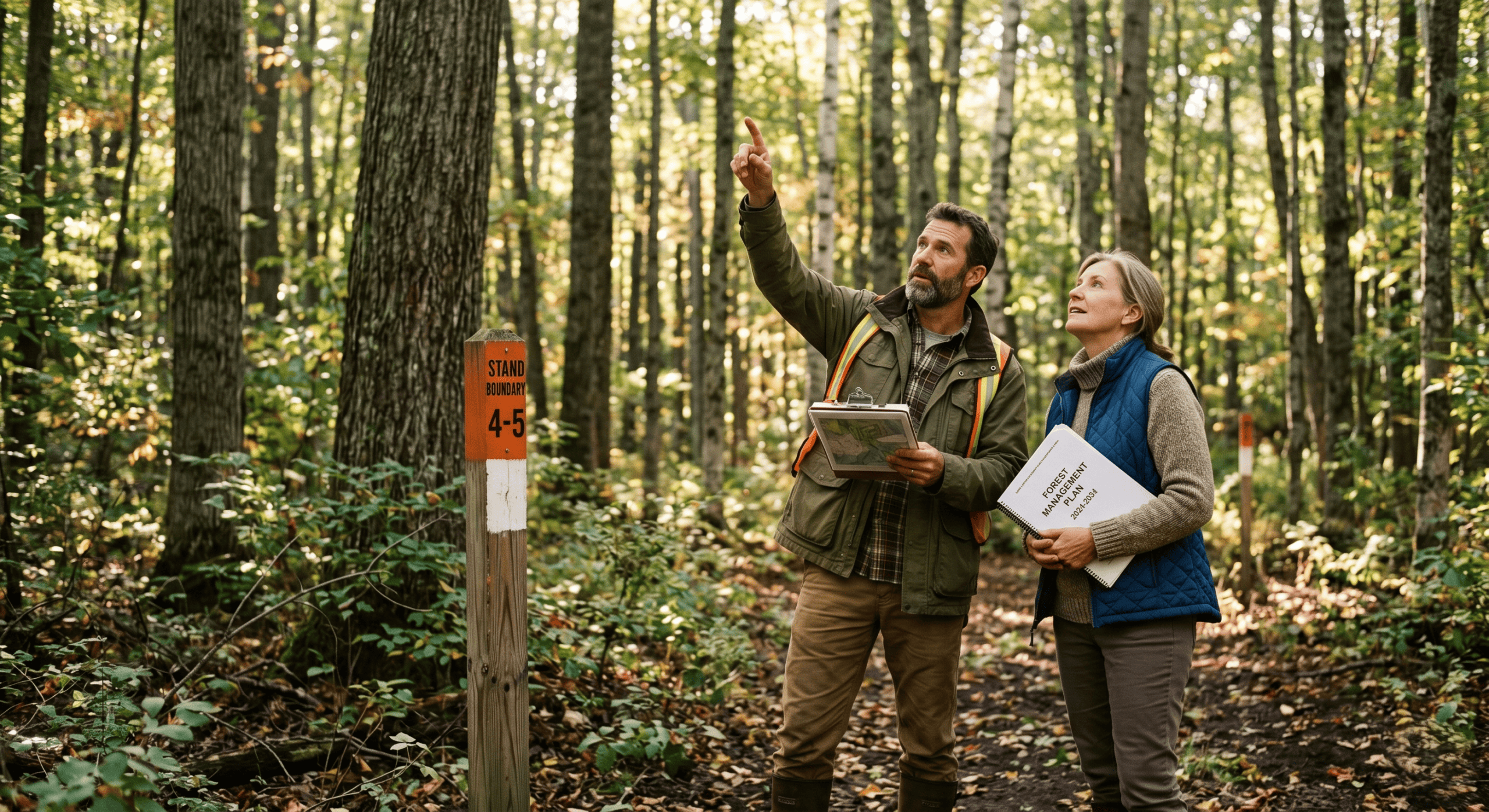
Before anything goes on paper, I walk the property. I identify qualifying and non-qualifying acreage — separating productive forest from wetlands, open fields, and non-productive areas. I assess whether the property meets the 50-acre minimum after those exclusions. Evaluate site productivity, access conditions, and any active forest health issues that will shape the management prescriptions.
This pre-plan assessment is where I tell you whether the property qualifies before you invest in plan writing. If it qualifies, the assessment also reveals what the plan needs to address — and what the realistic annual 480-a savings look like for your specific acreage and assessed value. If it doesn’t qualify, I’ve saved you the cost of a plan you couldn’t use.
During the Plan Process
The field inventory comes first — systematic stand assessment, timber cruise, health evaluation, and access documentation. Then I write the plan: stand descriptions, property map, management objectives, and ten-year activity schedule. I submit the completed plan to the NYSDEC regional office and communicate with the reviewer through approval. When NYSDEC requests clarifications or minor revisions — which happens occasionally — I respond and resolve them.
After approval, I guide the assessor application process. Most landowners have never filed a 480-a enrollment application with their local tax assessor. I walk you through what the assessor needs and when to file it. Missing the assessor’s annual application deadline by a few weeks can delay the first reduced tax bill by a full year. That deadline matters.
After Approval — Ongoing Compliance
Enrollment doesn’t end at approval. The management plan prescribes activities over ten years. When a timber harvest year arrives, I mark the trees, write the sale contract, and oversee the harvest — confirming the sale conforms to the plan’s prescription and satisfies the 480-a activity requirement. TSI work is prescribed, I supervise it. When invasive control is scheduled, I advise on treatment approach and documentation.
I’m also available when circumstances change. A severe storm damages a stand. EAB accelerates through the ash component faster than expected. The landowner’s goals shift. Any of these warrant a plan amendment — and a plan amendment beats non-compliance every time. Non-compliance risks back-tax liability for every year of enrollment the landowner received the reduced assessment.
For the full picture of how the 480-a stewardship commitment and tax savings interact over time, see my article on forest stewardship and 480-a tax savings.
Why a Consulting Forester Protects More Than Just Your Enrollment
The consulting forester’s role in 480-a enrollment is also the forester’s role in every other aspect of your woodland’s financial value. The same professional who qualifies your acreage and writes your plan is the one who can protect your timber sale return, identify your most urgent forest health threats, and tell you when your stand is ready for its next harvest.
That continuity is worth more than landowners typically realize when they think about the forester only as “the person who writes the 480-a plan.” The forester who knows your property for ten years makes better management recommendations in year eight than a forester who walks it for the first time at plan renewal. Institutional knowledge about your stands — what was cut, when, what came back, what threats emerged — shapes every management decision in ways that a new forester starting fresh cannot replicate.
A consulting forester also works for you — not for a mill, not for a buyer, not for a logging company. That professional independence is what makes the advice reliable. For the detailed explanation of how that distinction plays out in timber sales and management decisions, see my article on timber buyers vs. consulting foresters.
What Makes a Good 480-a Forestry Consultant
Not every licensed forester is the right choice for a 480-a engagement. Here’s what to look for when evaluating a consulting forester for this work.
Current NYS forester license. Verify it before the engagement begins at op.nysed.gov. Ask for the license number. A legitimate licensed forester provides this without hesitation.
480-a submission experience in your region. Ask specifically whether the forester has submitted plans to the NYSDEC regional office covering your county. Regional familiarity matters — different offices have different reviewers, different workloads, and different formatting expectations. A forester who knows your regional office writes plans that move through review cleanly.
Independence from logging or timber buying interests. A consulting forester’s fee comes from you — not from any logging company, mill, or buyer. If the person offering to “help with your 480-a plan” is affiliated with a logging operation or timber buyer, the conflict of interest problem applies regardless of their credentials.
Long-term availability for compliance guidance. The plan is a ten-year document. The forester should be available throughout that period for compliance questions, activity supervision, and plan amendments. A forester who writes plans and doesn’t stay engaged leaves you managing compliance alone — which is how landowners fall behind and trigger the back-tax risk.
What the Forester’s Fee Buys You — The Real Return
A management plan for a 100-acre Sullivan County property typically runs $1,500 to $2,500. At $2,400 in annual 480-a savings on that property, the plan cost recovers in seven to thirteen months. After that, every year of enrollment is pure savings with no additional plan cost until the ten-year renewal.
The forester’s fee also buys something harder to quantify: the confidence that the plan is accurate, the enrollment will survive NYSDEC review, and the management decisions the plan prescribes will build long-term forest value rather than degrade it. A bad plan — or a plan written by an unqualified person — costs more than the forester’s fee when it fails review, triggers non-compliance, or prescribes management that damages the stand.
For the detailed breakdown of what drives management plan cost and how the return calculation works across different property sizes, see my article on forest management plan cost in New York. For how 480-a savings stack with timber income and hunting lease revenue on the same property, see my article on how to qualify for the 480-a forest tax exemption.
Frequently Asked Questions
Can a timber company forester handle my 480-a enrollment?
A forester employed by a timber company or logging operation may hold a valid NYS license — but they work for their employer, not for you. A 480-a management plan written by a company forester carries the same conflict of interest as a plan written by a timber buyer: the person producing the document has financial interests that may diverge from yours. For a regulatory plan that will govern your property’s management for ten years, a consulting forester who works exclusively for landowner clients is the appropriate choice.
How do I know if a forester is qualified to write a 480-a plan?
Verify their current NYS forester license at op.nysed.gov before any engagement begins. Then ask specifically whether they have submitted 480-a management plans to the NYSDEC regional office covering your county. Regional submission experience matters — it determines whether the plan they produce will move through review cleanly or come back with revision requests. A forester who has submitted multiple plans to your regional office knows exactly what the reviewer expects.
Does my consulting forester need to be local to my county?
Not by regulation — but regional familiarity is a practical advantage that matters. A forester who regularly works in Sullivan County knows the local species composition, the active forest health threats, the county’s assessed value landscape, and the NYSDEC regional office’s expectations. That knowledge produces better field assessments, more accurate management prescriptions, and plans that clear review more efficiently than those produced by a forester unfamiliar with the region. For Sullivan, Ulster, and Orange Counties, local experience is a meaningful differentiator.
How Environmental Forest Products Can Help
I’m a licensed consulting forester serving woodland owners across Sullivan, Ulster, and Orange Counties. 480-a enrollment — from qualification assessment through ten-year compliance management — is the core of my practice. I’ve been writing plans and guiding landowners through this process for over 30 years.
My fee comes from the landowner. I work for no logging company, no mill, and no timber buyer. Every plan I write reflects what I found in the field — not what would benefit a buyer or a logging operation. That independence is what makes the plan reliable and the advice worth following.
Here’s what I provide for a 480-a engagement:
- Pre-plan qualification assessment — walking the property and confirming whether it meets all four 480-a requirements before any plan fees are committed
- Realistic savings estimate — reviewing your assessed value and tax rate to tell you what annual enrollment will save before you make any decision
- Complete plan writing — field inventory, stand descriptions, property map, and ten-year activity schedule meeting both NYSDEC and USDA NRCS technical standards
- NYSDEC submission and regional office communication through approval
- Assessor application guidance so enrollment is in place for the earliest possible tax year
- Ongoing compliance availability — activity supervision, plan amendments, and compliance documentation throughout the enrollment period
If you’re considering 480-a enrollment and want to know whether your property qualifies and what it would save, call me. That conversation is free and will give you the numbers before you commit to anything.
Request a Free 480-a Consultation
Call me directly: (845) 754-8242
Email: henry@eforestproducts.com
Serving Sullivan County NY, Ulster County NY, Orange County NY, Pike County PA, Wayne County PA, and Sussex County NJ.
Henry Kowalec is a licensed consulting forester and member of the Society of American Foresters with over 30 years serving private landowners in the Hudson Valley and Catskills. Environmental Forest Products | Westbrookville, NY 12785 | Licensed in NY, PA, NJ.