Every year I get calls from new woodland owners who are already in trouble — not because they did anything wrong, exactly, but because they acted before they understood what they had. They responded to a timber buyer who contacted them within weeks of closing. They started cutting without a plan. Paid full property taxes for three years on land that would have qualified for 480-a from day one. They made decisions from urgency rather than information.
The good news is that woodland doesn’t punish you for patience. Trees that have been growing for 50 years will still be there next month. The mistakes that cost new woodland owners the most — financially and silviculturally — almost all share a common root: acting before knowing.
Here’s the guide I wish every new woodland owner read before anyone else got to them. Whether you’ve just purchased wooded property or inherited it, these are your first steps — in the right order.
The First 90 Days — Observe Before You Act
Give yourself 90 days before making any significant decision about your woodland. That’s not passivity — it’s a deliberate orientation period. Use those 90 days to learn what you own before anyone tries to tell you what it’s worth or what you should do with it.
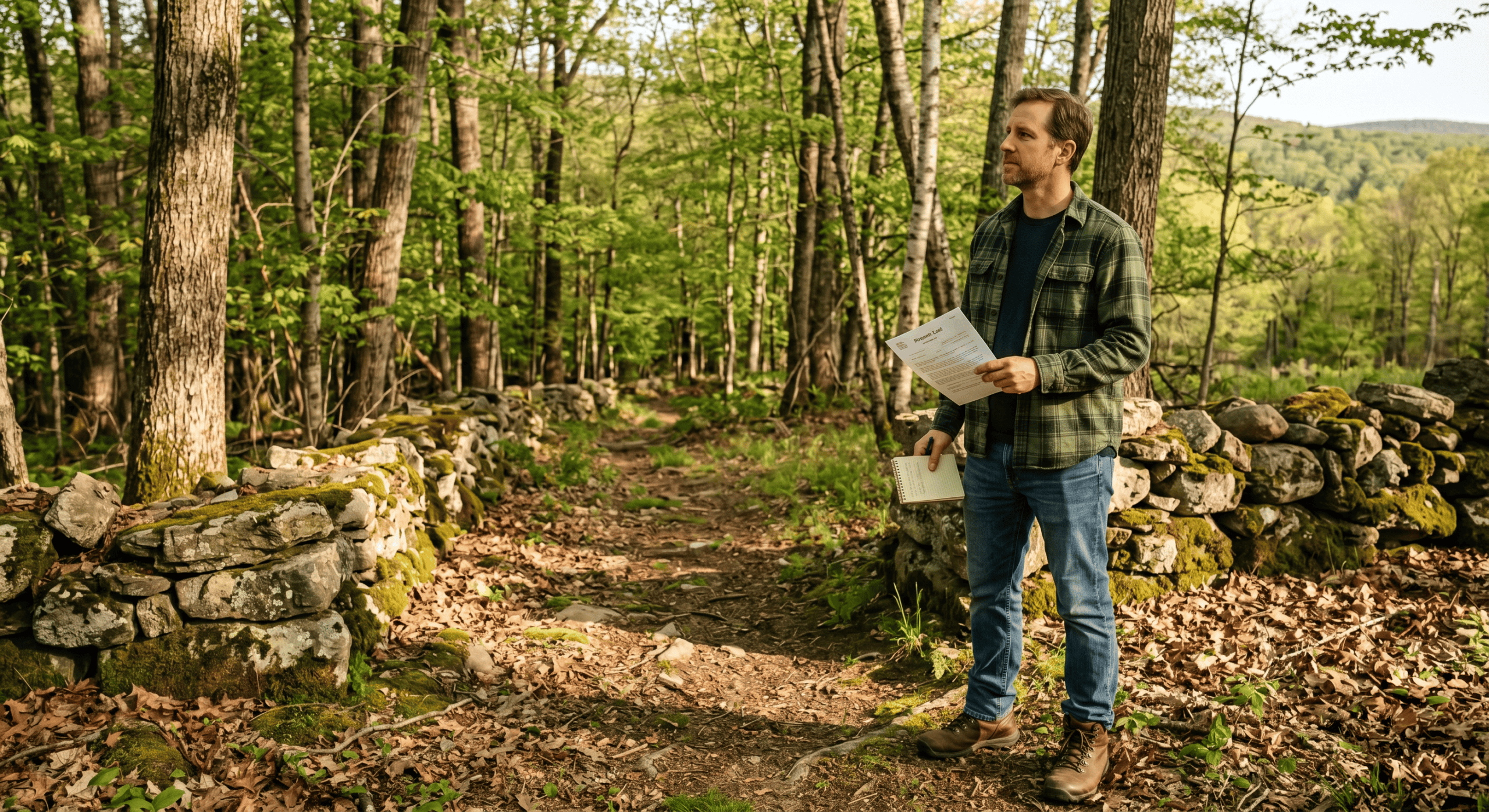
Walk the property. Walk it multiple times, in different seasons if possible. Note what tree species you see, where the land is wet and where it drains well, where there’s obvious deer activity, where old stone walls indicate historical agricultural use. Note where there are big trees and where the stand is crowded and young. None of this requires forestry training — it requires time and attention.
One exception to the 90-day pause: if you have ash trees on the property showing crown dieback or woodpecker activity on the upper trunk, call a forester sooner. Emerald ash borer creates genuine time-sensitive timber value windows. For everything else, 90 days of observation before action is the most protective decision a new woodland owner can make.
Step One: Understand Your Property Before Anyone Else Does
Your goal in the first 90 days is to develop a baseline understanding of what you own. You don’t need expert knowledge — you need your own direct observations before someone else’s financial interests shape how you see the property.
Walk every part of the property. Note the dominant tree species in the canopy — oak, cherry, maple, and birch are higher-value species; red maple and beech are lower-value but still relevant. Note stem quality — are the big trees straight and clear-boled, or heavily branched and defective? Understory conditions — is there native regeneration, or is the floor covered in Japanese barberry or multiflora rose? Note access — where can a vehicle enter, and where are the wet areas and stream crossings that would complicate logging?
Write these observations down. Sketch a rough map. The notes you take before a forester visit make that visit more productive — and they give you a reference point that protects you if a buyer later tells you things about your property that contradict what you saw.
For a more detailed guide to what to look for on a first management walk, see my article on forest land management for beginners.
Step Two: Secure the Boundaries
Boundary clarity is foundational to every management and financial decision you’ll make about your woodland. Before any timber sale, any management activity, or any agreement with a neighbor about access or shared boundaries, know where your property lines actually run.
Walk the boundary lines you received in the deed and compare them against the property on the ground. Look for surveyor pins, corner monuments, blazed boundary trees, or old fence lines. Note any areas where the boundary is unclear or where neighbor encroachment may have occurred.
If the boundaries aren’t clear on the ground, hire a licensed surveyor before moving forward with any timber-related activity. A timber sale on land where the boundaries are uncertain creates liability. A logging operation that inadvertently crosses a property line — even unintentionally — can produce timber trespass claims. Boundary clarity is a precondition for safe management, not an optional refinement.
Step Three: Find and Review All Existing Documents
Before spending money on any professional service, search for documents that may already describe your woodland’s condition, management history, and financial status.
Specifically, look for:
- Existing forest management plan — if the prior owner enrolled in 480-a or worked with a consulting forester, a management plan may exist. That plan tells you the stand conditions as of its last update and what management activities were scheduled. It may also tell you whether 480-a enrollment is active and whether prescribed activities are current.
- Prior timber sale contracts — these documents show when timber was last harvested, what species were cut, and what price was paid. That history shapes how you understand the current stand condition and what the next management priority is.
- Property tax records — your tax bill will show whether the property carries a 480-a reduced assessment. If it does, you need to notify NYSDEC of the ownership change to maintain the enrollment.
- Survey maps and deed descriptions — these define your boundaries and may identify easements, rights-of-way, or other encumbrances that affect what you can do on the property.
- Any conservation easements — some woodland properties carry permanent land use restrictions through conservation easements with land trusts or government programs. These run with the land — they transfer to you at purchase whether or not you were informed of them.
If the property came through an estate with inherited land, the documentation situation may be less organized than a conventional purchase. For a complete guide specific to inherited woodland, see my article on what to do if you inherited wooded land.
Step Four: Get a Professional Assessment Before Any Sale or Management Decision
The most financially protective decision a new woodland owner can make is to get an independent professional assessment before responding to any timber buyer, before starting any logging work, and before making any major management decision.
A consulting forester walk-through — which is less formal than a full timber cruise and management plan, but more rigorous than a self-assessment — tells you what species and timber quality you have, what the stand’s management history appears to be, what forest health threats are active, and what the realistic management options look like for your specific property and goals.
That assessment is your information foundation. Everything that follows — whether you decide to enroll in 480-a, pursue a timber sale, begin habitat improvement, or simply understand what you own — builds on it. Without it, you’re reacting to other people’s assessments of your property rather than working from your own.
For the full explanation of why buyer offers are not independent assessments, see my article on timber buyers vs. consulting foresters. For the seven situations that most call for a forester — several of which apply to every new woodland owner — see my article on when to call a consulting forester.
Step Five: Understand the Financial Landscape
Woodland ownership has a financial structure most new owners don’t fully understand until they’ve missed opportunities that could have been available from day one. Three financial dimensions matter most in the first year.
Property Taxes and 480-a
If your property has 50 or more contiguous acres of productive forest land, it likely qualifies for New York’s 480-a Forest Tax Law — a program that reduces the assessed value of enrolled woodland by up to 80%. On a 100-acre property assessed at $2,000 per acre, that’s the difference between paying taxes on $200,000 and paying on $40,000.
Every year you don’t enroll is a year of savings you can’t recover. The enrollment requires a licensed forester to write a management plan and NYSDEC to approve it — a process that takes three to six months. Start that process in your first year of ownership, not your third. For the full 480-a picture and what the enrollment involves, see my article on forest stewardship and 480-a tax savings. Current program information is at dec.ny.gov.
Timber Income Potential
Mature woodland in Sullivan, Ulster, and Orange Counties may carry significant timber value — or it may not. The only way to know is a timber cruise by a licensed forester. What you can’t do is evaluate a timber buyer’s offer without an independent valuation. A buyer’s offer reflects what works for his operation — not what your timber is actually worth at market price.
Before accepting any offer or agreeing to any logging arrangement, get an independent timber appraisal. That appraisal tells you what you have, what it’s worth at current stumpage prices, and whether any offer you’ve received is fair. For the complete timber value framework, see my guide on how much timber is worth.
Cost-Share Opportunities
USDA NRCS EQIP provides cost-share payments for qualifying conservation practices on private land — including invasive species control, timber stand improvement, and in some cases forest management plan writing. Availability changes by year and county. Check current program availability at nrcs.usda.gov or ask a consulting forester whether your property and situation qualify. New woodland owners who haven’t had a management plan written may be eligible for cost assistance that offsets some of the first-year professional fees.
The Five Mistakes New Woodland Owners Make Most Often
After 30 years of working with private landowners across Sullivan, Ulster, and Orange Counties, I’ve watched the same five mistakes repeat. Knowing them in advance is the most direct protection available.
One: Responding to a timber buyer before getting an independent appraisal. Real estate transfers are public record. Timber buyers monitor them in counties with active timber markets. If a buyer contacts you within weeks of closing on wooded property, it’s because he recognized the opportunity before you did. Don’t respond until you know what you have. See my article on timber buyers vs. consulting foresters for the full picture.
Two: Starting management activities without a plan. Well-intentioned cutting without a silvicultural prescription often damages stands in ways that take decades to correct. Releasing the wrong trees, removing the wrong competition, or creating openings in the wrong locations sets the stand back rather than forward. One forester walk-through before any chainsaw work prevents most of this.
Three: Missing the 480-a enrollment window. Every year of delayed enrollment is a year of tax savings permanently lost. On a 100-acre Sullivan County property, that can mean $2,000 to $3,000 or more forfeited every year you delay. Start the process in year one.
Four: Treating the property boundaries as the seller described them. Seller representations about boundaries are not surveys. Walk the bounds yourself or hire a surveyor before any activity that depends on boundary accuracy.
Five: Assuming the forest manages itself. An unmanaged woodland doesn’t stay the same — it changes in directions that reduce value, degrade habitat, and make eventual improvement more difficult. Doing nothing is a choice with compounding consequences over time.
How to Find the Right Consulting Forester
Not every forester is right for every situation. When evaluating a consulting forester as a new woodland owner, ask three questions.
First: do you hold a current New York State forester license? Verify the answer at the NYS Education Department’s online license verification system before engaging anyone. A licensed forester carries professional accountability for the advice they give and the plans they write.
Second: do you work for any logging company, mill, or timber buyer? A consulting forester’s fee should come from you — not from any entity that profits from your timber. Independence is the mechanism that makes professional advice reliable.
Third: do you have experience with properties in my county? Regional knowledge — species composition, active health threats, NYSDEC regional office expectations, local market conditions — is not transferable from a distant market. A forester who works regularly in Sullivan, Ulster, or Orange County knows things about your woodland that a generalist cannot replicate.
Frequently Asked Questions
How long before I should start managing my new woodland?
Start the process within your first year — but manage the sequence carefully. The first six months are for observation, document review, and a professional assessment. Active management activities — timber sales, TSI work, invasive control — follow from the assessment, not precede it. The one financial action that warrants parallel pursuit from the start is 480-a enrollment inquiry, since every year of delay costs tax savings you can never recover. Everything else should flow from knowing what you have.
What if a timber buyer contacts me before I’ve had the property assessed?
Tell them you’re in the process of having the property assessed and will be in touch after that’s complete. That’s a true statement — or it should be, immediately. Do not agree to any walk-through, any price discussion, or any logging arrangement until you have an independent appraisal of what the timber is worth. A buyer’s assessment of your timber serves his interests. Your assessment serves yours. You need yours first.
Do I need a forest management plan right away?
Not necessarily in the first month — but yes in the first year if the property qualifies for 480-a enrollment. The management plan is the required entry point for 480-a, and the enrollment process takes three to six months. Start the plan process early enough in year one to capture enrollment before the following tax year. Even without 480-a, a management plan in the first year gives you a professional baseline for every subsequent decision. It’s the document that converts curiosity about your woodland into a clear management direction.
How Environmental Forest Products Can Help
I work with new woodland owners regularly across Sullivan, Ulster, and Orange Counties — people who just closed on a wooded property and aren’t sure what they have or what to do with it, and people who inherited land from a relative who managed it for decades and left little documentation behind. Both situations are familiar to me. Both benefit from the same starting point: a clear-eyed professional assessment of what’s there before any decision gets made.
Here’s what I can do for a new woodland owner in the first year:
- Walk the property and give you a plain-language assessment of species composition, timber quality, stand condition, and any urgent forest health issues
- Review any existing management plan, timber sale contracts, or 480-a enrollment documentation you find in the estate or property records
- Conduct a timber cruise and written appraisal if a timber sale or estate valuation is needed
- Write a forest management plan and handle the 480-a enrollment process to start capturing tax savings in year one
- Advise on whether EQIP cost-share funding applies to any first-year management priorities
- Give you a sequenced management roadmap — what to address first, what can wait, and what the realistic ten-year outlook looks like
If you’ve recently acquired wooded land in Sullivan, Ulster, or Orange County, call me before you make any other decisions. The first conversation costs nothing. Everything that follows builds on it.
Request a Free New Landowner Consultation
Call me directly: (845) 754-8242
Email: henry@eforestproducts.com
Serving Sullivan County NY, Ulster County NY, Orange County NY, Pike County PA, Wayne County PA, and Sussex County NJ.
Henry Kowalec is a licensed consulting forester and member of the Society of American Foresters with over 30 years serving private landowners in the Hudson Valley and Catskills. Environmental Forest Products | Westbrookville, NY 12785 | Licensed in NY, PA, NJ.