“How much is my timber worth?” It’s the first question I hear from almost every landowner I work with. And it’s the right question to ask. But the honest answer — the one that actually helps you — is never a number I can give you over the phone.
Timber value is not a price per acre you can look up in a table. It’s the product of four specific factors on your specific property: species, quality, volume, and access. Two woodlots in the same township can differ by 300% in per-acre value based on those four variables alone.
What I can do is explain exactly how timber value is determined, what the key terms mean, how a professional appraisal works, and what you need to know before you accept any offer for your trees. If you own wooded land in Sullivan, Ulster, or Orange County and you’re trying to understand what you have — this is the guide.
Why There’s No Simple Answer to Timber Value
The internet is full of “average timber value per acre” figures. Most of them are useless for practical decision-making.
Here’s why. Timber value depends on what species you have, how well-formed those trees are, how much volume is there, and whether a logging crew can actually get equipment in and out. A woodlot with 10,000 board feet of prime black cherry accessible by a county road is worth dramatically more than 10,000 board feet of red maple on steep ground with no road access.
Stumpage prices also fluctuate with market conditions — mill capacity, regional log demand, fuel costs, and seasonal factors all move the number. What your neighbor got per thousand board feet of oak three years ago is a reference point, not a valuation.
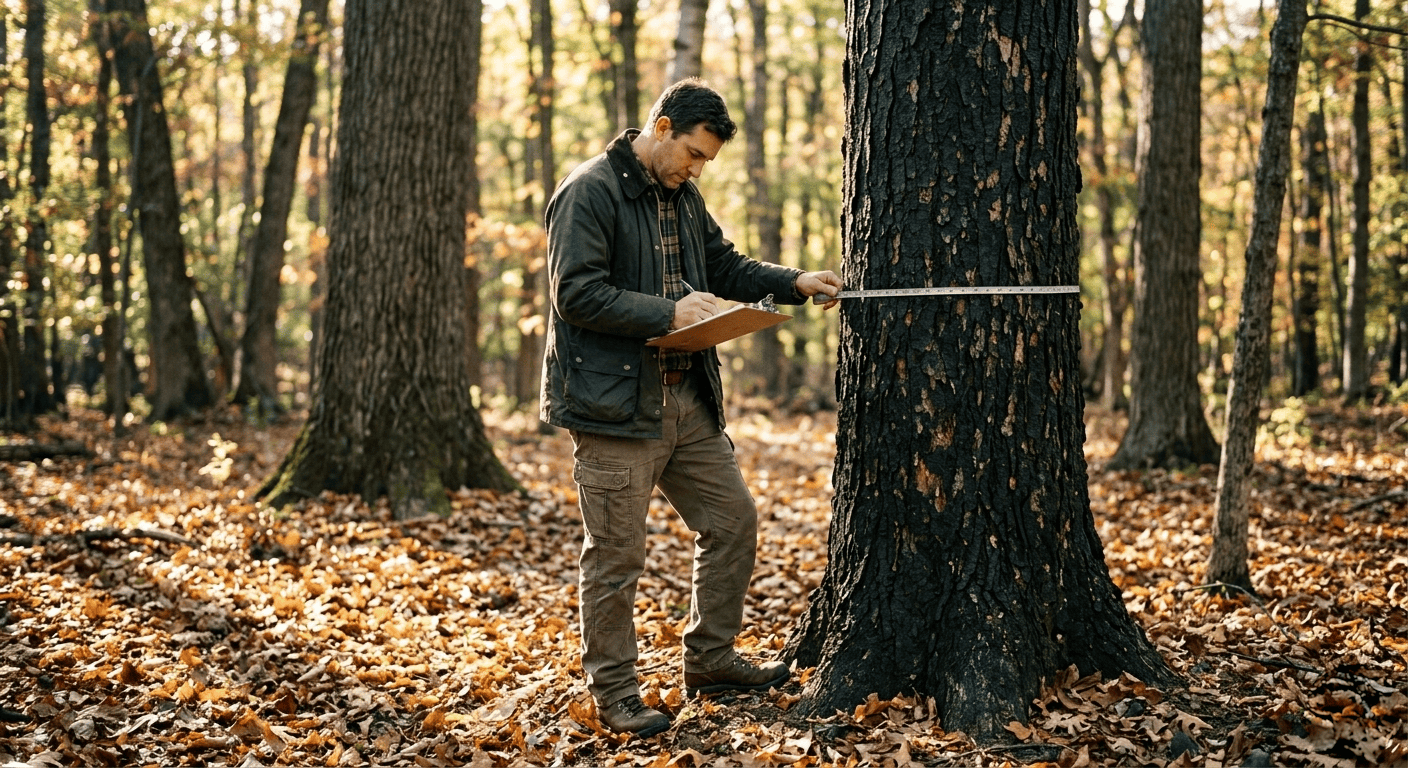
None of this means you can’t get a reliable answer. It means the reliable answer requires a trained forester to walk your property, measure your trees, assess quality, and compare results to current market data. That process is called a timber cruise, and it’s the foundation of every honest timber appraisal.
What Stumpage Price Actually Means
Stumpage price is what a buyer pays you for standing timber — trees that are still in the ground, not yet cut or moved. It’s the landowner’s price. The logger’s price is what the mill pays for delivered logs, which is always higher because it includes the cost of felling, skidding, loading, and hauling.
When a timber buyer makes you an offer, he’s quoting you a stumpage price. When you see published timber price data from NYSDEC or university extension services, those are also stumpage prices — what landowners in a region actually received for standing timber in a given period.
Stumpage prices are expressed in dollars per thousand board feet — written as MBF. If someone offers you $400/MBF for red oak, that means $400 for every thousand board feet of oak volume standing in your woods.
The gap between stumpage price and delivered log price — called the logging margin — covers the logger’s equipment, labor, and fuel. On difficult terrain or in low-volume stands, that margin is higher because the logger’s costs are higher. That cost comes directly out of your stumpage price.
NYSDEC publishes semi-annually stumpage price reports by region and species. Those reports give you a baseline for what timber is selling for in your area. They are publicly available at dec.ny.gov and worth reviewing before any timber sale conversation.
The Four Factors That Determine Your Timber’s Value
Every timber appraisal comes down to four variables. Understanding them gives you a framework for evaluating any offer you receive.
Species is the starting point. Not all trees carry equal market value. In the Hudson Valley and Catskills region, black cherry, sugar maple, red oak, and white ash have historically commanded the highest stumpage prices. Red maple, beech, and birch trade at lower values. Poplar, ironwood, and striped maple have minimal commercial value in most markets. What species dominate your canopy sets the ceiling on your timber’s value before any other factor is considered.
Log grade and stem quality is where the real money is made or lost. Two black cherry trees of the same diameter can differ by 200% in value based on stem quality alone. A straight, clear-boled cherry with no visible defects graded as a #1 sawlog is worth far more than a forked, knotty cherry of the same size. Log grade is assessed by looking at the lowest 16-foot log in each tree — its straightness, the size and frequency of knots, and any visible defects like sweep, rot, or seams.
Volume — and how it’s measured determines the total weight of what you’re selling. Volume is expressed in board feet, and estimated through a timber cruise. A board foot is a piece of wood 12 inches by 12 inches by 1 inch thick. Merchantable volume in a stand depends on the number of trees, their diameter at breast height (DBH), and their usable log length. A formal cruise uses timber inventory data and volume tables to produce a reliable estimate.
Access and terrain is the factor landowners most often overlook. A woodlot with no existing roads, steep slopes, wet soils, or stream crossings costs more to log. Those added costs reduce what a buyer can pay you in stumpage and still cover his operation. Conversely, a stand with good road access, gentle terrain, and large-diameter trees is the most efficient to harvest — and commands the best stumpage prices.
How a Timber Cruise Works
A timber cruise is a systematic field inventory of your standing timber. It’s the only reliable way to know what you have before you sell it.
The process varies by property size and complexity, but the core method is consistent. I establish a series of fixed-radius sample plots across your woodlot — typically every one to two acres depending on stand variability. Within each plot, I record every merchantable tree: species, diameter at breast height, estimated log grade, and usable log length.
That field data goes into volume tables that convert tree measurements into board foot estimates by species and grade. The result is a timber inventory — total estimated volume broken down by species, grade class, and value at current stumpage prices.
A timber cruise on a 50-acre woodlot typically takes one to two days of field work depending on stand density and terrain. The output is a written report that tells you what you have, what it’s worth at current market prices, and what you should expect to receive in a competitive bid process.
That report is also what I use to write the timber sale contract and to solicit bids from multiple buyers — a process that consistently produces better returns than accepting a single offer, as I explain in detail in my article on timber buyers vs. consulting foresters.
What Hardwood Species Are Most Valuable in New York?
Stumpage prices shift with market conditions, but the species hierarchy in our region has been consistent for decades. Here’s how the major species stack up in the Hudson Valley and Catskills market.
Black cherry is consistently among the top-value hardwoods in New York. Quality #1 sawlog cherry commands premium prices because of strong demand from furniture and cabinet manufacturers. Sullivan and Ulster Counties have good cherry populations in well-managed stands.
Red oak and white oak are strong performers when log quality is high. Oak markets are tied to flooring, millwork, and export demand. Grade matters enormously with oak — the spread between a #1 sawlog and a #3 sawlog can be several hundred dollars per MBF.
Sugar maple commands solid stumpage prices, particularly figured or curly maple for specialty markets. Hard maple is also in consistent demand for flooring. Sugar maple grows well in the higher elevations of Ulster and Sullivan Counties.
White ash was once a premium species in this region. Emerald ash borer has changed that equation significantly. Marketable ash is still present in some stands, but the window for capturing value before deterioration is limited. If you have ash, get it evaluated soon.
Red maple is the most abundant hardwood on most private woodlots in our region. It is also the lowest-value commercial species. Soft maple stumpage prices are a fraction of cherry or oak. A woodlot dominated by red maple has timber income potential, but it requires realistic expectations.
Yellow birch holds moderate value in our market, particularly for higher-grade logs. Paper birch has limited commercial value in most applications.
How Log Grade Changes Everything
Log grade is the single most misunderstood element of timber value. Most landowners think bigger trees are worth more. That’s often true — but log quality determines value far more than size alone.
The log grading system used in hardwood markets runs from #1 (highest quality) to #3 and below (low grade, typically used for pallet stock or pulp). A #1 sawlog must meet standards for straightness, minimum clear face length, and maximum defect. Each step down in grade represents a significant price reduction.
I’ve cruised stands where the average tree diameter was impressive but the log grade was poor across the board — heavy knots, excessive sweep, rot at the butt. The stumpage value was far lower than a naive look at the timber suggested. I’ve also walked modest-looking stands with tight-grained, clear-boled cherry and oak that cruised out at excellent value because the log quality was there.
This is why timber stand improvement matters so much for long-term value. TSI removes poor-quality competition and gives crop trees — your best-formed, highest-grade potential logs — the growing room to increase in both diameter and grade over time. A tree that’s a borderline #2 log today can be a solid #1 log in 15 years if the stand is managed correctly.
What a Single-Buyer Offer Tells You — and What It Doesn’t
When a timber buyer approaches you and offers a lump sum or a per-MBF price for your timber, that number tells you one thing: what that buyer is willing to pay on that day. It does not tell you what your timber is worth.
Without an independent cruise, you have no way to evaluate whether the offer reflects current market stumpage prices. You don’t know if the buyer’s volume estimate is accurate. You don’t know if the species breakdown in the offer matches what’s actually on your property. You’re negotiating blind.
I’ve seen lump-sum offers accepted by landowners who had no idea what the timber cruised out at. In several cases, the accepted offer was 40% to 60% below what a competitive bid process produced for comparable timber. That’s not unusual. It’s predictable — because the buyer knows what your timber is worth and you don’t.
The solution is not to distrust every timber buyer. It’s to get an independent appraisal before any conversation about price. Once you know what you have and what it’s worth, you negotiate from information rather than hope.
For the full picture on how timber buyers operate and where their interests diverge from yours, see my article on the difference between a timber buyer and a consulting forester.
How to Maximize Your Timber Sale Value
The steps that produce the best returns on a timber sale are consistent. I’ve run this process on properties across Sullivan, Ulster, and Orange Counties and the results hold up.
First, get a timber cruise before any buyer conversation. Know your volume, your species breakdown, and your grade distribution. That knowledge is your negotiating foundation.
Second, use a competitive bid process. Put the timber out to multiple qualified buyers simultaneously. Give them the cruise data, the sale boundaries, and your terms. Let them compete. Competition produces market price. A single offer produces whatever that buyer decides to offer.
Third, write a proper timber sale contract. The contract should specify which trees are marked for harvest, what happens to slash and logging debris, how skid trails are located and reclaimed, and what the penalty structure is for contract violations. A handshake deal protects nobody.
Fourth, have a forester monitor the harvest. Trees get cut that weren’t marked. Skid trails go where they shouldn’t. Slash gets piled in stream buffers. These things happen — not always intentionally, but they happen. On-the-ground oversight catches problems before they become permanent damage.
Fifth, consider the timing. Log markets are not static. Sawmill capacity, seasonal demand, and regional economic conditions all affect what buyers will pay in a given quarter. A forester with current market knowledge can advise on whether current conditions favor selling now or waiting.
All of these steps apply equally to a first-time sale and a repeat harvest. For a full overview of how the timber harvest process works from planning through completion, see my landowner’s guide to timber harvesting. And if your stand needs improvement work before it’s ready for a sale, my article on selective timber harvesting covers the silvicultural side of that decision.
Frequently Asked Questions
How much is an acre of hardwood timber worth in New York?
There is no reliable statewide average because value varies so much by species, quality, and location. A well-stocked acre of mature black cherry and oak in Sullivan County with good road access might return $1,500 to $3,000 per acre in stumpage — or more for exceptional quality. A red maple-dominated acre on wet ground might return $200 to $400. The only way to get a reliable per-acre figure for your property is a timber cruise by a licensed forester using current stumpage price data.
What is the most valuable timber tree in the Hudson Valley and Catskills?
Black cherry is consistently the top-value commercial hardwood in our region, particularly for high-grade sawlogs going to furniture and cabinet markets. Red oak and white oak are strong performers for grade logs. Sugar maple commands solid prices in flooring and specialty markets. The value of any species depends heavily on log quality — a low-grade cherry is worth less per MBF than a high-grade red oak in most markets.
How long does a timber appraisal take?
Field work on a 50-acre woodlot typically runs one to two days depending on stand density and terrain. The written appraisal report — including volume summary, species and grade breakdown, and current stumpage value estimate — is typically delivered within one to two weeks of the field work. Larger properties or complex stands take longer. I give landowners a realistic time estimate before starting any cruise.
What is the difference between stumpage value and log value?
Stumpage value is what you receive for trees standing in your woods — before they’re cut, skidded, or moved. Log value is what the mill pays for delivered logs at their gate. The difference between the two covers all logging costs: equipment, labor, fuel, and hauling. Stumpage is always lower than log value. When someone quotes you a timber price, make sure you know which number they’re using — the gap between them is significant.
How Environmental Forest Products Can Help
If you’re trying to figure out what your timber is worth, the right first step is a property walk and timber cruise — not a phone call with a timber buyer. I’ve been appraising and managing timber sales across Sullivan, Ulster, and Orange Counties for over 30 years. I work for you, not for the mill.
Here’s what I provide for landowners evaluating their timber:
- Full timber cruise with written volume, species, grade, and stumpage value report
- Current stumpage price comparison using NYSDEC regional data and local market knowledge
- Timber sale management: tree marking, competitive bid process, contract writing, and harvest oversight
- Integration with a forest management plan for 480-a Forest Tax Law enrollment if applicable
- Honest assessment of whether your stand is ready for harvest now — or whether timber stand improvement would increase its value first
- Advisory on USDA EQIP cost-share programs for landowners investing in stand improvement before a sale
I serve landowners in Sullivan County NY, Ulster County NY, Orange County NY, Pike County PA, Wayne County PA, and Sussex County NJ. If your property falls in or near those areas, I can walk it and give you a straight answer about what you have.
Request a Free Timber Appraisal Consultation
Call me directly: (845) 754-8242
Email: henry@eforestproducts.com
Serving Sullivan County NY, Ulster County NY, Orange County NY, Pike County PA, Wayne County PA, and Sussex County NJ.
Henry Kowalec is a licensed consulting forester and member of the Society of American Foresters with over 30 years serving private landowners in the Hudson Valley and Catskills. Environmental Forest Products | Westbrookville, NY 12785 | Licensed in NY, PA, NJ.