Every year I talk to landowners who sold timber without an appraisal first. Most of them got a check. Almost none of them know whether that check reflected what the timber was actually worth. A few of them found out later — from a neighbor, from a different forester, from a mill contact — that they left significant money on the table.
A timber appraisal is the document that tells you what you have before anyone makes you an offer. Without it, you’re negotiating with someone who knows exactly what your trees are worth while you’re guessing.
Here’s what a timber appraisal is, what it involves, what it costs, and when you need one — whether you’re planning a sale, settling an estate, or just trying to understand the asset you’re sitting on.
What Is a Timber Appraisal?
A timber appraisal is a written professional assessment of the value of standing timber on a specific piece of land. It documents the species present, the estimated volume in board feet or cords, the quality or grade of the timber, and the estimated stumpage value at current market prices.
Think of it the same way you’d think about a home appraisal before selling a house. You wouldn’t accept the first offer on a property without knowing its market value. Timber is no different — it’s a tangible asset with a market value that can be independently assessed.
A timber appraisal gives you three things a buyer’s offer never gives you: an independent volume estimate, an independent quality assessment, and a market-price comparison grounded in current stumpage data. Those three things together tell you whether an offer is fair.
For the full framework on what drives timber value — species, grade, volume, and access — see my guide on how much timber is worth.
Timber Appraisal vs. Timber Cruise — Is There a Difference?
These two terms are often used interchangeably, and in practice, they describe overlapping work. The distinction is mainly one of purpose and formality.
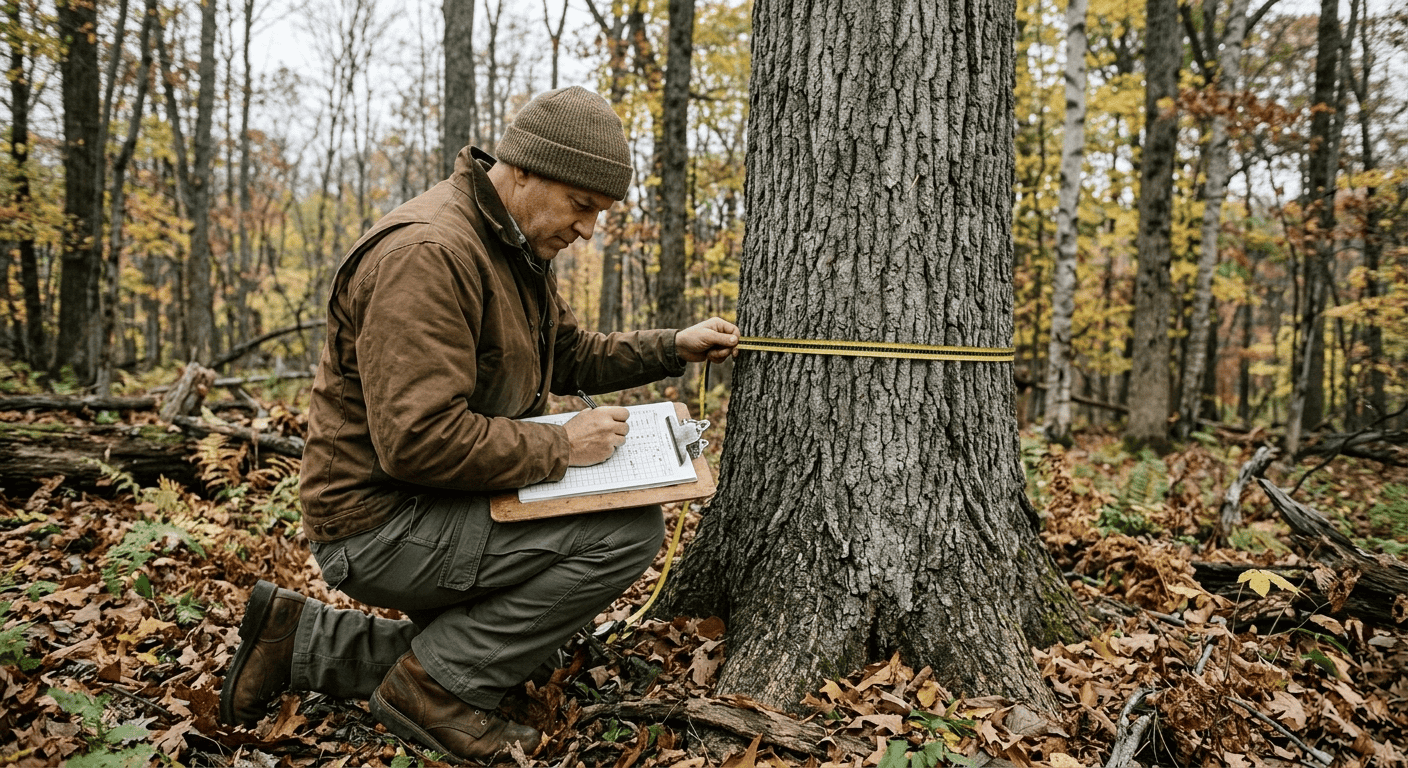
A timber cruise is the field inventory process — walking the property, establishing sample plots, measuring trees, recording species, diameter, and grade. It’s the data-collection phase. The output is a volume and value estimate.
A timber appraisal typically refers to the formal written report that comes from that cruise data — with current stumpage price comparisons, a methodology statement, and a signed valuation conclusion from a licensed professional. Appraisals are what you need when the document carries legal or financial weight: estate settlement, timber trespass claims, tax purposes, or a sale negotiation where you want documentation to stand behind.
For a straightforward pre-sale consultation on a private woodlot, the practical difference is small. What matters is that the work is done by a licensed forester using current market data — not estimated by a buyer with a financial interest in the outcome.
When Do You Actually Need a Timber Appraisal?
Not every situation requires a formal appraisal report. Some do. Here’s how to tell the difference.
You need a timber appraisal when:
- A timber buyer has approached you and you want to know whether their offer is fair before responding
- You’re planning a timber sale and want an independent valuation to anchor the bidding process
- You’re settling an estate that includes wooded acreage and need a documented asset value
- Timber trespass has occurred on your property and you need documented value for a legal claim
- You’re donating conservation land and need a timber value component for the tax deduction
- You’re considering enrollment in New York’s 480-a Forest Tax Law and want to understand the income potential of your timber before committing to the program
A simpler walk-and-talk consultation — without a formal written report — may be sufficient if you’re just getting oriented on your property for the first time or trying to decide whether to pursue a sale at all. I offer that as a starting point for landowners who aren’t sure what they need yet.
What Happens During a Timber Appraisal
The field work is systematic, not a casual walk. Here’s the sequence I follow on every timber appraisal.
First, I review any available records — deeds, prior management plans, aerial maps, and soil survey data. That background shapes how I design the cruise layout before I set foot on the property.
On the ground, I establish a grid of fixed-radius sample plots across the appraised area. Plot spacing depends on property size and stand variability — tighter spacing on complex or variable stands, wider spacing on uniform ones. Within each plot, I record every merchantable tree: species, diameter at breast height (DBH), estimated log grade for each 16-foot log section, and any visible defects.
That data goes into timber volume tables to calculate board foot estimates by species and grade class. I then apply current stumpage prices — cross-referenced with NYSDEC regional data and my own market knowledge — to produce a stumpage value estimate for the stand.
The field work on a typical 50-acre woodlot runs one to two days. Larger or more complex properties take longer. I give every landowner a time estimate before starting.
Understanding the cruise process also helps you evaluate whether your stand is ready for a sale now, or whether timber stand improvement would increase its value first. Sometimes the appraisal reveals that your best move is to invest in the stand for another decade before harvesting.
What a Timber Appraisal Report Contains
A formal timber appraisal report is a written document you can use in a negotiation, an estate proceeding, or a legal claim. It should contain specific components to carry that weight.
A complete timber appraisal report includes:
- Property description — legal description, acreage, location, and date of appraisal
- Methodology statement — cruise design, plot size, sampling intensity, and volume table used
- Timber inventory summary — volume by species and grade class, expressed in MBF (thousand board feet) or cords for pulpwood
- Stumpage value estimate — current price per MBF by species and grade, with sources cited
- Total appraised value — the bottom-line stumpage value of the standing timber as of the appraisal date
- Forester’s certification — signed statement of independence and professional qualifications
That certification matters. A timber appraisal signed by a licensed consulting forester carries professional accountability. An estimate from a timber buyer — however experienced — does not. That distinction is what I cover in detail in my article on the difference between a timber buyer and a consulting forester.
Who Can Perform a Timber Appraisal in New York?
In New York State, a timber appraisal should be performed by a licensed consulting forester. New York State licenses foresters through the State Education Department, with requirements covering forest mensuration, silviculture, and timber valuation.
A timber buyer is not a licensed forester. A logging contractor is not a licensed forester. Neither is legally or professionally qualified to produce an appraisal that carries independent evidentiary weight.
For appraisals used in estate settlement, litigation, or tax filings, ask specifically whether the forester holds a current NYS license and whether they carry professional liability insurance. Both matter when the document needs to stand up to scrutiny.
NYSDEC publishes stumpage price data by region that licensed foresters use as one benchmark in the appraisal process. You can access that data directly at dec.ny.gov to get a rough sense of regional price ranges before any professional engagement.
What a Timber Appraisal Costs — and What It Returns
Timber appraisal fees vary by property size, stand complexity, and the level of report formality required. A basic pre-sale cruise and valuation on a 50-acre woodlot typically runs several hundred dollars in professional fees. A formal appraisal report suitable for estate or legal purposes costs more — the methodology documentation, written certification, and professional liability it carries require additional time.
The return calculation is straightforward. If a timber appraisal on your property reveals that the single buyer who approached you is offering 30% below market stumpage — and your timber cruises out at $25,000 in value — the appraisal just identified $7,500 in recoverable income. The fee is a fraction of that.
I’ve never had a landowner tell me the appraisal wasn’t worth the cost after seeing the results. What I have heard — more than once — is regret from people who sold without one and found out later what they left behind.
If your stand needs improvement before it’s ready for a competitive sale, a timber appraisal is also the starting point for understanding what selective timber harvesting or TSI treatment would change about the value picture over time.
Frequently Asked Questions
Can I use a timber appraisal for estate or tax purposes?
Yes — a formal timber appraisal signed by a licensed consulting forester is a documented asset valuation that can be used in estate settlement, charitable conservation donations, timber trespass claims, and tax filings that require a substantiated value for standing timber. For these purposes, the appraisal needs to include a full methodology statement, stumpage price sources, and the forester’s professional certification. Not every cruise report meets that standard — ask specifically when you engage a forester.
How is a timber appraisal different from a real estate appraisal?
A real estate appraisal values land and improvements — structures, location, comparable sales. A timber appraisal values the standing timber as a separate asset: the volume, species, grade, and stumpage price of the trees themselves. The two are independent valuations. Some properties require both — particularly for estate settlement or conservation transactions where the timber value and the underlying land value are each documented separately.
Do I need a timber appraisal if I’m not planning to sell?
Not always — but it’s more useful than most landowners expect. An appraisal tells you what you have, whether your stand is improving or declining in value, and whether current market conditions make this a good time to consider a sale. It also establishes a baseline value for insurance, estate planning, or future sale negotiations. I recommend at least a walk-and-consultation on any woodlot over 25 acres every five to ten years, even without an active sale in mind.
How Environmental Forest Products Can Help
I’ve been performing timber appraisals and managing timber sales on private land in Sullivan, Ulster, and Orange Counties for over 30 years. Every appraisal I produce is signed by a licensed NYS forester and grounded in current stumpage price data. I carry professional liability insurance. I work for the landowner — not the mill, not the buyer.
Here’s what I can do for your property:
- Conduct a full timber cruise and produce a written appraisal report with species, volume, grade, and stumpage value
- Provide formal appraisal documentation for estate settlement, conservation donations, or timber trespass claims
- Use the appraisal as the foundation for a competitive timber sale bid process
- Assess whether timber stand improvement would increase your stand’s value before a sale
- Advise on 480-a Forest Tax Law enrollment if the timber inventory supports it
If a timber buyer has already contacted you — or you’re simply ready to find out what your woodlot is worth — call me before you respond to any offer or sign any agreement.
Request a Free Timber Appraisal Consultation
Call me directly: (845) 754-8242
Email: henry@eforestproducts.com
Serving Sullivan County NY, Ulster County NY, Orange County NY, Pike County PA, Wayne County PA, and Sussex County NJ.
Henry Kowalec is a licensed consulting forester and member of the Society of American Foresters with over 30 years serving private landowners in the Hudson Valley and Catskills. Environmental Forest Products | Westbrookville, NY 12785 | Licensed in NY, PA, NJ.