Most landowners who own wooded property have no idea whether their timber is worth selling. They look at the trees, they see big and small, old and young. They don’t know how to read what’s actually there.
That gap in knowledge is exactly what timber buyers count on. When you can’t assess your own timber, you can’t evaluate an offer. You take what you’re given and hope it’s fair.
You don’t need a forestry degree to get oriented on your own land. There are specific things to look for that tell you — before any buyer calls — whether your timber has real value, needs work first, or isn’t ready for a sale at all. Here’s how to read the signs.
Start with Species — It Sets the Ceiling
The first thing I look for when I walk an unfamiliar woodlot is species composition. Species sets the value ceiling for everything else. You can have a perfectly formed, large-diameter tree — but if it’s red maple or striped maple, the market value is a fraction of what a comparable black cherry or red oak would bring.
In the Hudson Valley and Catskills, the commercial hardwood species ranked by typical stumpage value run roughly in this order:
- Black cherry — top-value species in most regional markets; furniture and cabinet demand keeps prices strong
- Red oak and white oak — strong performers for grade logs; flooring and millwork demand is consistent
- Sugar maple — solid value, particularly at higher elevations in Ulster and Sullivan Counties
- Yellow birch — moderate value for quality logs; less common but worth noting where present
- Red maple — the most abundant hardwood in most local woodlots; also the lowest commercial value per MBF
- Beech, ironwood, striped maple — minimal commercial value in most markets; often TSI targets
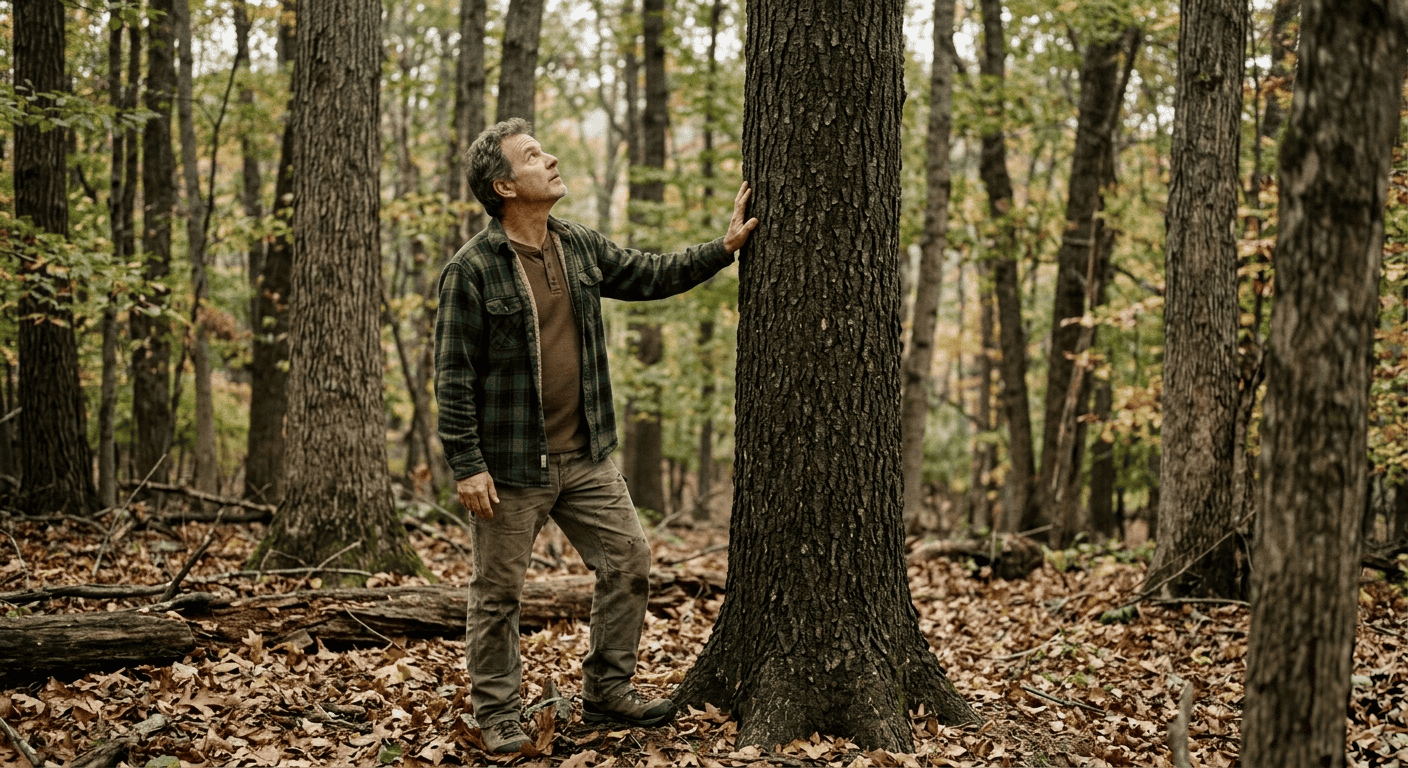
Walk your woodlot and make a rough mental count of what’s dominant. If your canopy is mostly red maple with scattered cherry and oak, that ratio matters more than any individual tree. The species mix is what determines the floor of your sale’s potential value.
For the full breakdown of how species interacts with the other value factors, see my guide on how much timber is worth.
Stem Quality Is Where Most Value Is Made or Lost
Species tells you the market. Stem quality tells you where in that market your trees actually land.
Stem quality is assessed by looking at the lowest 16 feet of a tree — the butt log. That first log is almost always the highest-value section. A clear, straight butt log with minimal knots, no visible seams or rot, and no severe sweep commands a #1 sawlog grade. Step down from there and stumpage price drops significantly at each grade level.
Here’s what to look for when you’re walking your own property:
Clear length — How many feet of straight, defect-free stem can you see from ground level up? The longer the clear bole before the first branch, the better the log grade potential. A cherry tree with 20 feet of clear, straight stem before the first branch is a very different animal than a cherry with branches starting at 8 feet.
Knots — Large, frequent knots on the lower stem signal low-grade lumber. Dead branches embedded in the bark — called ring knots — reduce log grade and surface value. Sound, tight knots from living branches are less damaging than dead ones, but frequent knots anywhere on the butt log drop the grade.
Sweep and crook — A tree that curves or bends on its lower stem produces shorter, lower-value boards. Log graders dock significantly for sweep. A straight-as-an-arrow stem is worth more than a curved one of the same species and diameter.
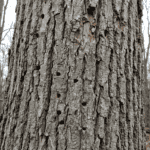
Visible defects — Seams, cracks, conks (fungal shelf growths), and wounds on the bark are surface signals of internal decay. Any conk on a standing tree is a deduction in value and often a sign the tree should be harvested before it deteriorates further.
Diameter Matters — but Not the Way Most People Think
Bigger is generally better in timber — but diameter is not the whole story, and it’s one of the most misread indicators by landowners doing their own assessment.
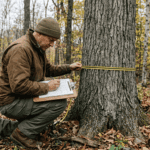
Minimum merchantable diameter for most hardwood sawlogs in the Northeast is around 10 to 12 inches DBH (diameter at breast height, measured at 4.5 feet above the ground). Below that threshold, most buyers aren’t interested for sawtimber. Trees in the 12- to 16-inch DBH range are merchantable. Trees above 18 inches are where the real volume and grade value concentrates.
Here’s the catch. A 20-inch red maple with poor stem quality — heavy knots, sweep, and branching starting at 10 feet — may return less stumpage than a 16-inch black cherry with a clean 24-foot butt log. Diameter is a multiplier on stem quality, not a substitute for it.
When you’re walking your property, look for trees with both: meaningful diameter AND clean, straight stems. That combination is what produces high-grade sawtimber. Either one alone is worth less than both together.
What Good Access Does to Your Timber’s Value
Access is the value factor landowners most consistently overlook. Your timber is worth what a buyer can afford to pay after covering his logging costs. Difficult terrain, wet soils, stream crossings, and absent roads all increase those costs — and every dollar of added logging cost comes directly out of your stumpage check.
Walk the perimeter of your woodlot and ask yourself three questions. Is there an existing road or skid trail a loaded log truck can reach? Are there wet areas, stream crossings, or steep slopes that would make skidding difficult? Is the timber concentrated enough that a logger can work efficiently, or is it scattered in small pockets across the property?
Good road access and gentle terrain on a stand of modest timber often produces a better stumpage return than exceptional timber on ground that’s expensive to log. Factor access into your read before you assume the trees alone determine the value.
Five Signs Your Timber May Be Worth a Sale
Based on what I see walking properties across Sullivan and Ulster Counties, here are the clearest positive indicators:
- Dominant canopy of black cherry, oak, or sugar maple with meaningful diameter — 14 inches DBH or better on many stems
- Long clear boles — 16 feet or more of straight, branch-free stem on your best trees before the crown begins
- Good road access — existing truck road or skid trail within reasonable reach of the timber
- No recent harvesting — stands that haven’t been cut in 20 or more years often have mature timber ready for a properly marked selective harvest
- Low invasive pressure — a relatively clean understory suggests the stand has been growing without major competition stress
Five Signs Your Timber Needs Work Before You Sell
These are the indicators that tell me a stand needs management investment before a sale will produce good returns:
- Red maple dominance — if more than half your canopy is soft maple, the species mix needs shifting before you’ll see strong stumpage numbers
- Heavy beech sprout competition — dense root sprout colonies are suppressing the next generation of high-value species
- Wolf trees dominating the canopy — wide-crowned, low-grade trees blocking growing space from better stems below
- Frequent visible defects on your best trees — conks, seams, and heavy sweep on the species that should be driving value
- No road access — without an entry point, logging costs may consume most of what the timber would otherwise return
Seeing these signs doesn’t mean the property has no future timber value. It means the path to value runs through timber stand improvement first — not a sale. A forester can tell you which investments make sense and what the realistic value picture looks like after treatment.
What You Can Read Yourself — and What Requires a Forester
You can walk your property and get a useful preliminary read on species mix, access conditions, and obvious stem defects. That’s enough to have an informed first conversation with a forester and to evaluate whether a sale is worth pursuing at all.
What you cannot do reliably on your own: estimate board foot volume, assign log grades, compare your stand to current regional stumpage prices, or produce a number that holds up in a negotiation. Those tasks require measurement tools, volume tables, current market data, and trained judgment built from hundreds of timber cruises.
The right sequence is: self-assess the obvious signals first, then call a licensed consulting forester for a proper timber appraisal before responding to any buyer. Never use a buyer’s estimate as your valuation baseline — I cover that distinction in detail in my article on timber buyers vs. consulting foresters.
If the preliminary signs look good and you’re ready to understand the full harvest picture, my article on selective timber harvesting explains how a properly marked sale works from the forester’s side.
Frequently Asked Questions
Can I assess my own timber value by walking my property?
You can get a useful orientation — species mix, obvious stem defects, access conditions, and a rough sense of canopy maturity. That’s a legitimate first step. What a self-walk can’t produce is a reliable volume estimate, log grade assignment, or stumpage value comparison. Those require measurement tools, volume tables, and current market data. Use your self-assessment to decide whether to engage a forester — then let the forester produce the number you actually negotiate from.
What diameter should a tree be before it’s worth selling?
Most hardwood sawlogs in the Northeast require a minimum of 10 to 12 inches DBH to be merchantable sawtimber. Trees in the 14- to 18-inch range are where most volume and grade value concentrates. Above 18 inches, you’re typically in premium territory — provided stem quality is there. Diameter without clean stem quality doesn’t produce high-grade logs, so measure both before drawing conclusions about any individual tree’s value.
Does a dying or damaged tree have any timber value?
Sometimes — and the window matters. A tree that is freshly wind-thrown or recently killed by insects may still have sound wood and recoverable timber value, but that window closes fast. Decay advances quickly once a tree is dead, particularly in warm months. A tree showing active decay — soft wood, staining, fungal conks — has likely lost most of its sawlog value. If you have recently downed or stressed timber on your property, get it evaluated quickly before the wood quality deteriorates further.
How Environmental Forest Products Can Help
If you’ve walked your woodlot and you’re trying to figure out what the next step looks like, I can help you read what’s there and give you a straight answer about whether it’s worth selling, when, and for how much.
I’ve been cruising timber and managing sales across Sullivan, Ulster, and Orange Counties for over 30 years. I know what black cherry and oak in this region are worth right now. I know which stands are ready and which ones need five more years of management first. And I work for you — not for any mill or logging operation.
Here’s what I can do for your property:
- Walk your woodlot and give you an honest read on species composition, stem quality, and sale readiness
- Conduct a full timber cruise and written appraisal if the stand warrants it
- Identify whether timber stand improvement or selective harvesting is the right first move
- Manage the full sale process if you’re ready: tree marking, competitive bids, contract, and harvest oversight
- Advise on 480-a Forest Tax Law enrollment if your property qualifies
If a timber buyer has contacted you — or you’re simply ready to know what you have — call me before you make any decisions.
Request a Free Woodlot Assessment
Call me directly: (845) 754-8242
Email: henry@eforestproducts.com
Serving Sullivan County NY, Ulster County NY, Orange County NY, Pike County PA, Wayne County PA, and Sussex County NJ.
Henry Kowalec is a licensed consulting forester and member of the Society of American Foresters with over 30 years serving private landowners in the Hudson Valley and Catskills. Environmental Forest Products | Westbrookville, NY 12785 | Licensed in NY, PA, NJ.