Most private woodland owners in New York have never heard of EQIP. Some have heard the name but assume it’s for farmers. A smaller number know it applies to woodland management but have never figured out how to access it. Almost none of them are using it — which means they’re leaving real money on the table for management work they’re going to do anyway.
USDA’s Environmental Quality Incentives Program — EQIP — pays private landowners to implement qualifying conservation practices on their land. For woodland owners, those practices include forest management plan writing, timber stand improvement, invasive species control, and wildlife habitat improvement. The payment doesn’t cover everything, and the funding is competitive. But for landowners who qualify and apply, EQIP cost-share can significantly offset the cost of first-year management activities.
Here’s how the program works, what it pays for, how to apply, and what to realistically expect in New York.
What EQIP Is — and What It Isn’t
EQIP is a voluntary federal conservation program administered by the USDA Natural Resources Conservation Service (NRCS). It pays private landowners a portion of the cost of implementing approved conservation practices on their land. The program aims to improve soil, water, air, plant, and animal resources on private agricultural and forest land.
EQIP is not a grant. It’s a cost-share payment — the government pays a percentage of the practice cost, and the landowner pays the rest. Payment rates vary by practice, by state, and by year depending on available funding. The program is also competitive: NRCS ranks applications by conservation benefit and funds the highest-scoring ones first. Not every applicant receives funding.
EQIP is also not permanent income. It’s a one-time or multi-year contract for specific practices in a specific location. Once the practice is completed and NRCS verifies it, the payment is made. The program does not pay for ongoing management — it funds discrete, documented conservation activities with defined start and end points.
For most woodland owners, EQIP is most useful as a way to offset the upfront cost of getting started — the management plan, the first TSI treatment, the first invasive control work — not as a long-term income source. For the complete picture of how EQIP fits alongside 480-a tax savings and timber income in a woodland financial strategy, see my article on how to make money from wooded land.
What Forestry Practices EQIP Funds
EQIP funds a defined list of practices called “practice codes.” Each practice has a technical standard that specifies exactly what qualifies. In New York, the practices most relevant to private woodland owners include the following.
Forest Management Plan (Practice 1050)
EQIP can fund the preparation of a forest management plan — the document that a licensed forester writes to describe your woodland’s current condition and prescribe management activities. Practice 1050 covers the forester’s fee for writing the plan to NRCS technical standards.
This is one of the most useful EQIP practices for new woodland owners. The management plan is both the required document for 480-a Forest Tax Law enrollment and the foundational document for any subsequent EQIP practice. Funding the plan writing through EQIP offsets a significant portion of the first-year professional cost. For what a qualifying management plan must contain, see my guide on what a forest stewardship plan is.
One important note: EQIP’s technical standards for Practice 1050 are not identical to NYSDEC’s 480-a plan requirements. A plan written specifically to EQIP standards may or may not satisfy NYSDEC’s 480-a review criteria without additional components. A forester who has written plans for both programs builds a single document that satisfies both from the start — saving the landowner the cost of a revision or a second plan. Confirm with any forester you engage whether their Practice 1050 plan also qualifies for 480-a submission.
Timber Stand Improvement (Practice 666)
Practice 666 funds timber stand improvement activities — the non-commercial cutting and treatment work that releases crop trees from competition, removes cull trees and wolf trees, and improves stand structure. This is among the most commonly accessed forestry practices in New York’s EQIP program.
The practice funds the labor cost of TSI treatments within a defined area over a contract period. NRCS specifies the technical standard — treatment intensity, target species for removal, documentation requirements — and verifies completion before payment. For a complete explanation of what TSI involves and why it matters, see my article on timber stand improvement.
Invasive Species Management (Practice 315)
Practice 315 funds invasive species control on forest land. It covers both the mechanical treatment (cutting) and herbicide costs for qualifying invasive species control in the areas defined by your management plan. Japanese barberry, multiflora rose, Oriental bittersweet, and other priority invasive species qualify in New York when their control aligns with documented forest management objectives.
This practice is particularly valuable for landowners with significant invasive pressure — where the cost of professional treatment would otherwise be a barrier to getting started. For the species-specific identification and control methods that Practice 315 work involves, see my article on invasive species in your forest.
Prescribed Burning and Other Practices
EQIP also funds prescribed burning (Practice 338) for woodland landowners where fire is an appropriate management tool, forest stand establishment practices for reforestation, and in some cases wildlife habitat improvement practices. Prescribed burning is less commonly applicable on typical private woodland in Sullivan and Ulster Counties — but it’s worth discussing with NRCS if your property has stand types where fire is a management option.
What EQIP Does Not Cover — Important Limitations
Understanding what EQIP doesn’t fund is as important as knowing what it does. Several common landowner assumptions about the program are incorrect.
EQIP does not pay for commercial timber harvests. A timber sale that generates stumpage income is a commercial activity — EQIP does not fund it. TSI work is fundable because it doesn’t produce commercial income. The moment TSI work produces merchantable timber that a buyer purchases, that portion of the work moves outside EQIP eligibility.
EQIP does not pay retroactively. You cannot complete a management activity and then apply for EQIP funding after the fact. NRCS must approve the contract before any funded work begins. Starting TSI work or hiring a forester to write a plan before a signed EQIP contract means that work is not EQIP-eligible.
EQIP payment rates are not the full cost. Cost-share percentages typically range from 50% to 75% of the practice cost, depending on the practice, the landowner’s situation, and the funding cycle. The landowner pays the remaining percentage. Budget both shares before committing to a practice.
EQIP availability changes annually. The practices NRCS funds, the payment rates it offers, and the ranking criteria it uses all change from year to year based on federal appropriations and state conservation priorities. A practice that was funded at a good rate last year may not be available at the same rate this year. Always confirm current practice availability with your local NRCS office before planning around specific EQIP payments.
How EQIP Applications Work — The Process
The EQIP application process runs through your local USDA Service Center — the office that houses both NRCS and FSA field staff for your county. Most counties in New York have a service center accessible to woodland owners.
The process follows these steps:
- Contact your local NRCS office — introduce yourself as a private woodland owner interested in EQIP for forestry practices. Ask what practices are currently funded in your county and when the next application ranking period opens.
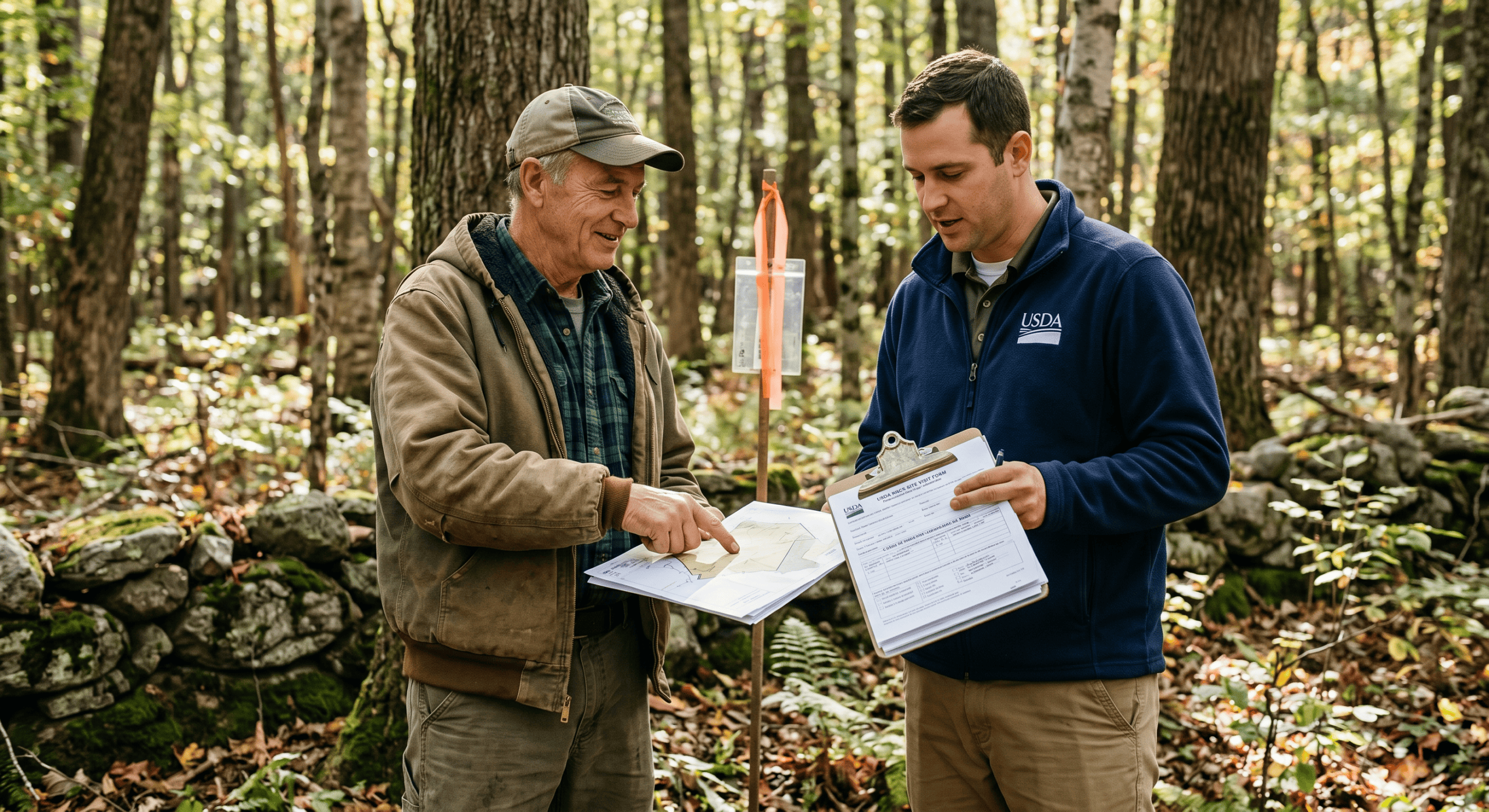
- Schedule a site visit — NRCS staff will visit the property to assess eligibility and identify what practices may apply. Bring any existing management plan or property documentation to this visit.
- Submit an application — NRCS accepts applications during open enrollment periods. Applications include a description of your property, the practices you’re requesting, and documentation of the conservation need.
- Wait for ranking — NRCS ranks all applications in the period by conservation benefit score. Highest-scoring applications receive funding offers first. You may not receive an offer in the first ranking period — reapplying in subsequent periods is common.
- Sign the contract — if your application receives a funding offer, NRCS and the landowner sign a contract specifying the practices, payment rates, completion timeline, and documentation requirements. No funded work begins before the contract is signed.
- Complete the work and request payment — complete each practice according to its technical standard, document the work, and submit for NRCS verification. Payment follows verified completion.
Current program information and local office contacts are at nrcs.usda.gov.
The Forest Management Plan Requirement
Most EQIP forestry practices require an existing approved forest management plan as a prerequisite — or they require Practice 1050 (plan writing) to be contracted simultaneously. NRCS cannot fund TSI work or invasive control without a plan that prescribes those activities for your specific property. The plan is what connects the practice to a documented conservation need.
This requirement creates a sequencing decision for new EQIP applicants. If you don’t have a current management plan, you have two options: contract Practice 1050 first through EQIP to fund the plan writing, then contract subsequent practices in a later funding cycle; or contract the plan writing outside of EQIP with a consulting forester, then use the completed plan to support EQIP applications for TSI and invasive control practices.
The right choice depends on your timeline and priorities. If getting the plan written is the most important first step, Practice 1050 is worth pursuing. If TSI or invasive control is the urgent priority and the plan can be funded outside EQIP, proceeding outside the program may get you to active management faster. A consulting forester familiar with both EQIP and NYSDEC requirements advises on which path fits your situation. For what the plan writing process involves, see my article on what a forest stewardship plan is.
How Much Does EQIP Pay?
EQIP payment rates are set by NRCS for each practice in each state, typically updated annually. In New York, the rates for forestry practices vary by county, stand condition, and practice complexity. General payment structure works like this.
For Practice 1050 (forest management plan), EQIP typically pays a per-acre rate for the plan writing that covers a significant portion of the forester’s fee — often 50% to 75% of the plan cost up to a per-acre maximum set by NRCS. On a 75-acre property, the EQIP payment for Practice 1050 can offset a meaningful portion of the plan cost.
For Practice 666 (TSI) and Practice 315 (invasive control), NRCS sets per-acre payment rates based on the practice’s cost in your region. Cost-share percentages typically range from 50% to 75% of practice cost. On high-priority practices or for producers who qualify as historically underserved, payment rates may be higher.
Payment rates change. The figures above reflect the general structure, not guaranteed current rates. Contact your local NRCS office for current payment schedules before making any planning assumptions based on specific dollar figures.
EQIP vs. 480-a — Two Different Programs with Different Purposes
Landowners sometimes conflate EQIP and 480-a because both involve forest management plans and both involve government programs. They serve different purposes and work through different agencies.
480-a is a New York State property tax reduction program administered by NYSDEC. It reduces the assessed value of enrolled woodland by up to 80%. Requires a management plan written by a licensed NYS forester and approved by NYSDEC. It runs indefinitely as long as the landowner follows the plan and keeps the land in forest use.
EQIP is a federal conservation cost-share program administered by USDA NRCS. It pays a portion of the cost of specific conservation practices. It operates through a competitive application process with no guarantee of funding. Contracts run for a defined term covering specific practices.
The programs are complementary, not competing. A landowner can pursue both simultaneously. The management plan funded through EQIP Practice 1050 can serve as the 480-a management plan if a forester writes it to meet both sets of requirements. The TSI and invasive control work funded through EQIP can satisfy management activities prescribed in the 480-a plan. When the programs work together, the landowner captures federal cost-share and state tax reduction from the same management activities. For the full 480-a picture, see my article on forest stewardship and 480-a tax savings.
Frequently Asked Questions
Can I use EQIP and 480-a at the same time?
Yes — the programs are complementary and can run simultaneously on the same property. EQIP funds specific conservation practices. 480-a reduces your property tax assessment. They operate through different agencies with different approval processes. A management plan written to satisfy both programs simultaneously is the most efficient approach. Confirm with any forester you engage that their plan meets both NRCS Practice 1050 technical standards and NYSDEC 480-a content requirements — not all plans do both without specifically being written for both.
How competitive is EQIP funding in New York?
Competitive enough that first-time applicants should not count on receiving funding in their first application period. NRCS ranks all applications within a funding period and funds the highest-scoring ones first. Available funding fluctuates with federal appropriations. Some counties in New York historically have more competition for EQIP forestry funding than others. Apply early, apply in multiple consecutive periods if the first doesn’t result in a contract, and work with a consulting forester who understands how to document conservation need in ways that score well in NRCS ranking criteria.
Do I need a consulting forester to apply for EQIP?
Not for the application itself — you can initiate an EQIP application directly through your local NRCS office without engaging a forester first. However, most EQIP forestry practices require a forest management plan as a prerequisite, and that plan requires a licensed forester. Additionally, a consulting forester who has worked with EQIP before can help you identify which practices are currently funded in your county, what the documentation requirements are, and how to structure your application to score well in the ranking process. That experience often makes the difference between a funded application and one that waits through multiple cycles.
How Environmental Forest Products Can Help
I’ve helped landowners access EQIP cost-share funding for forestry practices across Sullivan, Ulster, and Orange Counties as part of broader management planning engagements. I understand both the NRCS technical standards for EQIP practices and the NYSDEC requirements for 480-a management plans — and I write plans that satisfy both from the start.
Here’s what I can do for a landowner exploring EQIP:
- Evaluate which EQIP practices currently apply to your property and situation — plan writing, TSI, invasive control, or other qualifying practices
- Write a forest management plan that satisfies both NRCS Practice 1050 technical standards and NYSDEC 480-a requirements in a single document
- Advise on the sequencing decision — whether to pursue EQIP for the plan first or contract the plan outside EQIP to reach active management faster
- Help document the conservation need in your application in ways that support a strong NRCS ranking score
- Supervise EQIP-funded TSI and invasive control work to ensure it meets NRCS technical standards for payment verification
- Integrate EQIP-funded activities with your 480-a management plan compliance schedule so every practice advances both programs simultaneously
EQIP money is available for the management work most Sullivan, Ulster, and Orange County woodland owners should be doing anyway. Call me before you start any management activity — I’ll tell you whether EQIP applies to your situation before you spend anything out of pocket.
Request a Free EQIP Eligibility Assessment
Call me directly: (845) 754-8242
Email: henry@eforestproducts.com
Serving Sullivan County NY, Ulster County NY, Orange County NY, Pike County PA, Wayne County PA, and Sussex County NJ.
Henry Kowalec is a licensed consulting forester and member of the Society of American Foresters with over 30 years serving private landowners in the Hudson Valley and Catskills. Environmental Forest Products | Westbrookville, NY 12785 | Licensed in NY, PA, NJ.