Forty acres of woods is not a small property. It’s enough to hold a timber sale that generates meaningful income. It’s enough to create excellent deer and turkey habitat. And It’s enough to run a productive hunting lease. It’s enough to make real and lasting improvements to forest health and wildlife habitat over a management horizon. Most landowners who own 40 acres of woods don’t realize how much the property can produce — because nobody has ever walked it with them and told them.
What 40 acres cannot do is qualify for New York’s 480-a Forest Tax Law without additional qualifying acreage — the program requires 50 contiguous acres minimum. That’s the one significant limitation a 40-acre owner faces that a 50-acre owner doesn’t. Everything else is available.
Here’s a practical guide to what 40 acres of woods can produce, what the management priorities are, and what realistic expectations look like for a property this size in Sullivan, Ulster, or Orange County.
Start with What the Land Actually Has
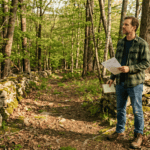
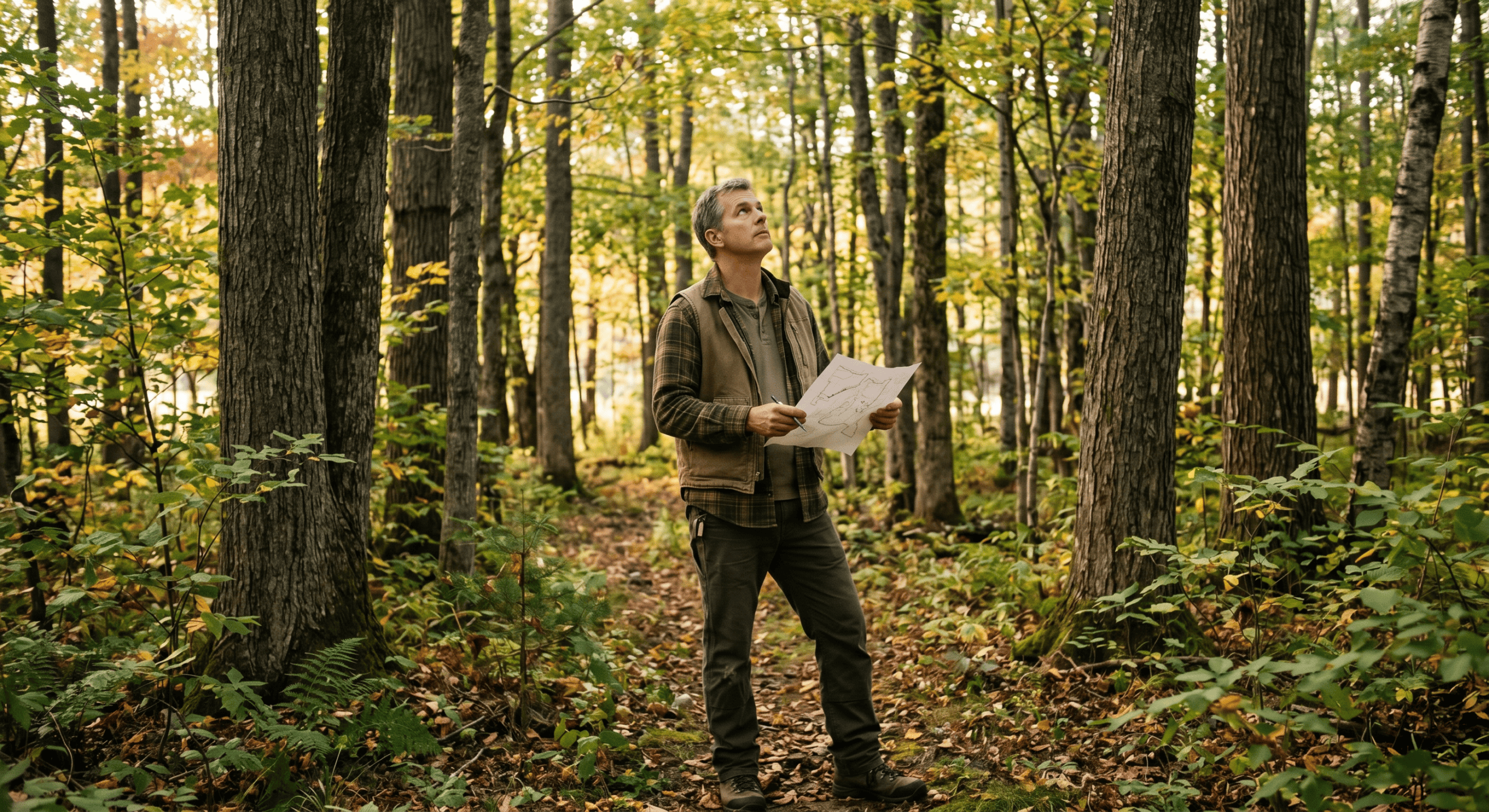
Before any management decision makes sense, you need to know what your 40 acres contains. That means a walk — a deliberate, observational walk with specific things in mind.
Species composition matters first. A 40-acre woodlot dominated by black cherry and red oak has a very different financial and management profile than one dominated by red maple and beech. Walk the canopy and note what species you see in the majority positions — high, well-lit crowns that intercept the most light and carry the most timber value.
Stand structure matters second. Is the canopy dense and uniform, with little light reaching the floor? Or does it have some variation — openings, young regenerating areas, mixed age classes? Structural diversity is the habitat foundation. A dense uniform canopy with a bare floor is the starting condition for most management work, not the end state.
Forest health matters third. Look for ash trees with crown dieback, hemlocks with white woolly masses under the needles, beech with rough crusty bark and root sprout colonies, and any areas where Japanese barberry or multiflora rose has taken over the understory. What you find shapes what you address first. For a systematic approach to reading your woodland for health indicators, see my article on how to do a woodlot health assessment.
What 40 Acres Can Realistically Produce — Income and Value
Forty acres is enough land to generate real income — from timber, from hunting leases, and from the underlying land value that active management builds over time. Here’s what each income stream looks like at this scale.
Timber Income
A well-stocked 40-acre woodlot of mature mixed hardwood in Sullivan or Ulster County — black cherry and oak dominant, good road access, reasonable stem quality — can support a meaningful timber sale. Total stumpage income from a properly managed selective harvest on 40 acres typically ranges from $8,000 to $25,000 or more, depending on species composition, log grade, and current market conditions.
That range is wide because the variables are wide. A 40-acre cherry and oak stand on good ground with high stocking and high-grade logs can return the upper end. A 40-acre red maple stand on wet ground with poor access returns the lower end or less. The only way to know where your 40 acres falls in that range is a timber cruise by a licensed forester before any sale conversation begins.
On 40 acres, the competitive bid process still works — as long as there’s enough total volume to attract multiple qualified buyers. Volume thresholds for competitive bids vary by buyer and market, but most buyers require a minimum volume that 40 well-stocked acres can readily supply. Forty acres with low stocking or poor species composition may not attract competitive bids. That’s another reason the cruise precedes everything. For the full timber value framework, see my guide on how much timber is worth.
Hunting Lease Revenue
Forty acres is viable for a hunting lease — particularly in Sullivan, Ulster, and Orange Counties where hunting pressure is significant and private land access is valued. A well-managed 40-acre woodlot with good deer sign, managed habitat, and clear access can realistically generate $500 to $1,500 annually from a small hunting group under a written lease agreement.
Habitat quality directly drives lease value. A 40-acre woodlot with released mast trees, some browse-producing canopy openings, and clean access commands better rates than an unmanaged dense stand with no habitat features. The management investment that improves the stand also improves the lease rate. For how to develop deer habitat on a woodlot this size, see my article on managing woods for deer.
The 480-a Question — 40 Acres and the Tax Program
New York’s 480-a Forest Tax Law requires a minimum of 50 contiguous acres of productive forest land. At 40 acres, you don’t qualify — unless you own adjacent parcels that together with the 40 acres exceed 50 contiguous qualifying acres. If adjacent land is in your ownership, or if you’re considering acquiring a neighboring parcel to reach the threshold, the 480-a math changes significantly. A consulting forester and your tax advisor can help evaluate whether reaching the 50-acre threshold makes financial sense given current assessed values and local tax rates.
Without 480-a, your property tax on the 40-acre woodlot reflects standard assessed value. That’s a real ongoing cost — and one more reason the timber income and hunting lease revenue matter as offsets to the ownership cost. For the full 480-a income picture that applies if you reach the threshold, see my article on how to make money from wooded land.
Wildlife Habitat — The Non-Income Value That Still Matters
Not every decision about a 40-acre woodlot has to pass a financial return test. Wildlife habitat improvement — improving the stand for deer, turkey, grouse, and songbirds — has value to most landowners that doesn’t show up in a ledger but shapes how much they value the property and what they do with it.
On 40 acres, habitat management works. Releasing mast trees from competition, creating small browse-producing canopy openings, controlling invasive shrubs in the understory — all of these produce measurable habitat improvement at this scale. Forty acres can become the best 40 acres in the neighborhood for deer habitat, which affects both how you experience the property and what a hunting lease can command.
The habitat improvement tools at 40 acres are the same as at 200 acres — just applied at a smaller scale. TSI work, invasive control, and targeted small canopy openings all work as well on 40 acres as they do on larger properties. For the wildlife habitat management framework that applies at any scale, see my article on managing woods for deer or my guide on timber stand improvement.
The Management Priorities for a 40-Acre Woodlot
With limited acreage, management priorities matter more than on larger properties. You don’t have the luxury of addressing everything simultaneously. Here’s the sequence that produces the best outcomes on a 40-acre woodlot.
Forest Health Assessment First
Before any management work begins, understand what health conditions exist on the property. EAB in ash trees, hemlock woolly adelgid on hemlocks, beech bark disease pressure — each of these creates time-sensitive decisions that should precede any other management work. Ash trees with early crown decline need evaluation before you spend a season on TSI work in the same stand. For a complete health assessment approach, see my article on how to do a woodlot health assessment.
Invasive Species — Address Before They Spread
On 40 acres, invasive species infestations that seem manageable today can cover the entire property in five to seven years if left unaddressed. The smaller the property, the higher the percentage of impact any given infestation represents. Priority invasive control around your best crop trees and in any areas you open through thinning or harvest should begin in year one or two — before the problem scales up to a multi-acre treatment commitment.
Early-stage barberry and multiflora rose infestations on 40 acres are genuinely manageable with motivated landowner effort and targeted herbicide work. Waiting until the infestation blankets the understory converts a manageable problem into a multi-year professional remediation project. For the species-specific control methods, see my article on invasive species in your forest.
Crop Tree Identification and Release
On every woodland property, regardless of size, the highest-leverage single management action is identifying your best trees and releasing them from competition. On 40 acres, you don’t have trees to waste on competition that suppresses your best crop trees. Identify the cherry, oak, and maple stems with the straightest boles, best crown potential, and least defect. Remove the competing stems that directly limit their growth.
Crop tree release on 40 acres is often a DIY-feasible project — or a one-to-two-day professional TSI prescription. The result is faster diameter growth on your highest-value trees, better mast production for wildlife, and a measurably improved stand structure. Each of those outcomes compounds over the next ten to fifteen years into meaningful financial and habitat value. For the full TSI framework, see my article on timber stand improvement.
What 40 Acres Cannot Do — Honest Expectations
A few expectations worth setting clearly before any landowner begins planning around a 40-acre woodlot.
It cannot generate annual timber income. A timber sale on 40 acres happens once every 15 to 20 years in a well-managed stand. Between harvests, the income from the timber asset is zero. Budget the property’s ongoing costs — taxes, any professional services, any management activities — against the hunting lease income and the eventual timber sale, not against an imagined annual timber revenue.
It cannot qualify for 480-a without additional acreage. As noted above, the 50-acre minimum is a hard threshold. If you own exactly 40 acres of productive woodland, the 480-a program is not available to you without either acquiring additional land or combining with adjacent parcels under common ownership that together exceed the threshold.
It cannot hold deer year-round on its own. Deer home ranges typically cover several hundred acres. Your 40 acres is a component of their range — potentially a very attractive one if you manage well — but not a self-contained deer management unit. The goal on 40 acres is to make your land the most attractive 40 acres within the surrounding home range, not to confine deer within your boundary.
Your First Year Action Plan
A realistic and sequenced first year on a 40-acre woodlot looks like this:
- Month one to two: Walk the property systematically. Note species, stand structure, health conditions, and invasive species presence. Write down observations and rough sketch the property.
- Month two to three: Engage a consulting forester for a property walk and assessment. Get a clear picture of timber value, health threats, and management options before any buyer conversation.
- Month three to six: If ash or hemlock health issues require immediate attention, address those first. If the stand is ready for a timber sale, begin the appraisal and bid process. If not, develop a TSI and invasive control plan for year one work.
- Month six to twelve: Execute the highest-priority management activity — crop tree release, invasive control in priority areas, or a forester-managed timber sale. Start the hunting lease conversation if the property and your goals support it.
- Year two onward: Build on year one. Repeat the invasive monitoring walk annually. Continue releasing crop trees incrementally. Plan the next management activity from the assessment baseline.
Frequently Asked Questions
Does a 40-acre woodlot need a forest management plan?
Not for regulatory purposes — a management plan is required for 480-a enrollment, which 40 acres doesn’t reach. But a management plan still has real value at this size. It gives you a professional baseline assessment, a prioritized activity schedule, and a written record of what was on the property when you started managing it. For a 40-acre woodlot with meaningful timber value or active habitat management goals, a written plan is worth the cost — it keeps management sequential rather than reactive and supports any future timber sale with documentation of the stand’s history.
How much could I realistically make from a timber sale on 40 acres?
On a well-stocked 40-acre woodlot of mature mixed hardwood in Sullivan or Ulster County with good road access, a properly managed selective harvest typically returns $8,000 to $25,000 or more in stumpage income. Red maple-dominated stands on difficult terrain return significantly less. The only reliable answer for your specific property comes from a timber cruise by a licensed forester — the per-acre stumpage value varies too much between properties for any regional average to be useful for individual sale planning.
Is a 40-acre woodlot big enough for a hunting lease?
Yes — particularly in Sullivan, Ulster, and Orange Counties where private land hunting access is valued and not always easy to find. A well-managed 40-acre woodlot with good deer sign, managed habitat features, and clear written access terms can realistically support a small hunting group at $500 to $1,500 per year. Habitat quality drives the rate — a managed stand with mast trees and browse areas commands better lease rates than an unmanaged dense forest. A written lease agreement is essential before granting access to anyone.
How Environmental Forest Products Can Help
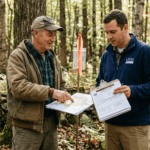
Forty-acre woodlot owners are some of the clients I work with most often in Sullivan, Ulster, and Orange Counties. The property is small enough that every management decision matters and large enough that those decisions produce real results. A forester walk on a 40-acre property costs a fraction of what a timber sale or invasive control project will eventually involve — and it prevents the costly mistakes that happen when decisions precede information.
Here’s what I can do for a 40-acre woodland owner:
- Walk the property and give you an honest assessment of species composition, timber quality, health conditions, and invasive pressure
- Identify and mark crop trees for release — the single highest-leverage management action on a woodlot this size
- Conduct a timber cruise and appraisal if a sale is appropriate — before any buyer conversation
- Write a forest management plan if your goals and budget support one — or provide a written assessment summary as a lower-cost starting point
- Advise on hunting lease structure and habitat improvement priorities that support lease value
- Advise on adjacent parcel acquisition if reaching the 480-a threshold is a realistic option given your situation
If you own 40 acres of woods and you’re not sure what to do with it, a property walk is where the answer starts. Call me.
Request a Free 40-Acre Woodland Assessment
Call me directly: (845) 754-8242
Email: henry@eforestproducts.com
Serving Sullivan County NY, Ulster County NY, Orange County NY, Pike County PA, Wayne County PA, and Sussex County NJ.
Henry Kowalec is a licensed consulting forester and member of the Society of American Foresters with over 30 years serving private landowners in the Hudson Valley and Catskills. Environmental Forest Products | Westbrookville, NY 12785 | Licensed in NY, PA, NJ.